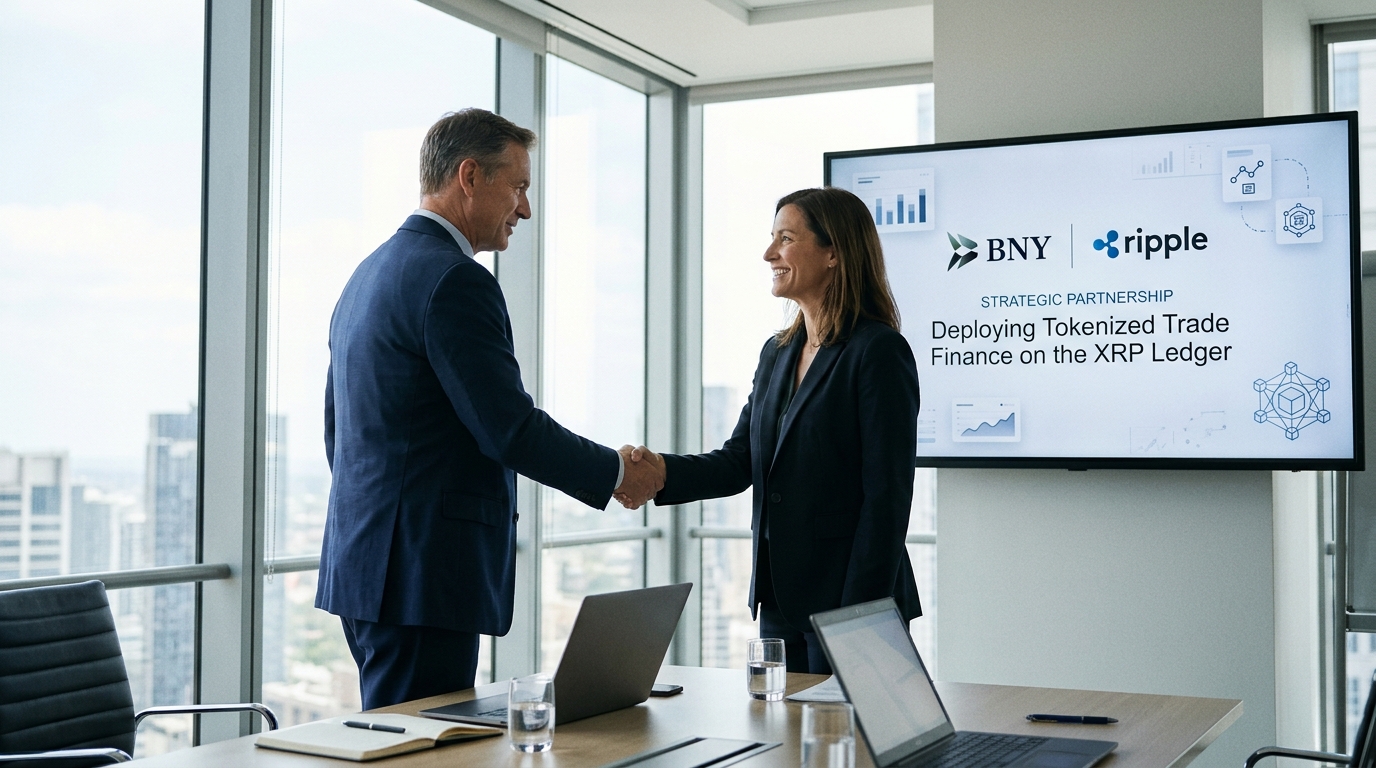
BNY and Ripple Expand Strategic Institutional Partnership to Deploy Tokenized Trade Finance on the XRP Ledger
The world’s oldest bank is no longer just holding digital assets—it is plugging Wall Street's immense capital engine directly into public blockchain rails to unlock the $10 trillion global trade finance bottleneck. KuCoin
For centuries, international trade finance has remained stubborn, paper-heavy, and painfully slow. Millions of global suppliers wait 30, 60, or even 90 days for corporate buyers to settle approved invoices, trapping trillions of dollars in working capital inside financial friction traps.
Now, America’s oldest bank—BNY (The Bank of New York Mellon Corporation), managing an astronomical $63.4 trillion in assets under custody and administration—has officially joined forces with Ripple to execute a historic paradigm shift.
Announced in October 2026, the two institutional giants have expanded their strategic alliance to bring tokenized trade finance directly to the public XRP Ledger (XRPL) alongside major working capital marketplace C2FO. Concurrently, BNY is adding support for native XRP and Ripple’s enterprise stablecoin (RLUSD) onto its institutional Digital Asset Custody platform.
This is not a closed-loop pilot or a theoretical whitepaper. By bridging traditional capital markets with public ledger settlement, BNY and Ripple are laying the foundation for a continuous, always-on global settlement layer. The central question for institutional investors, CFOs, and digital asset markets is clear: Is this the moment tokenized real-world assets (RWAs) break out of the sandbox and permanently rewire global supply chain finance?
To understand the magnitude of this expansion, one must look closely at the underlying architecture, corporate roles, and operational mechanics powering the BNY-Ripple trade finance framework.
1. The Tri-Party Architecture: BNY, Ripple, and C2FO
The collaboration fuses three distinct pillars of modern global finance into a unified on-chain workflow:
- BNY (Institutional Custody & Reserve Rail): Serving as the primary reserve custodian for Ripple's stablecoin (RLUSD) and custodian for Ripple Prime, BNY extends its institutional custody infrastructure to safely hold native XRP and RLUSD. Eligible institutional clients can safekeep and transfer digital assets backed by BNY’s strict regulatory controls.
- Ripple & The XRP Ledger (Public Settlement Layer): Built specifically for enterprise payment throughput and low-cost transaction finality, the XRP Ledger serves as the underlying public blockchain architecture. Native assets—including XRP and RLUSD—provide the liquid bridges required for cross-border settlement, automated liquidity management, and invoice collateralization. BNY+ 1
- C2FO (Working Capital Marketplace Engine): As the world's largest working capital marketplace, C2FO connects millions of businesses looking to accelerate liquidity against approved receivables. C2FO integrates its corporate supplier network to bridge real-world invoices onto the XRPL.
2. How Tokenized Invoice Financing Works
The tokenization of trade finance converts static receivables into dynamic, liquid on-chain instruments:
- Invoice Approval & On-Chain Minting: A corporate buyer approves an invoice from a supplier. Through C2FO and Ripple’s infrastructure, the approved receivable is digitally represented as a tokenized trade asset on the XRP Ledger. Binance+ 1
- Institutional Capital Deployment: Instead of waiting months for payment, suppliers can access immediate working capital from institutional liquidity providers connected via BNY’s custody ecosystem.
- Instant Stablecoin & Native Settlement: Capital is instantly disbursed using RLUSD or XRP, drastically compressing settlement times from weeks to seconds while lowering transaction fees. Upon invoice maturity, the corporate buyer settles the obligation, distributing yield to liquidity providers programmatically.
3. Institutional Regulatory Validation
The expanded collaboration coincides with major regulatory milestones for Ripple, including receiving final approval from the U.S. Office of the Comptroller of the Currency (OCC) for a National Trust Bank charter. This regulatory alignment gives Tier-1 financial institutions the legal certainty required to deploy capital into public tokenized environments.
Notice: The following section explores forward-looking market scenarios, speculative probabilities, and industry projections based on current institutional infrastructure developments. These outcomes represent theoretical possibilities and market sentiment, and should never be interpreted as guaranteed events, absolute facts, or financial advice.
The integration of America’s largest custodian into public ledger trade finance marks a decisive shift in real-world asset (RWA) tokenization. Industry strategists, quantitative analysts, and corporate treasurers are monitoring three primary trajectories.
Scenario A: The Institutional Trade Liquidity Supercycle (High-Probability Bull Case)
In this scenario, tokenized trade finance becomes the premier yield engine for institutional stablecoin reserves.
- Capital Siphoning: As corporate CFOs and institutional funds seek low-risk, asset-backed yields superior to traditional money market funds, billions in liquidity flow into XRPL invoice pools.
- Global Supply Chain Acceleration: Small and medium enterprises (SMEs) gain instant, friction-free access to working capital, reducing supply chain insolvencies. The persistent, high-volume utility of RLUSD and XRP for invoice clearing drives sustained, structural demand across public order books.
Scenario B: Regulatory Coexistence & Parallel Settlement (Base-Case Realism)
A secondary, highly pragmatic model foresees a dual-track trade finance system.
- Enterprise Market Segmentation: Cross-border corridors with high counterparty friction or legacy banking delays rapidly adopt XRPL tokenized receivables. Meanwhile, domestic trade within deeply integrated banking unions continues using traditional clearinghouses.
- Stable RWA Integration: Tokenized invoices join U.S. Treasuries as standard collateral on BNY’s digital asset platforms, establishing a stable, multi-billion-dollar RWA market on the XRP Ledger without fully displacing legacy trade rails overnight.
Scenario C: Integration Friction & Legal Jurisdictional Hurdles (Risk-Adjusted Case)
A comprehensive forward-looking evaluation must also consider potential operational friction points.
- Cross-Border Legal Discrepancies: While tokenizing an invoice on-chain takes seconds, enforcing international commercial law and debt collection across disparate legal jurisdictions remains complex.
- Adoption Delays: If international courts hesitate to recognize on-chain tokenized receivables as legally binding claims during corporate bankruptcies, institutional adoption could slow, confining tokenized trade finance primarily to pre-approved corporate networks.
The expansion of BNY and Ripple's strategic collaboration across digital custody and tokenized trade finance represents the formal end of the "crypto vs. Wall Street" narrative. By connecting $63.4 trillion in custodial scale with public, always-on blockchain infrastructure, two of finance’s biggest players are building the operational nervous system for 21st-century global trade.
Moving forward, institutional allocators, corporate treasurers, and market observers should track four critical variables:
- XRPL On-Chain Receivable Volumes: The total dollar value of tokenized invoices minted and settled on the XRP Ledger via C2FO and Ripple infrastructure.
- RLUSD Circulating Supply Growth: Net minting and redemption volumes for Ripple USD as BNY scales its reserve custody and settlement integrations.
- Institutional XRP Custody Inflows: The percentage of institutional digital asset holdings migrating to BNY’s Digital Asset Custody platform.
- Cross-Border Legal Frameworks: Regulatory updates clarifying the legal enforceability of tokenized real-world trade assets across international trade corridors.
The shift from holding digital assets to actively deploying them across capital markets has officially begun. Wall Street's oldest institution is turning the page—and the ledger is open.
Regulatory & Legal Disclaimers
This article is published strictly for informational, educational, and editorial purposes and does not constitute financial, legal, tax, or investment advice. Discussions regarding BNY, Ripple, C2FO, the XRP Ledger, RLUSD, and tokenized financial assets are based on official press releases, corporate announcements, and verified public records. Forward-looking market projections, theoretical scenarios, and speculative outlooks represent analytical perspectives rather than guaranteed performance or factual certainty.