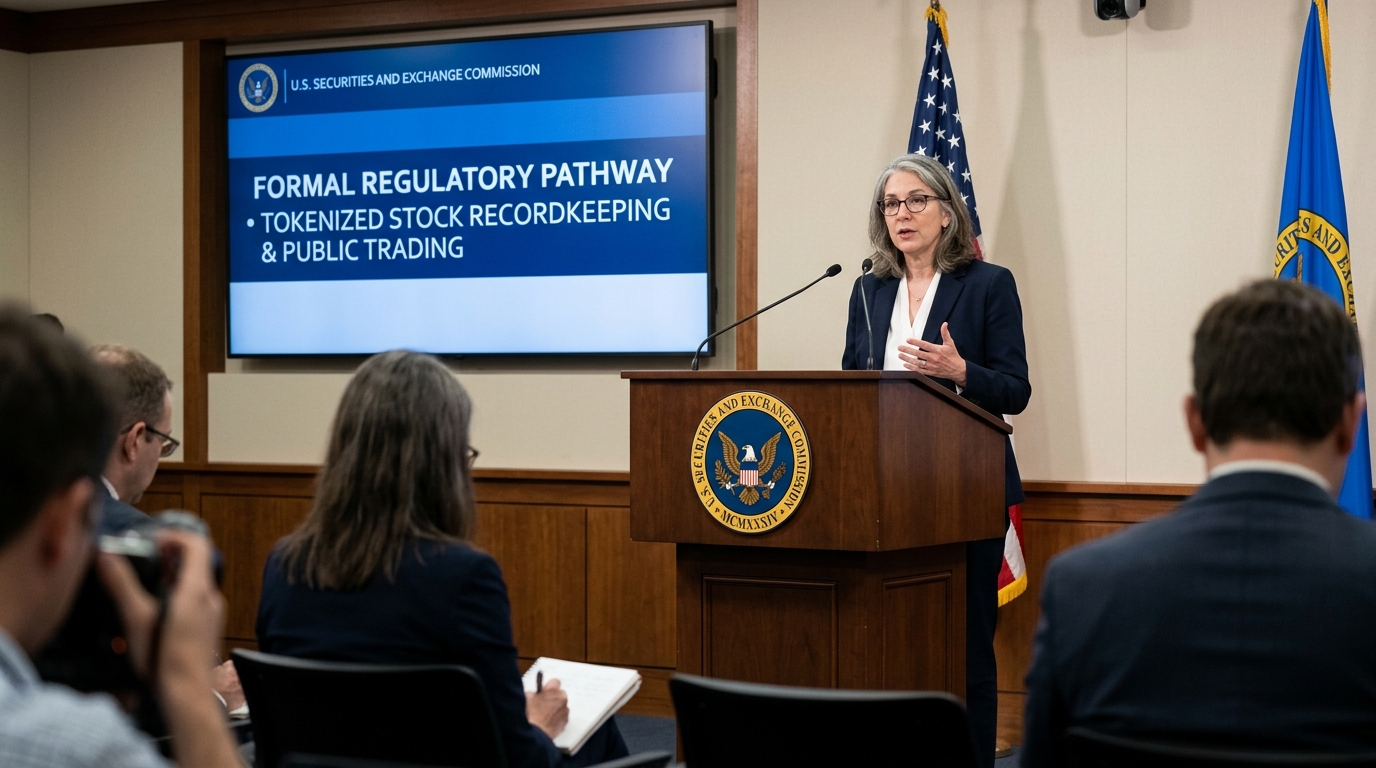
U.S. SEC Opens Formal Regulatory Pathway for Tokenized Stock Recordkeeping and Public Trading
The wall separating traditional Wall Street market infrastructure from public blockchain ledgers has officially cracked open.
On September 17, 2026, the U.S. Securities and Exchange Commission (SEC), under Chairman Paul S. Atkins, issued a landmark five-year conditional "Innovation Exemption". The order formally establishes a regulatory pathway for National Market System (NMS) stocks—the very lifeblood of the U.S. equity market—to undergo secondary recordkeeping and trading directly on public, permissionless distributed ledgers.
For decades, stock ownership has remained trapped behind centralized depository institutions, strict clearing-house settlement cycles, and traditional 9:30 AM to 4:00 PM operating hours. By granting specialized Tokenized Securities Venues (TSVs) a temporary exemption from full national exchange registration, federal regulators have cleared a path for 24/7 liquidity pools and automated market makers (AMMs) to handle real, physically backed shares of publicly traded companies.
Coming directly after Capitol Hill's legislative gridlock over digital asset market structure, the SEC’s unilateral administrative action marks a massive shift. The tokenization of real-world assets (RWAs) is no longer a speculative pilot program—it is officially becoming an operational pillar of the American financial system.
To understand the scope of this regulatory breakthrough, market participants must look past general crypto sentiment and evaluate the precise, conditional guardrails established in SEC Release No. 34-106402.
The Tokenized Securities Venue (TSV) Sandbox
The SEC’s five-year administrative order creates a new category of trading infrastructure known as Tokenized Securities Venues (TSVs). Rather than forcing blockchain-native venues into the traditional alternative trading system (ATS) or national securities exchange frameworks, the exemption provides conditional relief, provided platforms satisfy strict operational requirements:
- U.S. Jurisdiction & Sanctions Enforcement: Every TSV must operate as a U.S. person, enforce strict Know-Your-Customer (KYC) access controls, and comply fully with Office of Foreign Assets Control (OFAC) economic sanctions.
- Public Distributed Ledgers: Smart-contract applications utilized by a TSV must be public, permissionless, fully auditable, and capable of rendering transaction data in machine-readable U.S. dollar terms within 10 minutes of execution.
- Permitted Trading Pairs: Tokenized shares on a TSV can be paired directly against other tokenized NMS stocks, non-security crypto assets (including payment stablecoins), or tokenized money market funds.
Strict Rights Equivalence and the Anti-Synthetic Ban
The SEC’s framework explicitly limits tokenization to direct, 1:1 backed representations of listed equity classes. Synthetic exposures, equity derivatives, rights, and security-based swaps are barred from utilizing the Innovation Exemption.
TSVs must verify that holding a tokenized share confers identical economic and governance rights as holding a traditional share. On-chain holders are guaranteed equal rights to dividend distributions, corporate voting procedures, proxy materials, and residual liquidation assets—distributed at zero cost to the shareholder.
The Issuer 30-Day Notice and Objection Gateway
One of the most debated aspects of the order is its "opt-out" mechanism regarding third-party tokenization. O'Melveny
If a third-party TSV intends to tokenize a company’s listed stock without an explicit corporate partnership, it must deliver a formal written notice to the issuer. The issuer then has a strict 30-calendar-day window to file a formal written objection. If the public company objects within 30 days, the TSV is legally barred from listing the tokenized asset. If the company fails to respond or elects not to object, trading may proceed subject to SEC volume thresholds.
Secondary Markets Only
The SEC order does not exempt primary share issuances or initial public offerings (IPOs). Companies cannot seed TSV liquidity pools with newly created or treasury shares without standard Securities Act registration. The venue is strictly designed for secondary market trading and real-time ledger settlement.
As public corporations, digital asset exchanges, and traditional market makers digest the SEC’s order, financial analysts are projecting three potential future developments for capital markets.
Scenario A: Corporate Treasury Adoption & Issuer-Sponsored Tokenization (Trend-Driven Probability)
Industry analysts are watching to see if major tech-forward public companies choose to bypass third-party venues by launching their own issuer-sponsored tokenization programs.
One potential scenario is that corporations, seeking to avoid liquidity fragmentation across uncoordinated third-party TSVs, will partner directly with transfer agents and regulated exchanges (such as Nasdaq or the NYSE) to mint primary on-chain shares. Market sentiment suggests that companies adopting native on-chain recordkeeping could streamline dividend payouts via smart contracts, reduce proxy voting friction, and attract a global pool of 24/7 digital capital. Davis Polk
Scenario B: Corporate Pushback & Systematic Objection Waves (Worst-Case Outlook)
While unproven, some corporate governance specialists speculate that risk-averse legal departments will routinely invoke their 30-day objection rights to block third-party tokenization altogether.
Industry observers hypothesize that concerns over price divergence between tokenized and traditional shares, insider trading monitoring during non-market hours, and compliance with corporate blackout periods could cause S&P 500 boards to adopt blanket opt-out policies. If a critical mass of public issuers rejects third-party venues, analysts predict that the TSV sandbox could experience limited trading volumes, forcing the SEC to reconsider its opt-out architecture when the five-year pilot expires.
Scenario C: The 24/7 Global Financial Infrastructure (Best-Case Probability)
A scenario widely discussed among fintech strategists is that the SEC's temporary exemption acts as the bridge toward permanent federal rulemaking.
Market commentators theorize that as permissioned AMM liquidity pools demonstrate operational stability and zero-settlement-risk clearing over the next five years, traditional market centers will sunset legacy T+1 settlement cycles. Under this best-case transformation, tokenized U.S. equities, yield-bearing stablecoins, and tokenized money market funds will trade frictionlessly on unified, public blockchain rails, operating 24 hours a day, 365 days a year.
The SEC’s Innovation Exemption represents a fundamental pivot in American securities regulation. By creating an explicit, conditional administrative pathway for on-chain stock trading, standard-setters have formally integrated public blockchain infrastructure into mainstream capital markets.
For executive leadership, investor relations teams, and digital asset market participants navigating this historic transition, four key variables require immediate tracking:
- Notice Intake Hardening: Public issuers must audit their official SEC filing cover pages and internal legal mailboxes to ensure 30-day TSV tokenization notices are identified and reviewed immediately.
- Board-Level Tokenization Policies: Companies should formulate clear internal guidelines regarding whether to approve third-party venue requests, object via template notices, or pursue issuer-sponsored programs.
- TSV Public Registrations: Watch the SEC's public disclosures for initial TSV filings to track which venues, liquidity providers, and public stocks enter the sandbox first.
- 24/7 Compliance Updates: Corporate compliance teams must update insider trading frameworks, 10b5-1 plans, and executive trading blackout windows to account for round-the-clock secondary market activity.
The era of digital-native equities has officially arrived. The technology is live, the regulatory sandbox is open, and the future of global stock trading is being rewritten block by block.
Editorial Disclaimer: This article is strictly for educational, informational, and analytical purposes. It does not constitute legal, tax, financial, or investment advice. The regulatory frameworks, SEC orders, and speculative scenarios cited reflect research of official government releases and public legal analysis. Readers should consult qualified corporate legal counsel and financial compliance experts before making operational, strategic, or investment decisions.