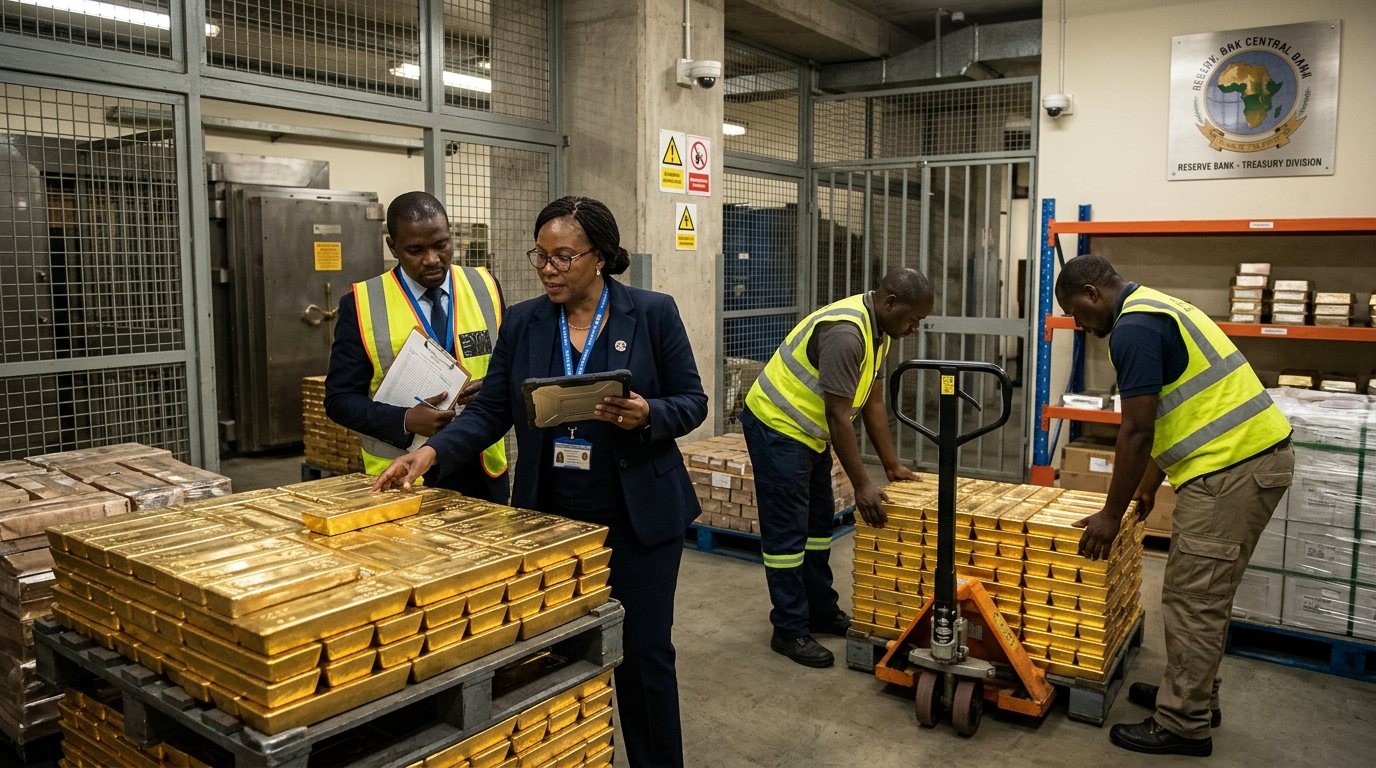
Gold Rally Doubles Sovereign African Reserves as Central Banks Shift Capital Toward Non-Dollar Hard Assets
The Fortress Built on Bullion
The monetary balance of power across the Global South is undergoing a quiet, high-stakes mutation. Deep within the vaults of African central banks from Cairo to Pretoria, a structural revolution is unfolding that threatens to permanently rewrite the rules of international reserve management.
While Western institutional investors debate interest rate trajectories and bond yields on trading desks in New York and London, African monetary authorities are executing a decisive pivot toward financial sovereignty. Driven by a historic, multi-year bullion rally and a deliberate strategic push away from sovereign dollar dominance, the valuation of gold reserves held by African nations has surged by over 113 percent over the past three years. The combined dollar valuation of sovereign gold hoards across key regional economies has rocketed to roughly $66.6 billion, effectively doubling the financial buffer backing some of the world's most vulnerable fiat currencies. Businessday NG
This is not a temporary tactical hedge or a routine portfolio adjustment. It represents a coordinated, systemic hedge against weaponized global fiat architecture, persistent domestic inflation, and the lingering threat of structural currency devaluations. Across the continent, central bank governors are converting local mineral wealth directly into tier-one, non-dollar hard assets, insulating their domestic balance sheets from the external shocks of Western monetary policy.
As the world's major financial capitals confront escalating geopolitical fractures and unpredictable debt cycles, Africa’s central banks are building an unyielding monetary fortress out of solid gold.
Inside the Multi-Billion-Dollar Sovereign Pivot
To understand the magnitude of this monetary shift, one must examine the hard balance-sheet data coming out of African central bank filings. The structural surge in reserve values is anchored by a double engine: a historic upward re-rating of global spot gold prices and an aggressive, domestic-currency bullion purchasing strategy pioneering across key African mining hubs.
The sheer balance-sheet expansion across major African sovereign holders is extraordinary. In Nigeria, official monetary reporting reveals that the dollar-denominated value of state gold holdings expanded from $1.31 billion to $2.79 billion over a three-year span. Across the southern tip of the continent, South Africa’s reserve bank saw its gold asset valuation more than double, leaping from $7.71 billion to an eye-watering $16.3 billion. North African powerhouses witnessed parallel surges, with Egypt’s gold reserve valuations jumping 117 percent and Algeria’s expanding by 110 percent. Similar double-digit valuation leaps were recorded across Morocco and Mauritius, reflecting a continent-wide asset re-rating.
However, the true story extends far beyond market mark-to-market appreciation. What makes this cycle historically unique is the institutionalization of domestic gold-buying programs. Rather than relying exclusively on foreign exchange markets to purchase bullion from international bullion banks, nations like Ghana and Tanzania pioneered aggressive domestic purchase directives.
Under these domestic programs, central banks bypass intermediate international trade corridors entirely by purchasing artisanal and small-scale gold directly from local miners using domestic fiat currencies. Ghana’s historic "Gold-for-Oil" and domestic purchasing frameworks created a direct operational model: local gold is absorbed into state reserves using local currency, preserving scarce foreign exchange while simultaneously establishing a physical asset floor beneath the domestic currency. Tanzania rapidly adopted a similar playbook, allocating domestic funds to build state bullion reserves directly from local output.
Yet this strategic accumulation is not entirely uniform across the continent, exposing contrasting sovereign tactics. While nations like Egypt, Rwanda, and Namibia have consistently expanded their physical hoards, others have faced acute short-term foreign exchange pressures. Kenya’s reported central bank gold reserves, for example, experienced a dramatic drawdown from $1.8 billion to near-zero levels as policymakers mobilized assets to settle pressing external debt obligations and stabilize liquidity. Businessday NG
Furthermore, central bankers acknowledge a fundamental macroeconomic reality: holding gold alone cannot magically cure structural inflation or repair deep fiscal deficits. Gold is an unencumbered, highly liquid reserve asset, but it does not generate organic yield, nor can it completely replace the foreign exchange liquidity required to service daily import bills. The challenge facing African governments is transforming this raw reserve growth into broader industrial processing, domestic refining capacity, and long-term economic diversification.
What Comes Next? (Scenarios & Probabilities)
As global central banks collectively absorb record quantities of bullion, the future trajectory of African reserve strategies sits at the intersection of international trade policy, de-dollarization trends, and local resource nationalism. Market strategists and macro researchers are evaluating three distinct probabilistic scenarios for how this sovereign gold migration could evolve over the next decade.
Scenario A: The De-Dollarized Trade Settlement Matrix (High Probability)
Industry analysts and emerging-market strategists are watching closely to see if African nations expand their domestic gold purchasing programs into direct international trade settlement mechanisms.
In this scenario, bilateral trade between African economies and global trade partners—particularly within the expanded BRICS+ framework—increasingly bypasses the traditional SWIFT settlement network and the U.S. dollar entirely. African central banks could utilize localized, tokenized, or physically vaulted gold reserves as collateral for bilateral credit lines, energy imports, and infrastructure debt service.
If this materializes, the demand for physical gold as an unencumbered neutral settlement asset will accelerate. African nations with robust domestic gold production would gain immense geopolitical leverage, effectively converting underground mineral wealth directly into global trade liquidity without drawing down foreign exchange reserves.
Scenario B: The Local Refining and Sovereign Vault Boom (Base-Case Trend)
A second scenario models the structural transformation of local supply chains. Historically, African nations exported unrefined dore gold to refining hubs in Dubai, Switzerland, or London, only to buy back London Bullion Market Association (LBMA) accredited bars at a steep premium.
Market sentiment indicates that central banks will increasingly mandate that a fixed percentage of all domestically mined gold be refined locally at accredited domestic or regional refineries before being absorbed into official state vaults. We are already seeing early infrastructure investments in regional refining capacity across West and East Africa.
Under this framework, African central banks create an integrated domestic ecosystem: local mining generates local employment, domestic refining captures value-add processing margins, and the final accredited bullion is vaulted domestically, eliminating counterparty risk from Western custodial accounts.
Scenario C: The Liquidity Crisis Disgorgement (Downside Risk Scenario)
While unproven, some risk analysts warn of a potential worst-case scenario where persistent global high interest rates, debt servicing burdens, and sovereign debt defaults force vulnerable African nations to sell off their newly acquired gold reserves.
If external debt obligations mature without refinancing options, central banks may be forced to disgorge their physical gold onto the open market to raise immediate dollar liquidity, mirroring the reserve liquidations seen in specific distressed economies. A sudden, forced sell-off of central bank reserves would dilute the sovereign balance-sheet gains achieved over the past three years, exposing local currencies to renewed speculative attacks and severe devaluation cycles.
The Key Variables Shaping Sovereign Power
The doubling of African central bank gold reserves marks a decisive break from the post-Cold War monetary status quo. The rush toward non-dollar hard assets is a clear indicator that sovereign nations are actively seeking protection against global monetary polarization, sanctions risk, and structural dollar volatility.
To monitor whether this sovereign reserve transformation will deliver lasting economic stability or founder under fiscal friction, financial observers and global investors must track four critical variables:
- The Ratio of Domestic Currency Gold Purchases: Track how many African central banks establish formal, domestic-currency gold buying programs. The more bullion bought in local currency, the less vulnerable the state becomes to external foreign exchange shortages.
- Regional Refining Accreditations: Watch the progress of domestic and regional gold refineries seeking international certification. Local accredited refining is the missing bridge between raw dore extraction and tier-one central bank reserve assets.
- BRICS+ Trade Collateral Frameworks: Monitor official policy announcements regarding gold-backed or gold-collateralized trade instruments within emerging market trade corridors. Any formal integration of physical gold into bilateral trade clearing will drastically reduce dollar reliance.
- Sovereign Debt Maturity Calendars: Keep a vigilant eye on upcoming foreign-debt refinancing dates across key African nations. Severe debt-servicing bottlenecks remain the single greatest threat that could force central banks to liquidate their hard-earned bullion hoards.
The global monetary regime is fracturing, and physical gold has once again reclaimed its throne at the center of international finance. For African central banks, building a vault of hard assets is no longer just a conservative risk strategy—it is the foundational requirement for 21st-century economic survival.