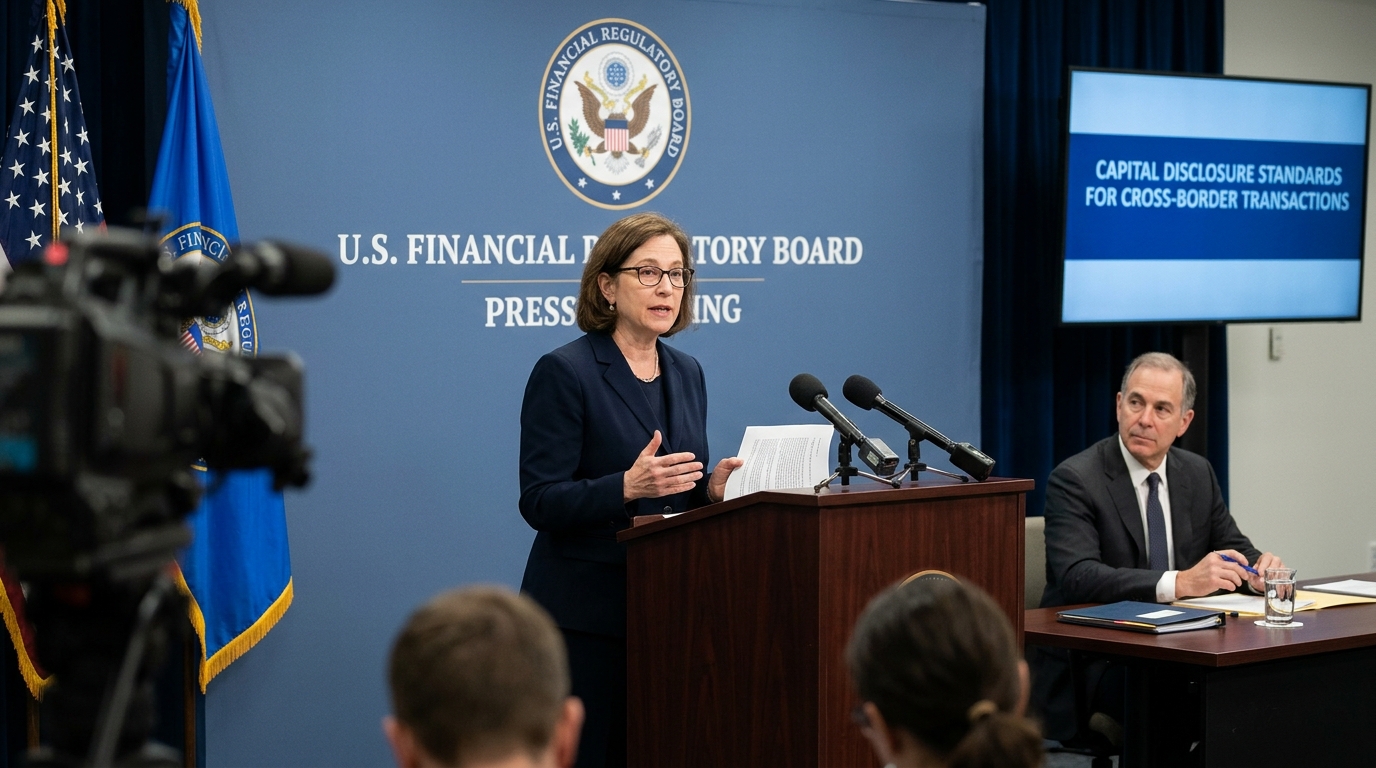
U.S. Federal Regulators Advance Strict Capital Disclosure Standards for Cross-Border Financial Transactions
The golden age of frictionless, low-disclosure international money movement has collided directly with an unyielding regulatory brick wall.
For decades, global corporations, private wealth desks, and cross-border financial intermediaries have moved capital through an intricate web of offshore accounts, corresponding banking channels, and multi-jurisdictional liquidity hubs. But as major U.S. federal financial regulators—led by the Federal Reserve, the Office of the Comptroller of the Currency (OCC), the Financial Crimes Enforcement Network (FinCEN), and the Securities and Exchange Commission (SEC)—advance strict, standardized capital disclosure mandates for cross-border financial transactions, the rulebook for international banking is being aggressively rewritten.
This regulatory wave represents much more than routine paperwork. By requiring real-time, line-item disclosures on ultimate beneficial ownership (UBO), origin-to-destination capital routing, and underlying asset backing for high-value cross-border transfers, federal agencies are systematically closing the structural loopholes that previously permitted anonymous, off-balance-sheet capital flows.
As compliance teams scramble to overhaul legacy clearing operations and international correspondent banks evaluate their U.S. dollar exposure, one reality is undeniably clear: the global financial perimeter is locking down, and every cross-border dollar transfer is about to face an unprecedented level of regulatory scrutiny.
To understand the operational shockwaves reverberating across international treasury departments, financial institutions must look past high-level policy announcements and analyze the concrete compliance mandates taking effect.
Mandatory Granular Disclosures & ISO 2022 Integration
At the center of this regulatory push is a mandate for structural transparency in high-value electronic funds transfers. Regulators are requiring financial institutions handling cross-border payments to embed rich, standardized metadata within every messaging protocol.
Moving beyond basic account numbers and bank codes, foreign and domestic clearing houses must now transmit complete, unredacted data fields. This includes verified legal entity identifiers (LEIs), detailed transaction descriptions, structural corporate hierarchies, and real-time origin-to-destination tracking data. Financial institutions relying on legacy messaging systems or incomplete routing fields face immediate transaction rejections, mandatory clearing holds, and severe administrative fines.
Ultimate Beneficial Ownership (UBO) Transparency
The days of hiding cross-border corporate movements behind layers of offshore holding companies, shell trusts, or nominee directors are effectively numbered.
Under the expanded regulatory framework, cross-border capital allocations exceeding specified threshold limits must trigger mandatory UBO disclosures. Financial intermediaries are legally required to verify and report the natural persons who ultimately own or control 20% or more of the equity interest in the transacting entities. Attempting to split transactions into smaller increments to bypass disclosure thresholds—a practice known as structuring—will trigger automated, algorithmic red flags across federal anti-money laundering (AML) networks.
Real-Time Balance Sheet & Liquidity Matching
In addition to identification metrics, regulators are targeting the underlying capital soundness of non-bank financial intermediaries, international payment gateways, and foreign banking branches operating within U.S. corridors. Convera
Institutions processing large-scale international settlements must demonstrate that cross-border capital transfers are matched by verified, liquid reserve assets in real time. This requirement is designed to eliminate liquidity mismatches, unhedged foreign exchange risks, and hidden counterparty leverage that could pose systemic contagion threats to the broader U.S. financial system during periods of global market volatility.
As cross-border capital disclosure standards solidify across global corridors, risk intelligence units, institutional treasurers, and technology strategists are evaluating three forward-looking market outcomes.
Scenario A: Accelerated Automated Compliance & Smart Payment Rails (Trend-Driven Probability)
Industry analysts are watching to see if the strict disclosure requirements spark a wave of technological modernization across traditional correspondent banking.
One potential scenario is that financial institutions will deploy AI-driven compliance engines capable of automatically validating, enriching, and auditing cross-border payment metadata in sub-second intervals. Market sentiment suggests that institutions that successfully integrate smart compliance protocols directly into their payment rails will achieve faster clearing speeds, lower error rates, and a distinct competitive advantage in managing international trade corridors.
Scenario B: Correspondent Bank De-Risking & Regional Capital Friction (Worst-Case Outlook)
While unproven, some risk managers speculate that the high operational cost of mandatory compliance could cause major U.S. clearing banks to scale back their international correspondent networks.
Industry observers hypothesize that if tier-one banks decide that handling transactions from emerging markets or high-risk jurisdictions presents unacceptable regulatory exposure, they may systematically sever correspondent banking ties. In this scenario, analysts predict that regional trade corridors could face severe capital friction, driving up transaction costs for legitimate cross-border businesses and restricting international capital access for smaller developing economies.
Scenario C: Unification of Public Blockchains & Regulated Settlement Networks (Best-Case Probability)
A scenario widely discussed among financial technology strategists is that strict capital disclosure rules will accelerate the migration of cross-border settlements onto public, permissioned blockchain networks.
Market commentators theorize that by pairing programmable digital asset rails with zero-knowledge identity proofs, institutions can deliver continuous, real-time capital auditing to federal regulators while preserving proprietary corporate privacy. Under this best-case operational model, automated smart contracts would verify reserve adequacy, enforce sanctions screening, and complete global settlements 24/7 with zero human intervention.
The advancement of strict cross-border capital disclosure standards by federal regulators marks a permanent transition in global finance. Opaque corporate structures and fragmented international payment wires are giving way to an era of real-time visibility, automated data auditing, and enforced institutional transparency.
For corporate leaders, compliance officers, and international investors navigating this shifting landscape, four operational priorities require immediate focus:
- Payment Infrastructure Audits: Review current international wire systems to ensure full compatibility with rich data messaging standards and mandatory disclosure fields.
- UBO Registry Verification: Audit global corporate hierarchies to verify that ultimate beneficial ownership data is documented, accurate, and ready for regulatory reporting.
- Counterparty Risk Management: Assess the compliance readiness of overseas correspondent banking partners to prevent sudden disruptions in international clearing channels.
- Automated Monitoring Adoption: Deploy intelligent AML and transaction-screening tools capable of detecting data anomalies before cross-border wires hit federal clearing networks.
The global regulatory perimeter has expanded. Moving capital across borders is no longer just a financial execution—it is an auditable regulatory event.
Editorial Disclaimer: This article is strictly for educational, informational, and analytical purposes. It does not constitute legal, tax, financial, or investment advice. Regulatory policies, enforcement guidelines, and speculative scenarios reflect editorial research of public government announcements and international financial compliance frameworks. Readers should consult qualified legal counsel and compliance specialists before making corporate or operational decisions.