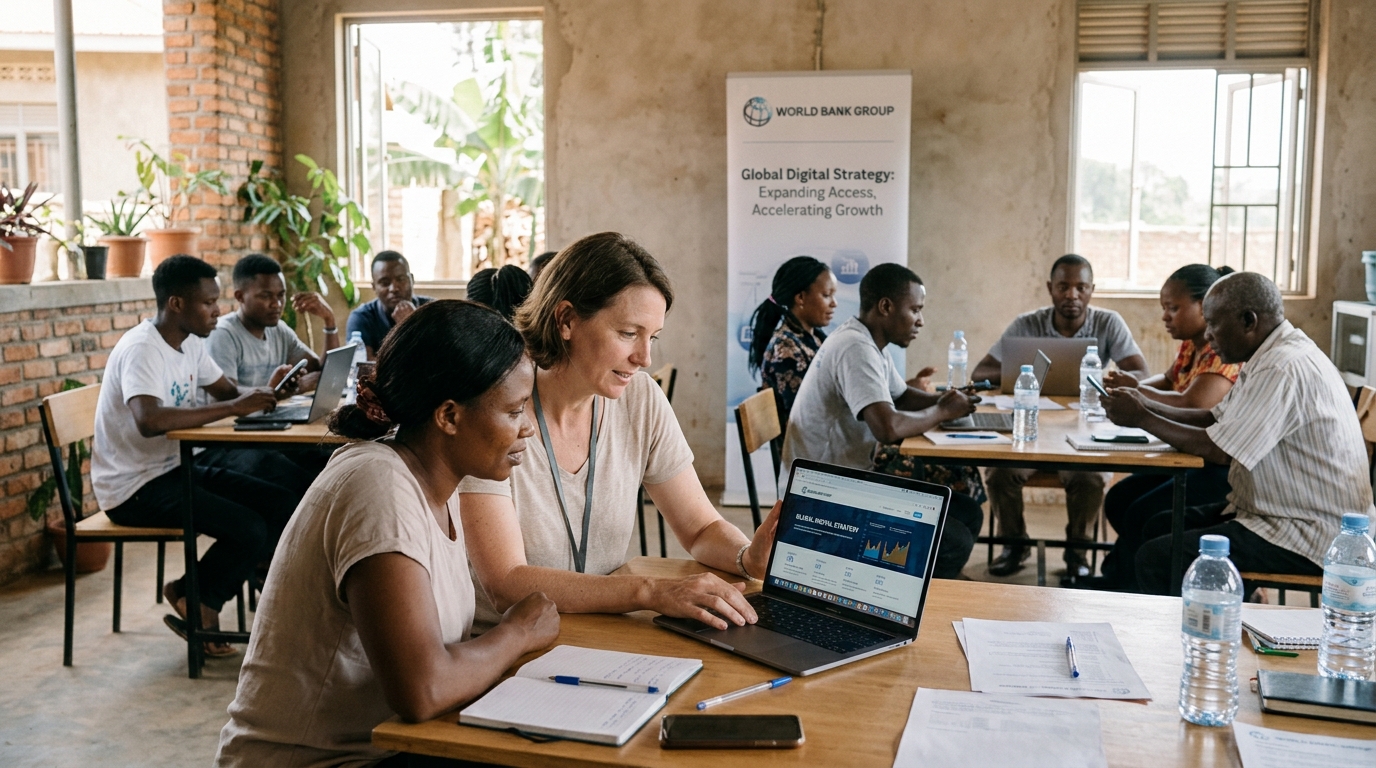
World Bank Group Launches First Global Digital Strategy to Expand Access and Accelerate Economic Growth
Over the next 10 to 15 years, a demographic tidal wave will sweep across the developing world: 1.2 billion young people will reach working age. Under current economic trajectories, global markets are projected to generate only about 420 million jobs for them—leaving a staggering, dangerous deficit of nearly 780 million young adults without formal employment.
This is not just an economic bottleneck; it is a ticking geopolitical clock.
On October 20, 2026, speaking from Seoul, World Bank Group President Ajay Banga unveiled the multilateral institution’s first-ever comprehensive Global Digital Strategy. Armed with a blueprint to connect one billion people by 2030, deploy shared AI compute infrastructure directly to the Global South, and slash the cost of entry-level smartphones, the World Bank is executing its most aggressive operational pivot in decades.
By unifying its public sector financing with private-sector guarantee arms like the International Finance Corporation (IFC) and the Multilateral Investment Guarantee Agency (MIGA), the World Bank is betting that borderless digital rails, localized "small AI," and mobile micro-economies can absorb hundreds of millions of job seekers before structural unemployment triggers widespread instability.
Can an international development icon built for 20th-century concrete dams and highways successfully re-engineer itself into the primary architect of 21st-century digital rails? Let’s investigate the data, the architecture, and the high-stakes future of the global digital economy.
To understand the urgency driving this strategy, one must examine the stark structural divide that characterizes global telecommunications and compute capacity in late 2026.
The Anatomy of the Global Digital Divide
Despite decades of mobile network expansion, the digital divide remains an economic barrier. World Bank metrics reveal that over two billion people worldwide remain completely offline. In low-income economies, internet penetration hovers at a mere 23 percent, compared to an overwhelming 94 percent across high-income nations.
Even where 4G or basic 5G signal coverage exists, a secondary "usage gap" persists. Hundreds of millions of citizens live under active cellular coverage but cannot participate in the digital economy because entry-level smartphones remain financially out of reach, high-speed data costs swallow disproportionate shares of daily wages, or users lack foundational digital literacy and secure digital identification.
The Four Operational Pillars
The World Bank Group's Digital and AI Implementation Plan (FY26–30) consolidates its public lending, policy reform, and private capital guarantee tools across four distinct lines of action:
- Expanding Infrastructure and Connectivity: The Bank is deploying public capital, shared infrastructure models, and political risk guarantees to crowd private investment into high-risk, underserved fiber-optic, subsea cable, and last-mile cellular markets. Where electrical power grids and internet access are simultaneously absent, the Bank is mandating integrated "power-and-data" infrastructure planning.
- Device and Data Affordability Schemes: To eliminate the physical equipment barrier, the World Bank is constructing structured co-financing partnerships alongside device manufacturers, telecommunications operators, local micro-finance entities, and device refurbishment firms. These frameworks aim to establish responsible installment-based financing and lower the base purchase price of entry-level smart devices. World Bank Group
- Digital Public Infrastructure (DPI) and Skills: The plan accelerates the rollout of secure Digital Public Infrastructure—specifically interoperable digital ID systems, fast payments rails, and secure data-sharing frameworks—paired with localized digital literacy programs to allow small-and-medium enterprises (SMEs) to trade online securely.
- "Small AI" and Shared Compute Infrastructure: Rather than pushing developing nations to build capital-intensive, multi-billion-dollar national data centers, the Bank launched its companion AI Infrastructure and Readiness Initiative. Partnering with technology leaders such as NVIDIA and Cassava Technologies, the initiative provides shared, pay-as-you-go Graphics Processing Unit (GPU) cluster access, focusing initially on Africa and Latin America. The goal is to power task-specific, localized "small AI" tools—such as automated agricultural crop-disease identification, localized medical triage support, and small-business inventory optimization. Thailand Business News+ 2
Speculative Scenarios and Probabilities
As the World Bank Group begins deploying its public and private sector capabilities toward its 2030 targets, technology analysts, macroeconomists, and sovereign policy planners are modeling three distinct operational scenarios.
Note: The following scenarios reflect analytical modeling, market sentiment, and structural economic projections rather than guaranteed outcomes.
Scenario A: The Leapfrog Renaissance (Estimated Probability: ~45%)
- The Hypothesis: De-risking mechanisms successfully unlock massive private capital inflows. Shared GPU clusters allow tech hubs in Sub-Saharan Africa, South Asia, and Latin America to deploy lightweight, highly specialized AI applications tailored to local languages and informal supply chains. Digital ID and payment systems enable hundreds of millions of informal workers to enter the formal banking and trade system, closing a significant portion of the projected 780-million job deficit by 2030.
- Market Sentiment Impact: Global investors re-rate emerging-market digital infrastructure. Venture capital and private equity flow into localized fintech, agtech, and digital logistics firms, turning developing markets into high-margin growth frontiers.
Scenario B: The Asymmetric Tiering Model (Estimated Probability: ~40%)
- The Hypothesis: Implementation scales effectively across middle-income economies with existing policy frameworks (such as Egypt, Kenya, and Vietnam), but encounters operational friction in low-income, landlocked, or politically unstable states. Smartphone financing initiatives succeed, but local data-localization laws, bandwidth costs, and power grid deficits limit "small AI" adoption to tier-one urban centers. Ahram Online+ 1
- Market Sentiment Impact: A "two-speed" digital economy emerges within the Global South. Digital hubs capture the majority of global trade integration, while rural and low-income zones remain reliant on traditional primary sector activities.
Scenario C: The Debt and Compute Bottleneck (Estimated Probability: ~15%)
- The Hypothesis: Macroeconomic headwinds, high sovereign debt levels, and currency devaluations make smartphone consumer credit models difficult to sustain in local currency terms. Meanwhile, global demand for advanced hardware creates severe GPU supply shortages, elevating pay-as-you-go compute costs beyond the reach of early-stage startups in developing nations.
- Market Sentiment Impact: Public sector balance sheets absorb higher-than-expected guarantee losses, forcing the World Bank and sovereign partners to restructure funding allocations back toward baseline physical power and transport infrastructure.
The launch of the World Bank Group's first Global Digital Strategy represents a structural acknowledgment that digital connectivity, secure identity systems, and compute access are no longer luxury infrastructure—they are fundamental economic preconditions for human development. Facing a historic demographic transition, the international community's ability to bridge the digital divide will determine whether the next decade is defined by widespread economic mobility or chronic economic fragmentation.
For policy watchers, institutional investors, and technology leaders, four critical metrics will signal whether this strategy delivers on its promise:
- Private Capital Crowding-In Ratios: Track the ratio of private capital mobilized by MIGA and IFC guarantees for every dollar of public World Bank financing deployed into frontier telecommunications markets.
- Device Financing Default and Adoption Rates: Monitor the scale and performance of smartphone co-financing partnerships in low-income pilot markets across Sub-Saharan Africa and South Asia.
- Shared GPU Compute Utilization: Observe actual developer and government uptake of the new shared GPU clusters deployed under the AI Infrastructure and Readiness Initiative in Africa and Latin America.
- Digital Public Infrastructure (DPI) Interoperability: Track the official registration numbers and transaction volumes flowing through newly deployed national digital ID and fast-payment networks.
The physical blueprints for 20th-century economic development have officially been rewritten. The battle to provide 1.2 billion young people with a viable economic future will be fought not on assembly lines alone, but across high-speed fiber lines, shared compute clusters, and digital market networks.