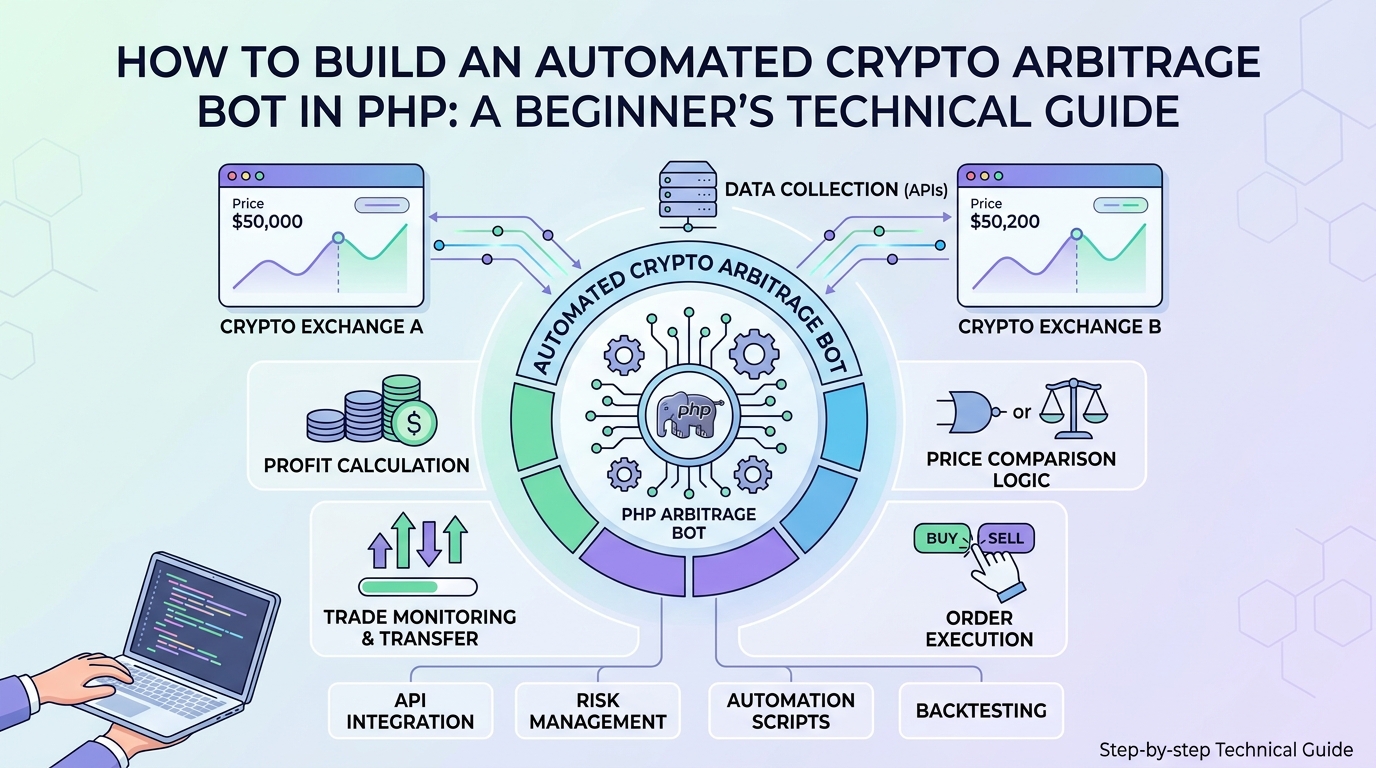
How to Build an Automated Crypto Arbitrage Bot in PHP: A Beginner’s Technical Guide
Automating cryptocurrency arbitrage in PHP requires moving beyond traditional synchronous HTTP scripts into event-driven execution using unified exchange APIs and non-blocking I/O.
Step 1: Core System Architecture & Dependencies
To execute cross-exchange arbitrage—buying an asset on Exchange A at a lower price and selling it on Exchange B at a higher price—your engine needs four core components:
- Exchange Abstraction Layer: CCXT (CryptoCurrency eXchange Trading Library) unifies API calls across 100+ crypto exchanges into a single PHP interface.
- Asynchronous Event Loop: ReactPHP or PHP 8.1+ Fibers allow continuous background polling of order books without blocking application execution.
- Order Book Engine: Fetches real-time bid and ask prices rather than simple ticker averages.
- Execution Manager: Validates spreads and submits atomic trade requests when profit thresholds are met.
Initialize your project directory and install the necessary dependencies via Composer:
Bash
Step 2: Calculate the Arbitrage Mathematical Threshold
A raw price difference between exchanges does not guarantee profitability. Your bot must account for maker/taker trade fees and withdrawal costs across both platforms.
$$Net\ Profit = (Price_{sell} - Price_{buy}) - (Fees_{buy} + Fees_{sell} + Fees_{withdrawal})$$
If the resulting $Net\ Profit$ yields a percentage higher than your predefined risk tolerance (e.g., > 0.5% after all slippage and network costs), the trade executes.
Step 3: Implement the PHP Arbitrage Monitor
Create arbitrage.php to fetch live order books asynchronously from two exchanges (e.g., Binance and Kraken) and evaluate immediate spread opportunities:
PHP
Step 4: Operational Risk & Production Safeguards
Deploying an automated arbitrage bot in production requires addressing structural failure points before granting live trading permissions:
| Risk Factor | Root Cause | Mitigation Strategy |
| Execution Latency | Price moves between order submission and execution. | Use pre-funded accounts on both exchanges to execute simultaneous buy/sell orders instead of transferring crypto during a live trade. |
| Slippage | Low order book depth eats into calculated margins. | Calculate spreads against the cumulative order book volume up to your required trade size, not just top-of-book prices. |
| Rate Limiting | Spamming exchange REST endpoints leads to API bans. | Enable enableRateLimit => true in CCXT, or transition to WebSocket order book streaming via CCXT Pro or OpenSwoole. |
| Partial Fills | One side of the arbitrage trade fills while the other fails. | Implement immediate conditional stop-losses or market orders to auto-hedge unhedged positions within milliseconds. |