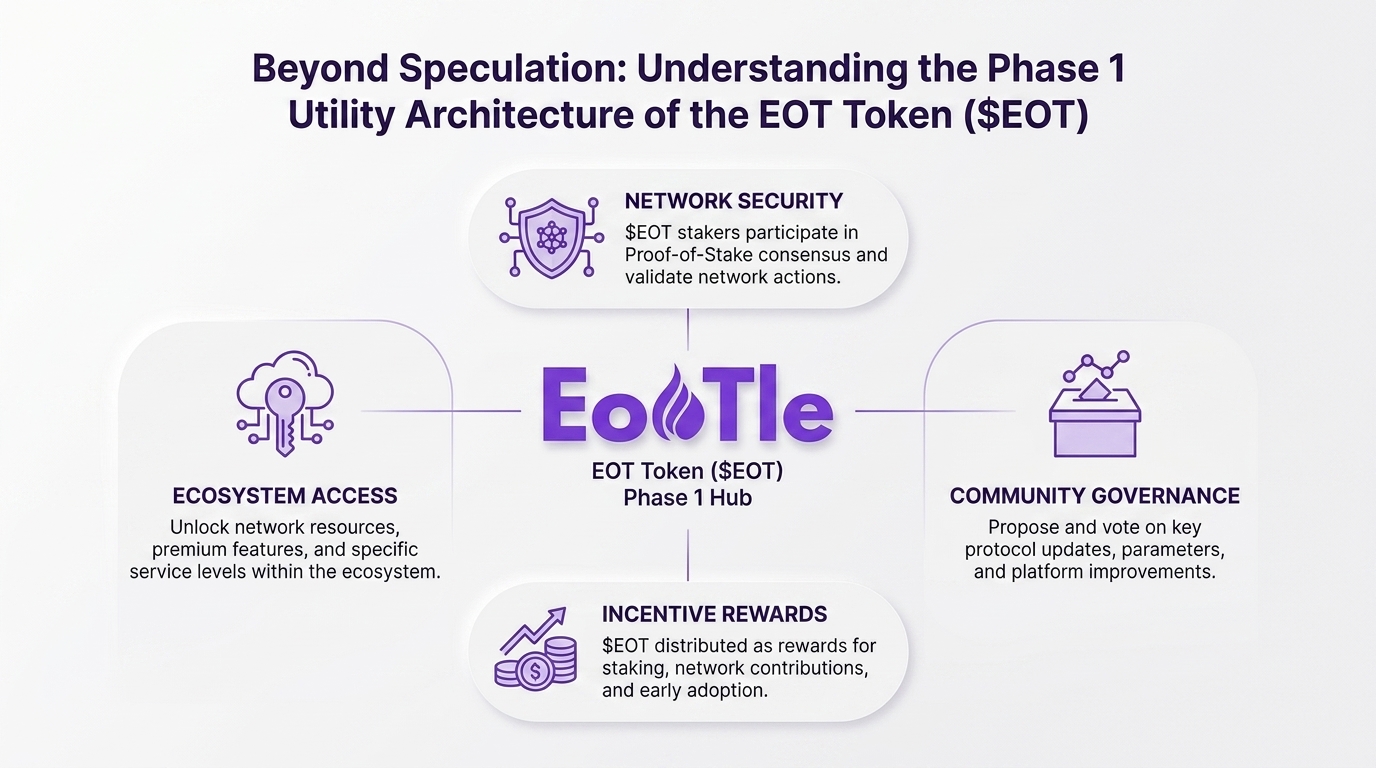
Beyond Speculation: Understanding the Phase 1 Utility Architecture of the EOT Token ($EOT)
In a market where digital assets often launch backed by speculation rather than substance, the EOT Token ($EOT) was engineered with a clear priority: utility first, zero speculation.
To maintain complete transparency with our community, developers, and platform users, this overview outlines the operational mechanics of $EOT during Phase 1, its closed-loop design within the Eootle ecosystem, and how this foundation prepares the ecosystem for future decentralized expansion.
The Phase 1 Architecture: Public Standard, Closed-Loop Utility
The EOT Token is deployed as an on-chain BEP-20 utility asset on the BNB Smart Chain. While it lives on a public, verifiable blockchain, its initial operational framework is intentionally controlled to prioritize platform stability:
- Internal Application Peg ($1.00 USD): Inside the Eootle App and platform backend, 1 $EOT is pegged directly to $1.00 USD. This fixed valuation simplifies platform fees, micro-services, and escrow calculations.
- Controlled Exchange Exposure: To insulate early platform operations from predatory trading bots and extreme slippage, $EOT is not actively listed on public decentralized exchanges (DEXs) during Phase 1.
- External Web3 Compatibility: Users can hold, transfer, and manage $EOT externally in self-custodial Web3 wallets (such as MetaMask or Trust Wallet) by importing the official contract address (0x5EbFf72D9c2F336898eFd70C4C3eE94C229AfEE9).
This dual-layer setup provides the security of an on-chain BEP-20 token alongside the predictability of a fixed internal unit of account.
Strategic Advantages of Phase 1
Insulating $EOT from open-market speculation during early rollout delivers key operational benefits:
- Predictable Transaction Costs: Escrow fees, peer-to-peer (P2P) transfers, and service discounts remain completely stable regardless of broader crypto market swings.
- Zero Gas Overhead for Internal Operations: While external transfers execute on the BNB Smart Chain, internal app-to-app transfers settle instantly on our database ledger with zero gas fees.
- Protection from Volatility: Holding $EOT internally shields user balances from automated arbitrage bots and external order book manipulation.
- Simplified Platform Accounting: Evaluating balances and escrow holdings in a 1:1 USD-equivalent unit eliminates complex real-time conversion math.
Navigating Phase 1 Operational Trade-offs
A transparent model requires recognizing the structural limitations of early-stage deployment:
1. Absence of Speculative Appreciation
During Phase 1, $EOT functions strictly as a utility credit pegged at $1.00 USD inside the platform—it is not an investment vehicle. Users hold $EOT to access lower fees, fast escrow clearing, and platform tools, not to speculate on price increases.
2. Platform-Centered Liquidity
Outside of direct Web3 peer-to-peer wallet transfers, primary utility and redemption gateways exist directly within Eootle's native exchange rails.
3. Hybrid Ledger Reliance
Zero-gas micro-settlements require a hybrid approach: external wallet holdings are decentralized on the BNB Smart Chain, while active in-app operations run on Eootle's internal database ledger.
The Evolution Roadmap: Transitioning to Phase 2
Phase 1 is a strategic stepping stone, not a permanent limitation. As platform user volume, transaction velocity, and system reserves mature, Eootle will execute Phase 2: Decentralized Market Expansion.
Plaintext
What Phase 2 Will Introduce:
- Public DEX Liquidity Pools: Seeding dedicated capital on decentralized exchanges (such as PancakeSwap) to support organic trading volume.
- Open Withdrawal Gateway: Enabling seamless two-way bridging so users can move $EOT between internal app balances and public DEX trading pairs.
- Dynamic Price Discovery: Allowing open-market supply and demand to drive secondary market valuation as the user base expands globally.
By establishing high user utility in Phase 1 before unlocking public market liquidity in Phase 2, Eootle ensures that $EOT builds genuine transactional demand rather than relying on temporary market hype.