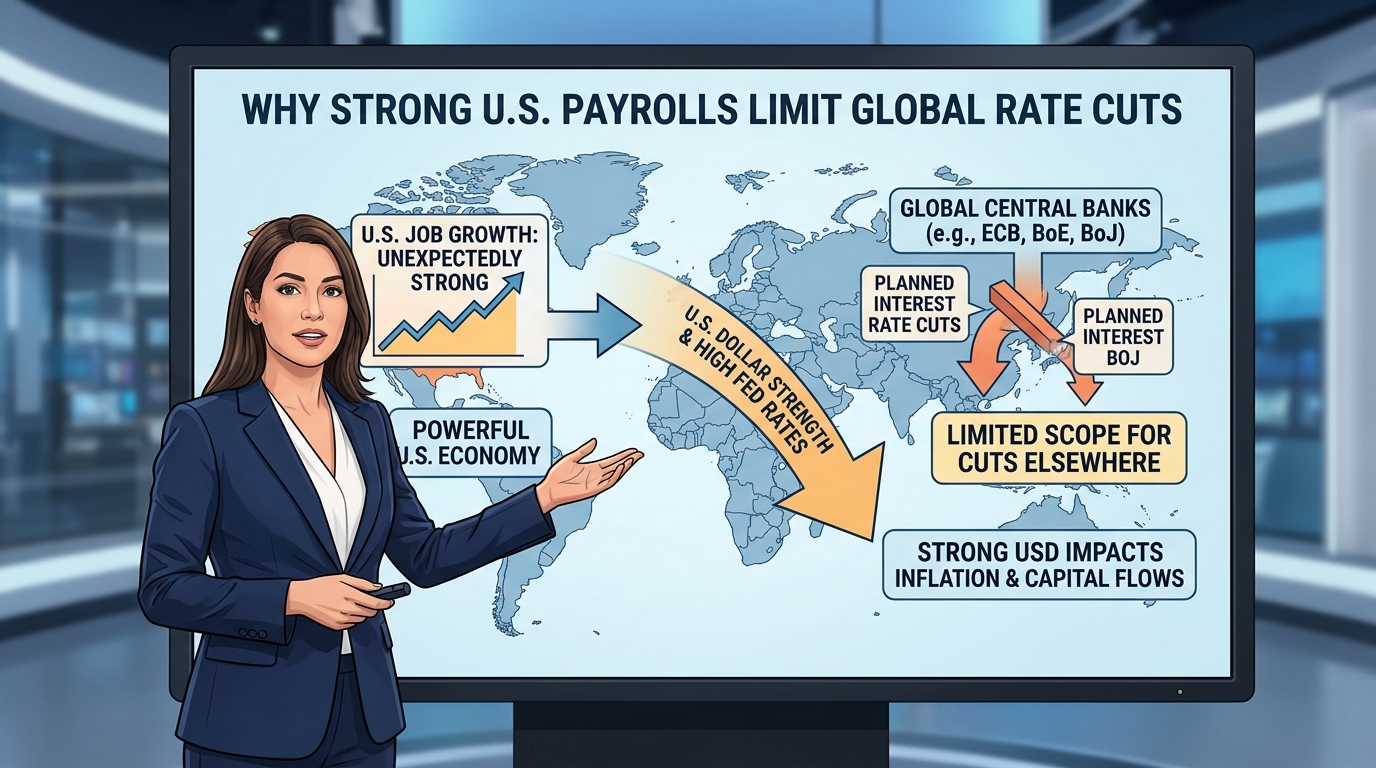
Why Unexpectedly Strong U.S. Payroll Data Limits Scope for Global Central Bank Interest Rate Cuts
The global monetary playbook just encountered a massive roadblock in the American labor market.
For months, financial institutions, sovereign wealth funds, and global asset managers operated under a shared macroeconomic assumption: a synchronized global monetary easing cycle was underway. With inflation retreating from its historic peaks, major central banks—from Frankfurt to London and Washington—were expected to steadily lower interest rates.
That narrative was upended by the latest U.S. nonfarm payrolls release. Rebounding sharply beyond consensus forecasts, the U.S. economy added 162,000 jobs in August 2026, blowing past the 56,000 baseline projection while holding the unemployment rate firm at 4.1%.
When the world’s largest engine of consumer demand demonstrates this level of underlying momentum, the ripple effects spill across international borders. The sudden surge in U.S. hiring doesn't just re-anchor Federal Reserve policy—it severely constrains the monetary maneuvering room for central banks across Europe, Asia, and emerging markets.
The Reality
Understanding why a single domestic jobs report limits international interest rate cuts requires breaking down three structural channels of global monetary transmission: exchange rate dynamics, imported inflation, and yield curve spillovers.
1. The Federal Reserve's Policy Recalibration
The U.S. Federal Reserve operates under a dual mandate: maximum employment and price stability. When payroll data reveals robust hiring alongside wage growth running at 3.1% year-over-year, the risk of a secondary inflation wave rises.
- Higher Terminal Rates: A tight labor market supports sustained consumer spending, preventing economic growth from cooling to non-inflationary levels.
- Rate-Cut Delays: With job creation far exceeding expectations, Fed policymakers face little urgency to aggressively ease interest rates, choosing instead to hold policy in restrictive territory. Forex Factory
2. The Foreign Exchange Channel and Dollar Strength
Interest rate differentials dictate the global flow of capital. When U.S. yields remain elevated because the Fed delays rate cuts, international investors channel funds into U.S. dollar-denominated assets.
$$\text{Capital Allocation Incentive} = \text{Yield}_{\text{US Treasury}} - \text{Yield}_{\text{Foreign Sovereign}}$$
When U.S. bond yields rise relative to those in Europe, Japan, or emerging markets, the U.S. dollar strengthens against peer currencies. For global central banks, this presents a severe policy dilemma:
- Imported Inflation: A weaker local currency makes foreign imports—specifically commodities priced in U.S. dollars, such as crude oil—significantly more expensive.
- Policy Constraints: If the European Central Bank (ECB) or Bank of England cuts interest rates rapidly while the Fed holds firm, their domestic currencies risk further depreciation, importing inflation back into their economies.
3. Sovereign Yield Curve Spillovers
Global capital markets are deeply interconnected. Fixed-income markets worldwide take their benchmark cues from U.S. Treasuries. As Treasury yields jump on strong labor data, sovereign bond yields in Frankfurt, London, and Tokyo experience upward pressure regardless of local economic conditions. This automatic tightening of financial conditions forces central bankers worldwide to proceed with caution. iShares
The Horizon
As central banks navigate this asymmetric economic backdrop, global financial markets are contemplating several potential forward-looking scenarios.
Base Case Scenario: "Higher for Longer" Synchronized Hold
In this baseline scenario, central banks in developed economies pause or slow down their rate-cut trajectories to preserve currency stability and prevent reigniting inflation.
- Cautious Easing Cycles: Central banks limit themselves to small, widely spaced rate adjustments, constantly monitoring U.S. employment and CPI data releases before making policy moves.
- Yield Curve Behavior: Short-term sovereign yields remain anchored to elevated policy rates, keeping borrowing costs high for corporations and consumers across major economies.
Alternative Scenario: Currency Friction and Divergent Policy
An alternative scenario involves global central banks prioritizing domestic economic weakness over currency protection, leading to sharp divergence from U.S. policy.
- Aggressive Foreign Cuts: Central banks facing sluggish domestic growth cut interest rates independently of the Fed.
- Currency Volatility: Unilateral easing leads to sharp depreciations in foreign currencies against the U.S. dollar, prompting currency interventions by foreign monetary authorities to stabilize exchange markets.
The Takeaway
Unexpectedly resilient U.S. labor data serves as a stark reminder that the global economy remains tethered to U.S. macroeconomic conditions. Central banks aiming to cut interest rates must contend with the realities of exchange rate pressures and cross-border financial conditions.
Going forward, market participants are paying close attention to three core variables:
- U.S. Wage-Growth Trajectory: Sustained wage increases will reinforce the Federal Reserve's hawkish posture, keeping global monetary policy constrained. International Monetary Fund
- Imported Inflation Metrics in Non-U.S. Economies: Foreign central banks will closely monitor imported input prices to evaluate how much currency depreciation their economies can tolerate.
- Cross-Border Capital Flows: The widening interest rate differential between the U.S. and the rest of the world will continue to dictate currency valuations and sovereign bond demand.
Global Policy Reaction Matrix
| Region / Central Bank | Immediate Policy Response | Key Currency Mechanism | Primary Vulnerability |
| United States (Federal Reserve) | Pause / Rate Hikes On Table | Stronger USD driven by yields | Secondary wage-push inflation |
| Eurozone (ECB) | Cautious / Prolonged Pauses | EUR weakness increases energy import costs | Stagnant economic growth vs. imported inflation |
| United Kingdom (Bank of England) | Gradual, Measured Easing | GBP exposed to capital outflows to USD | Sticky services inflation and wage pressure |
| Emerging Markets | Rate Cut Suspensions | Local currency depreciation risks capital flight | Foreign currency debt service costs |
Disclaimer: This post is published strictly for informational, educational, and analytical editorial purposes. It does not constitute financial, legal, tax, or investment advice, nor does it represent a recommendation to buy or sell any financial security or asset class.