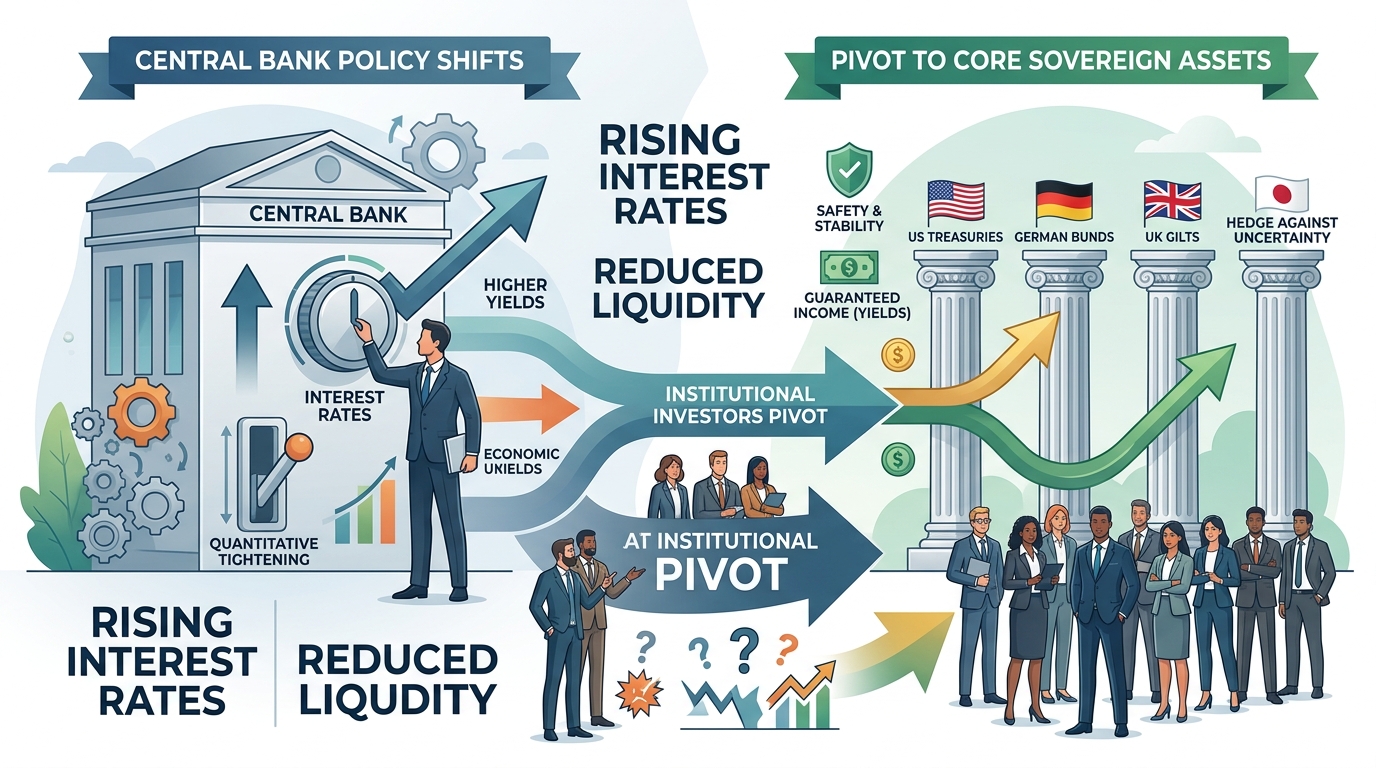
Why Central Bank Policy Shifts Are Prompting Institutional Investors to Pivot Toward Core Sovereign Assets
The monetary apparatus that fueled a decade of speculative mania has broken its own machinery.
For nearly fifteen years, the global institutional investment apparatus operated under a single, unspoken imperative: chase yield down the risk spectrum. When central banks pinned policy rates near zero and flooded fixed-income markets with trillions in balance-sheet expansion, sovereign paper became a drag on performance. Asset managers were forced into compressed corporate spreads, private credit, and highly leveraged equity strategies just to clear benchmark liabilities.
That paradigm has fractured. As major central banks complete a historic transition from aggressive rate-hike cycles to nuanced monetary recalibration, a structural shift is taking hold across capital markets. Institutional capital—managing trillions in pension funds, sovereign wealth pools, and insurance reserves—is executing a systemic retreat toward core sovereign paper.
The Reality
The macro environment driving this pivot is rooted in structural shifts within yield mechanics, sovereign borrowing trends, and central bank reserve management.
1. Yield Normalization and Real Return Dynamics
During the era of Zero Interest Rate Policy (ZIRP), holding ten-year sovereign debt yielded negative real returns after accounting for inflation. Today, central bank policy shifts have reset nominal yields across sovereign curves to levels not seen in over fifteen years.
- The Yield Floor: Core sovereign paper—such as U.S. Treasuries, German Bunds, Japanese Government Bonds (JGBs), and UK Gilts—now provides structural income without requiring portfolio managers to absorb credit or default risk.
- Real Rates: With inflation moderating toward central bank targets across major economies, real (inflation-adjusted) yields on risk-free sovereign instruments have returned to positive territory, restoring sovereign debt to its historic role as a primary capital preservation tool.
2. Quantitative Tightening (QT) and Structural Issuance
Central banks are continuing to downsize their balance sheets through quantitative tightening, unwinding massive holdings of domestic government obligations.
- Market-Driven Price Discovery: As monetary authorities cease acting as buyers of first resort, private institutional capital must step in to absorb unprecedented volumes of sovereign issuance.
- Fiscal Supply Pressure: Global sovereign debt levels continue to expand. OECD estimates indicate government and corporate borrowing requirements reaching up to $29 trillion, creating a structural supply dynamics that keeps nominal sovereign yields elevated and structurally attractive. OECD
3. Macro Volatility and Corporate Spread Compression
Corporate credit spreads—the yield premium demanded by investors to hold corporate bonds over risk-free government bonds—have compressed significantly. Institutional risk managers are faced with a asymmetric risk-reward math:
$$\text{Credit Spread Risk Premium} = \text{Yield}_{\text{Corporate}} - \text{Yield}_{\text{Sovereign}}$$
When corporate credit spreads narrow to historically low levels, the incremental return gained by taking on default or liquidity risk in corporate markets becomes marginal. High-grade core sovereign assets offer nearly identical yield profiles without the tail-risk exposure of corporate defaults or refinancing cliffs.
The Horizon
As central bank policy frameworks transition from emergency intervention to structural neutrality, institutional allocators are positioning for several potential forward-looking scenarios.
Base Scenario: "The Great Rebalancing"
In this baseline scenario, major central banks execute a controlled path toward terminal policy rates. Inflation remains contained near official target ranges, while global economic growth continues at a moderate pace.
- Institutional Portfolio Allocation: Multi-asset institutional allocators structurally rebalance away from inflated equity valuations and illiquid private assets back toward traditional 60/40 or risk-parity frameworks anchored heavily in core sovereign debt.
- Duration Demand: Fixed-income managers lock in high nominal coupons along the 10-year and 30-year points of sovereign yield curves, anticipating long-term capital appreciation when policy rates eventually settle.
- Market Dynamics: Sovereign debt markets experience consistent institutional demand from pension funds matching long-dated liabilities, stabilizing global capital flows.
Alternative Scenario: "Fiscal Dominance and Yield Curve Steepening"
An alternative scenario involves persistent structural fiscal deficits across major developed economies, leading to an oversupply of sovereign paper that tests the market's capacity to absorb it. Central Bank of Nigeria
- Term Premium Expansion: Institutional investors respond to elevated issuance by demanding a significantly higher "term premium"—additional yield compensation for holding longer-dated government bonds.
- Curve Dynamics: Yield curves steepen dramatically. Institutional allocators pivot away from long-duration sovereign bonds, concentrating their capital instead in ultra-liquid short-duration Treasury bills, money market instruments, and central bank reserve assets.
- Alternative Anchors: According to central bank survey data, reserve managers increasingly look toward gold and non-traditional mid-sized sovereign assets (such as Australian dollars or onshore renminbi) to diversify core allocations alongside primary sovereign debt. Central Banking
The Takeaway
The institutional pivot back to core sovereign paper represents a fundamental regime shift in global finance. After a decade of forced risk-taking, the return of positive real yields has re-established government debt as the core anchor of the multi-asset portfolio.
Moving forward, institutional market participants will monitor three primary variables:
- The Trajectory of Quantitative Tightening: The rate at which central banks reduce balance sheet assets will dictate private market absorption requirements and liquidity conditions.
- Corporate Credit Spread Compression: Should credit spreads widen, institutional money may selectively re-enter risk assets; if spreads remain tight, sovereign paper will continue to capture dominant capital flows.
- Fiscal Deficit Volatility: The sheer volume of new sovereign debt issuance will test global institutional liquidity and determine the long-term structure of yield curves.
Institutional Asset Allocation Matrix
| Asset Class | Structural Stance | Core Allocation Rationale | Key Risk Factor |
| Core Sovereign Bonds (US / Bunds / UK) | Overweight | High nominal yields, positive real returns, maximum balance sheet liquidity | Fiscal oversupply driving term-premium expansion |
| Investment Grade Corporate Credit | Neutral | Narrow spreads offer minimal risk premium over risk-free benchmarks | Refinancing friction at higher interest rate baselines |
| Private Credit & Speculative Debt | Underweight | Illiquidity discount eroded by attractive sovereign alternatives | Default risk escalation amid tight monetary conditions |
| Gold & Central Bank Reserves | Overweight (Strategic) | Reserve diversification asset against geopolitical and currency volatility | High real yields increasing opportunity cost of non-yielding assets |
Disclaimer: This post is published strictly for informational, educational, and analytical editorial purposes. It does not constitute financial, legal, tax, or investment advice, nor does it represent a recommendation to buy or sell any financial security or asset class.