Category: Opinion & Analysis || Posted Aug 17, 2026
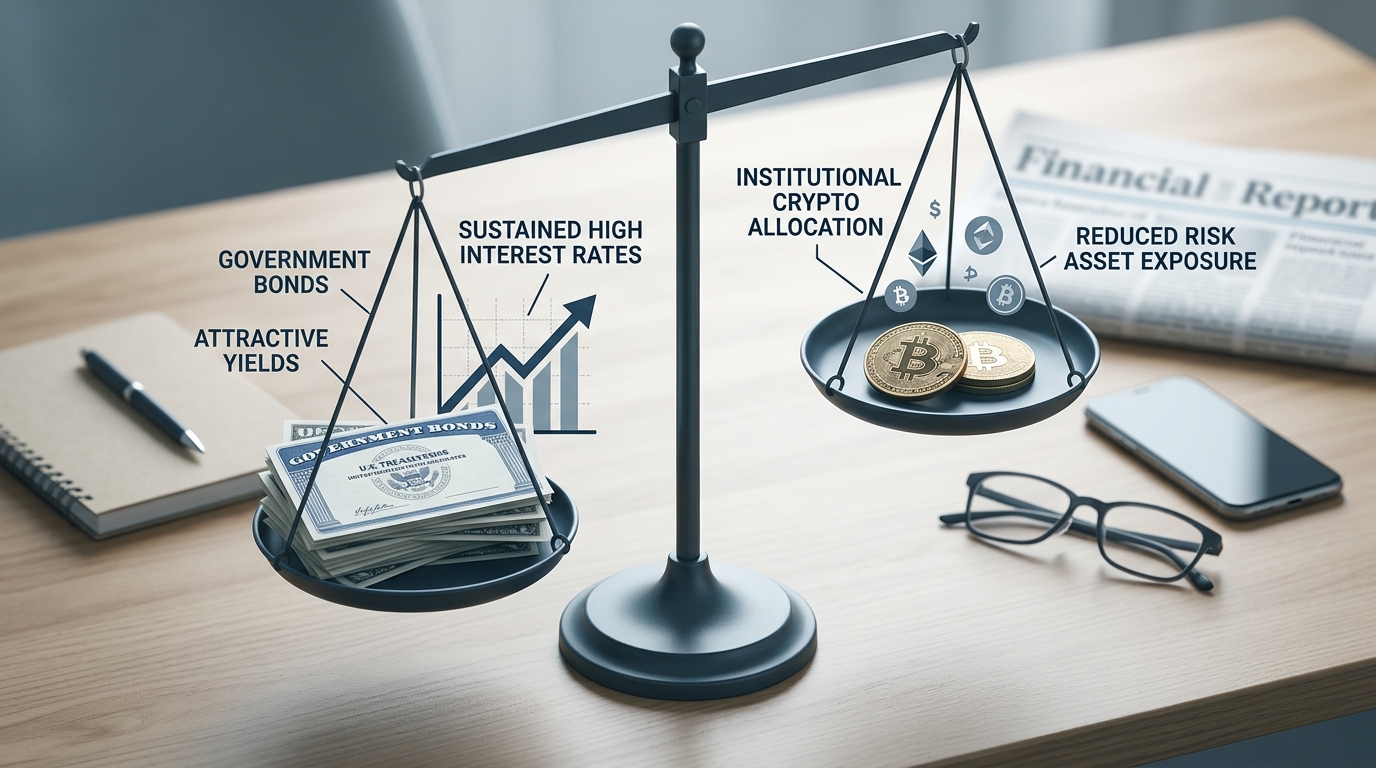
Why Sustained High Interest Rates Are Fundamentally Changing Institutional Crypto Allocation Strategies – Analysis
The End of "Free Money" and the Re-Engineering of Crypto: How Sustained High Rates Transformed Institutional Digital Asset Strategy
For nearly a decade, the foundational economic calculus of the cryptocurrency market relied on a single, structural variable: zero-interest-rate policy (ZIRP).
When cash yielded nothing, global pension funds, sovereign wealth managers, and risk-tolerant family offices were forced to venture far down the risk curve in pursuit of nominal returns. In that environment, digital assets were evaluated predominantly as high-beta hyper-growth plays or non-yielding speculative call options on a decentralized technological future.
That regime is dead.
With global central bank policy rates settling into a sustained "higher-for-longer" baseline, risk-free cash yields on U.S. Treasury bills and sovereign debt sit near multi-decade highs. The financial gravity of a non-zero interest rate world has drastically rewritten institutional hurdle rates. Allocating capital to digital assets can no longer be justified by grand narratives, pure momentum, or uncollateralized yield farming.
Today, institutional allocators are executing a quiet, fundamental pivot. The era of treating crypto as a speculative outlier is giving way to a disciplined integration phase—one where capital efficiency, real-world asset (RWA) tokenization, yield-bearing structures, and strict corporate governance dictate which assets attract capital and which face structural liquidity starvation. Interactive Brokers
The New Math of Allocation: Hurdle Rates, Real Yields, and Regulated Infrastructure
To quantify how prolonged high interest rates have altered institutional behavior, one must look at the mechanics of portfolio construction. When risk-free paper pays 4% to 5% annually with virtually zero credit or operational risk, the opportunity cost of holding non-yielding, volatile assets skyrockets.
This economic reality has driven three structural pivots across global institutional trading desks and asset management firms:
1. The Death of Nominal Yield and the Rise of On-Chain Treasuries
During the 2020–2021 bull run, institutional DeFi participation was driven by protocol token emissions—yields denominated in highly volatile tokens that often masked underlying principal risk. When macroeconomic rates rose, these artificial yields collapsed under the weight of token inflation.
Today, institutional demand has pivoted decisively toward tokenized Real-World Assets (RWAs). Major asset managers like BlackRock, Franklin Templeton, and Ondo Finance have built multi-billion-dollar pipelines translating traditional money-market instruments into on-chain rails. Institutional treasuries now use tokenized U.S. T-Bills as high-grade, yield-bearing collateral for on-chain derivatives and lending, effectively bridging traditional risk-free returns into the digital asset ecosystem.
2. The Shift from Unregulated Native Yield to Cash-Flow Fundamentals
Institutional investment committees are applying traditional equity evaluation models to layer-1 and layer-2 networks. Rather than viewing tokens purely as speculative monetary commodities, analysts are evaluating:
- Staking Yield vs. Inflation Rate: The net real yield generated by proof-of-stake networks after accounting for baseline protocol dilution.
- Fee Capture & Token Burn: On-chain transaction revenues generated by real network activity.
- Capital Efficiency: The ability to stake assets while retaining operational liquidity through liquid staking and liquid restaking derivatives (LSDs/LRTs).
3. Regulated Wrapper Preference (ETFs and ETPs as Default On-Ramps)
High interest rates have coincided with a tightening regulatory environment, prompting investment committees to prioritize institutional-grade governance. Data from the EY Institutional Investor Digital Assets Survey shows that an overwhelming majority of institutional investors prefer accessing digital assets through registered spot Exchange-Traded Products (ETFs/ETPs) rather than direct, unsegregated wallet custody.
These registered wrappers eliminate custody security gating factors and operational due diligence hurdles, allowing pension funds, endowments, and RIA networks to integrate digital assets into standardized 60/40 or multi-asset portfolio models.
Comparative Shifts in Institutional Strategy
| Operational Metric | Low-Rate Era (2015–2021) | High-Rate Baseline Era |
| Primary Allocation Driver | Non-correlated asymmetric upside; speculative growth narrative | Adjusted risk-return, inflation hedging, and real capital efficiency |
| Yield Benchmark | Protocol token inflation; uncollateralized DeFi lending | Tokenized U.S. Treasuries, money market funds, and net staking yields |
| Access Vehicle | Direct exchange accounts; OTC desks; offshore funds | Regulated Spot ETFs/ETPs, tokenized fund shares, and multi-custodian setups |
| Stablecoin Utilization | Zero-yield transactional medium (e.g., standard USDT/USDC) | Yield-bearing stablecoins, tokenized MMFs, and ERC-4626 vault wrappers |
| Portfolio Role | Satellite speculative allocation (<1%) | Core alternative asset bucket alongside commodities, gold, and private credit |
Scenarios, Market Hype, and Strategic Probabilities
As central bank policy stabilizes and the institutionalization of digital assets matures, financial analysts and market strategists are watching several divergent scenarios unfold. How institutions navigate the intersection of sustained high interest rates and blockchain technology will define the next decade of capital markets.
Scenario A: The Baseline Integration (Systemic Tokenization of TradFi)
Probability Assessment: High
In this scenario, sustained interest rates accelerate the migration of traditional financial infrastructure onto public and permissioned blockchains.
- The $2+ Trillion RWA Horizon: Market research from major investment banks and consultancy groups suggests tokenized assets could scale dramatically over the coming years. Institutional treasuries are expected to increasingly run 24/7 liquidity operations using tokenized money market funds as margin collateral across global exchanges.
- Disappearance of the "Crypto vs. TradFi" Divide: Rather than treating crypto as an isolated, exotic asset class, institutional trading stacks are converging. Multi-asset desks are anticipating seamless rebalancing between sovereign debt, corporate credit, spot Bitcoin/Ether ETPs, and tokenized commodities within a single unified operational dashboard.
- Regulatory Standardization: Legal frameworks like Europe's MiCA and proposed U.S. digital market structure legislation are expected to solidify clear boundaries between interest-bearing security tokens and transactional stablecoins, providing the compliance runway needed for sovereign wealth funds to enter.
Scenario B: The High-Rate Squeeze (Liquidity Concentration in Top-Tier Assets)
Probability Assessment: Moderate
If central banks maintain tighter policy longer than current markets price in, the resulting cost of capital could create a persistent "flight to quality" within digital assets.
- The Altcoin Liquidity Drain: Industry analysts caution that high risk-free yields make speculative, non-revenue-generating tokens structurally unviable for institutional capital. Capital could remain strictly concentrated in Bitcoin (as a digital monetary store of value against fiat debasement) and Ethereum (as an institutional utility layer generating network yield).
- Private Credit Realignment: Smaller, high-risk DeFi lending protocols that rely on retail leverage may see capital evaporate as institutional capital moves exclusively into over-collateralized, real-world asset credit vehicles backed by audited, physical claims.
Scenario C: The Programmable Efficiency Breakthrough (On-Chain Yield Supremacy)
Probability Assessment: Moderate to Speculative
Proponents of decentralized finance argue that blockchain infrastructure will eventually out-compete traditional banking rails purely on operational capital efficiency.
- Automated Corporate Treasuries: Industry observers are watching the rise of AI-driven corporate treasury bots that automatically shift idle enterprise balances between interest-bearing stablecoins, short-term sovereign debt tokens, and liquid staking vaults in real time.
- Compression of Intermediary Costs: Cross-border corporate payments and collateral mirroring agreements could significantly reduce operational transaction costs compared to legacy SWIFT and correspondent banking channels. If on-chain settlement nets even a 50 to 100 basis point efficiency advantage over traditional clearinghouses, institutional treasuries may migrate trillions in settlement volume onto public blockchains regardless of macroeconomic rate cycles.
Strategic Variables to Watch
The transition from a low-rate, speculation-driven market to a high-rate, fundamentally driven institutional landscape marks the maturation of the digital asset class. As institutions build out their 2026–2030 allocation models, investment committees should monitor four key operational indicators:
1. RWA Total Value Locked (TVL) Growth Rates
What to watch: The velocity of capital inflows into tokenized short-term U.S. Treasuries, money market funds, and private credit protocols. Growth in this metric signals institutional comfort with using public blockchains as financial settlement layers.
2. The Net Real Yield Gap (Staking Rate minus Inflation)
What to watch: The real, net-of-inflation yields of major proof-of-stake networks compared to sovereign benchmark yields (e.g., 10-year Treasury notes). When net on-chain yields clear the risk-free hurdle rate, institutional staking participation increases.
3. Institutional ETP Inflows and Net Supply Absorption
What to watch: The percentage of circulating Bitcoin and major layer-1 tokens held by registered spot ETPs and institutional treasuries. A rising structural floor signals that digital assets are successfully locking into long-term buy-and-hold portfolio frameworks.
4. Regulatory Clarity on Yield-Bearing Stablecoins and Tokenized Funds
What to watch: How major financial regulators enforce boundaries around interest-bearing stablecoins, tokenized money market funds, and ERC-4626 vault structures. Clear rules will determine whether institutional treasuries can deploy trillions of idle capital onto public chain architectures.
In a world where money is no longer free, digital assets are no longer judged by the grandeur of their promises, but by the rigor of their fundamentals, the efficiency of their infrastructure, and the real value they yield.
Disclaimer: This analysis is provided strictly for educational, informational, and editorial purposes. It does not constitute financial, legal, tax, or investment advice. Any mentions of specific protocols, assets, or financial vehicles are presented as factual records or market examples, not as endorsements or recommendations.