Category: Tutorials & Guides || Posted Aug 14, 2026
How the Global Supply Chain Actually Works And Why It Breaks
You tap a glowing glass screen. A transaction is verified in milliseconds. Somewhere across the globe, a robotic arm drops a product into a cardboard box, a barcode is scanned, and within forty-eight hours, that box is resting neatly on your front porch.
To the modern consumer, this frictionless sequence feels like magic. We have been conditioned to view global commerce as an invisible, flawless utility—much like turning on a faucet and expecting water. But behind the "Buy Now" button lies the most complex, heavily optimized, and terrifyingly fragile physical machine ever constructed by human hands: the global supply chain.
It is a planetary ballet of 24,000-TEU (Twenty-foot Equivalent Unit) mega-ships, high-speed rail networks, algorithmic port cranes, and millions of miles of asphalt. According to the United Nations Conference on Trade and Development (UNCTAD) Review of Maritime Transport 2025, global maritime trade volumes recently reached a staggering 12.72 billion tons. Roughly 80% of the volume of all international trade in goods is carried across the world's oceans.
But this colossal machine is currently buckling. The era of hyper-optimized, "just-in-time" delivery—a philosophy designed to eliminate warehouse costs by keeping goods in perpetual motion—is colliding with a world defined by geopolitical friction, climate anomalies, and shifting trade policies. As Rebeca Grynspan, Secretary-General of UNCTAD, recently stated regarding the current state of global shipping: "Not since the closure of the Suez Canal in 1967 have we witnessed such sustained disruption to the arteries of global commerce."
The illusion of seamless global trade has been shattered. To understand where the global economy is heading, we must first pull back the curtain on how this massive engine actually works—and, more importantly, exactly why it breaks.
The Mechanics of the Machine
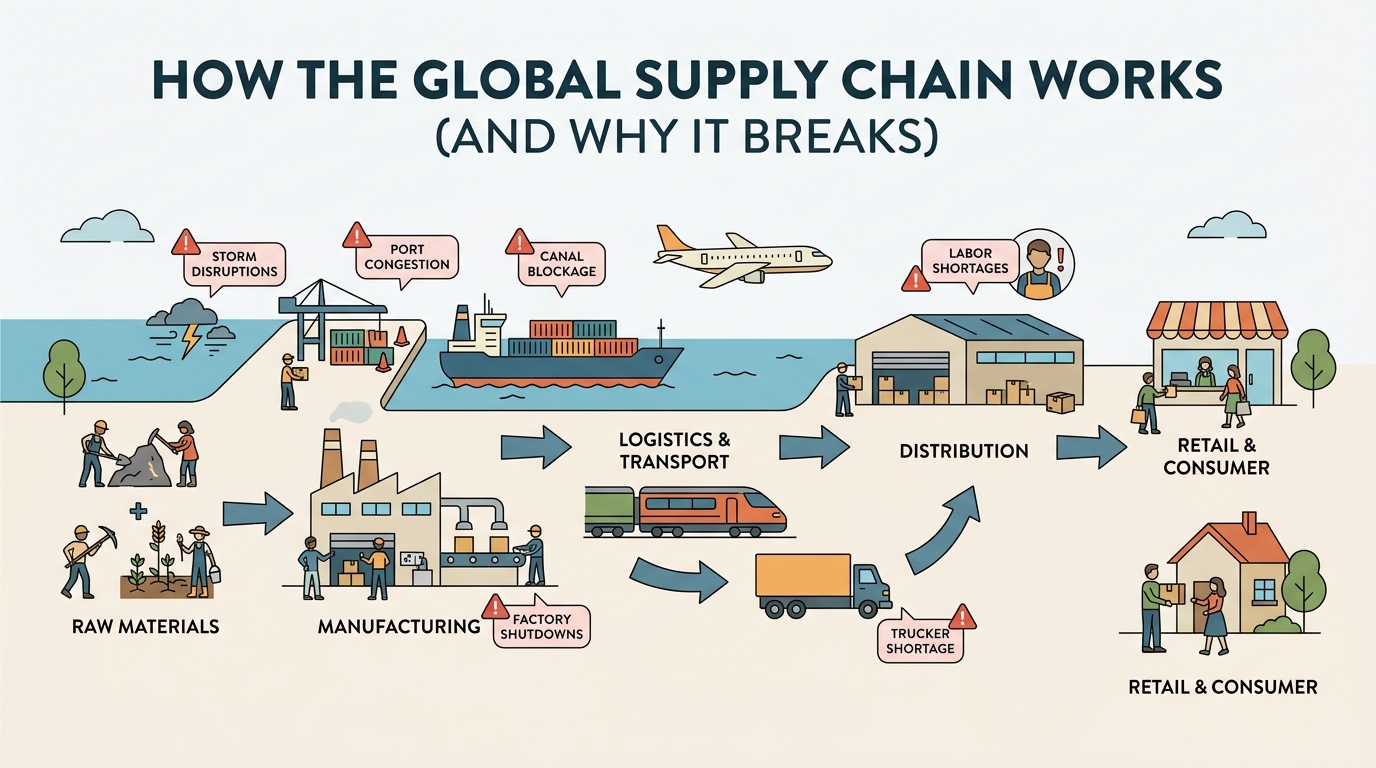
To comprehend the fragility of the supply chain, you must understand its architecture. The system is fundamentally built on the concept of containerization—the standardization of the steel shipping container in the mid-20th century. Because every container is exactly the same size, ships, trucks, trains, and port cranes worldwide can handle them interchangeably.
This standardization gave birth to the "hub-and-spoke" model. Instead of sailing from a small port in Vietnam directly to a small port in Italy, a mega-ship acts as a massive oceanic bus. Smaller "feeder" vessels ferry goods from local ports to massive hubs like Singapore or Shanghai. There, the mega-ships are loaded with tens of thousands of containers, crossing the oceans to unload at mega-hubs like Rotterdam or Los Angeles, where the process is reversed.
This system is a marvel of capital efficiency. However, its Achilles' heel is that it relies on a handful of narrow geographical corridors to function. When one of these corridors constricts, the mathematical models governing global shipping collapse, triggering cascading delays that inflate the cost of everything from crude oil to consumer electronics.
The Geography of Vulnerability: The Four Chokepoints
The breakdown of the global supply chain is rarely a systemic failure of technology; it is almost always a failure of geography. Right now, over 50% of global maritime trade is vulnerable to disruption across four primary chokepoints:
1. The Suez Canal and the Bab El-Mandeb Strait Connecting the Mediterranean Sea to the Red Sea, the Suez Canal normally handles about 12% of all global maritime trade. However, following geopolitical conflicts and the escalation of Houthi attacks on international shipping in the Red Sea starting in late 2023, the route became a high-risk zone.
The facts are stark: by mid-2024, traffic through the Suez Canal dropped by approximately 70% compared to previous averages. To protect crews and cargo, major shipping lines began rerouting vessels around the southern tip of Africa—the Cape of Good Hope. This massive detour adds 9 to 17 days to a journey. The financial and environmental toll is immense; UNCTAD calculations revealed that a single large container ship on the Far East-Europe route diverts around Africa incurs an estimated $400,000 in additional emissions costs under the European Union's Emissions Trading System (ETS), not to mention the millions in extra fuel, crew wages, and delayed cargo capital.
2. The Panama Canal While the Red Sea faces geopolitical threats, the Panama Canal has been battling the climate. Linking the Atlantic and Pacific Oceans, this engineering marvel handles 5% of global container trade and a critical 46% of trade moving from the US East Coast to East Asia.
Unlike the sea-level Suez, the Panama Canal relies on a freshwater lock system fed by nearby lakes. Severe, climate-induced droughts drastically lowered water levels, forcing authorities to slash the number of daily vessel transits by over 50% from late 2023 through 2024. Ships were forced to either carry lighter loads, pay exorbitant auction fees to jump the queue, or take the long way around South America.
3. The Strait of Malacca Sitting between Singapore, Malaysia, and Indonesia, the Strait of Malacca is the shortest shipping route connecting East Asia with the Middle East and Europe. It accounts for a massive 30% of global trade. Furthermore, it is a critical energy artery: roughly two-thirds of China’s trade and 80% of its energy imports pass through this narrow waterway. It remains highly vulnerable to regional disputes in the South China Sea, acting as a critical geopolitical pressure point.
4. The Strait of Hormuz Located between Iran, the UAE, and Oman, the Strait of Hormuz is the world's most critical artery for energy. An estimated 20% to 30% of global oil trade passes through this corridor. Any escalation of conflict in the Middle East that threatens the free passage of vessels here has immediate, verified impacts on global energy markets, spiking fuel costs for logistics networks worldwide.
The "China Plus One" Reconfiguration
Because of these disruptions—coupled with rising labor costs and trade tariffs—the manufacturing map is actively being redrawn. Verified trade statistics show a clear acceleration of the "China Plus One" strategy. Multinational corporations are not necessarily abandoning China, but they are aggressively diversifying their manufacturing bases to mitigate risk.
For example, major electronics and apparel brands have steadily moved portions of their assembly lines to Southeast Asia and India. According to UNCTAD data tracking the shift up to 2022, the share of United States container imports originating from Vietnam doubled from 4% to 8%, while India’s share grew from 3% to 5%. In contrast, China’s share of US imports dropped from 40% to 31% in that same period. This creates a far more complex, multi-origin supply chain network that logistics providers are still struggling to optimize.
As we look toward the late 2020s and beyond, the supply chain is transforming from a cost-saving utility into a strategic defense mechanism. While no one can predict the future with absolute certainty, industry analysts, logistics giants, and economic forecasters are closely watching several potential scenarios and emerging trends that could redefine global trade.
Scenario 1: The End of "Just-In-Time" and the Rise of "Just-In-Case"
For decades, holding excess inventory was viewed as a financial sin. Companies minimized warehousing to free up capital. However, market sentiment suggests a paradigm shift toward "Just-in-Case" logistics. Analysts are watching to see if corporations will permanently expand their warehousing footprints, deliberately stockpiling raw materials and finished goods closer to the end consumer.
If this scenario plays out fully, we could see a boom in industrial real estate near major urban centers and ports. However, this resilience comes at a price. Holding more inventory requires more capital, which could theoretically embed a baseline level of inflation into consumer goods for the foreseeable future.
Scenario 2: Hyper-Regionalization and Nearshoring
While globalization is not dead, it may be fracturing into distinct, regionalized blocs. Supply chain strategists are actively exploring the potential of "nearshoring"—moving production closer to the final market to bypass oceanic chokepoints entirely.
One potential outcome is the solidification of the North American manufacturing bloc, with massive investments flowing into Mexican manufacturing to serve the United States market via rail and truck, circumventing the Panama Canal and trans-Pacific shipping entirely. Similarly, European markets might look toward Eastern Europe and North Africa to shorten supply lines. While unproven at a total global scale, if hyper-regionalization accelerates, it could fundamentally alter the economic destinies of developing nations that historically relied on cheap export manufacturing.
Scenario 3: AI-Driven Predictive Logistics
The sheer complexity of rerouting ships, managing port congestion, and tracking fragmented manufacturing bases has exceeded human cognitive limits. The market is highly speculative about the integration of advanced Artificial Intelligence (AI) into global logistics.
In a best-case technological scenario, AI and machine learning models could analyze thousands of variables in real-time—weather patterns, geopolitical news feeds, port labor negotiations, and satellite imagery—to predict bottlenecks weeks before they happen. Ships could be dynamically rerouted mid-ocean, and cargo could be seamlessly transferred from sea to rail to air based on algorithmic optimization. If these technologies mature, they could restore a degree of the efficiency lost to recent global disruptions.
Scenario 4: The Trillion-Dollar Decarbonization Squeeze
The shipping industry accounts for roughly 3% of global greenhouse gas emissions, a figure that has risen 20% over the last decade. As regulatory bodies enforce stricter environmental mandates aiming for full decarbonization by 2050, the industry faces an existential and financial reckoning.
The current global fleet runs almost exclusively on fossil fuels. Transitioning to green methanol, ammonia, or other alternative fuels requires not only retrofitting or replacing thousands of vessels but also building entirely new global bunkering (refueling) infrastructures. Industry experts warn that this transition will require massive, unprecedented capital investment. A worst-case scenario for consumers involves these green transition costs being passed directly down the line, permanently raising the floor for global logistics costs and heavily impacting vulnerable, shipping-reliant nations.
The global supply chain is no longer an invisible, boring backend process managed exclusively by procurement officers; it is the frontline of global geopolitics, climate adaptation, and macroeconomic stability. The vulnerabilities exposed over the last few years have proven that efficiency without resilience is a dangerous gamble.
Moving forward, the key variables to watch are not just consumer demand, but the physical realities of the planet. Will the Panama Canal secure alternative freshwater sources? Will the Red Sea return to being a safe transit corridor? How fast can the commercial fleet transition to green energy without bankrupting the developing world?
The businesses that thrive in the coming decade will likely not be those that simply hunt for the cheapest manufacturing labor. Instead, they will be the organizations that map their supply chains down to the raw material level, invest heavily in predictive data analytics, and build redundancies into their logistics networks. The era of frictionless, perfectly timed global trade has evolved into something far more demanding. The supply chain of the future will not be measured merely by how fast it can move, but by how much punishment it can take before it breaks.