Category: Global politics || Posted Aug 13, 2026
Colombia Declares Three Days of Mourning After Deadly Earthquake
A low, guttural rumble that rapidly morphed into a deafening roar. In a matter of seconds, the vibrant, coffee-growing heartlands of western Colombia were reduced to twisted metal, shattered concrete, and plumes of suffocating dust. On Monday, August 10, 2026, a catastrophic 7.4-magnitude earthquake—officially the strongest to strike the South American nation in a century—tore through the earth, leaving entire urban blocks flattened and thousands of lives forever altered.
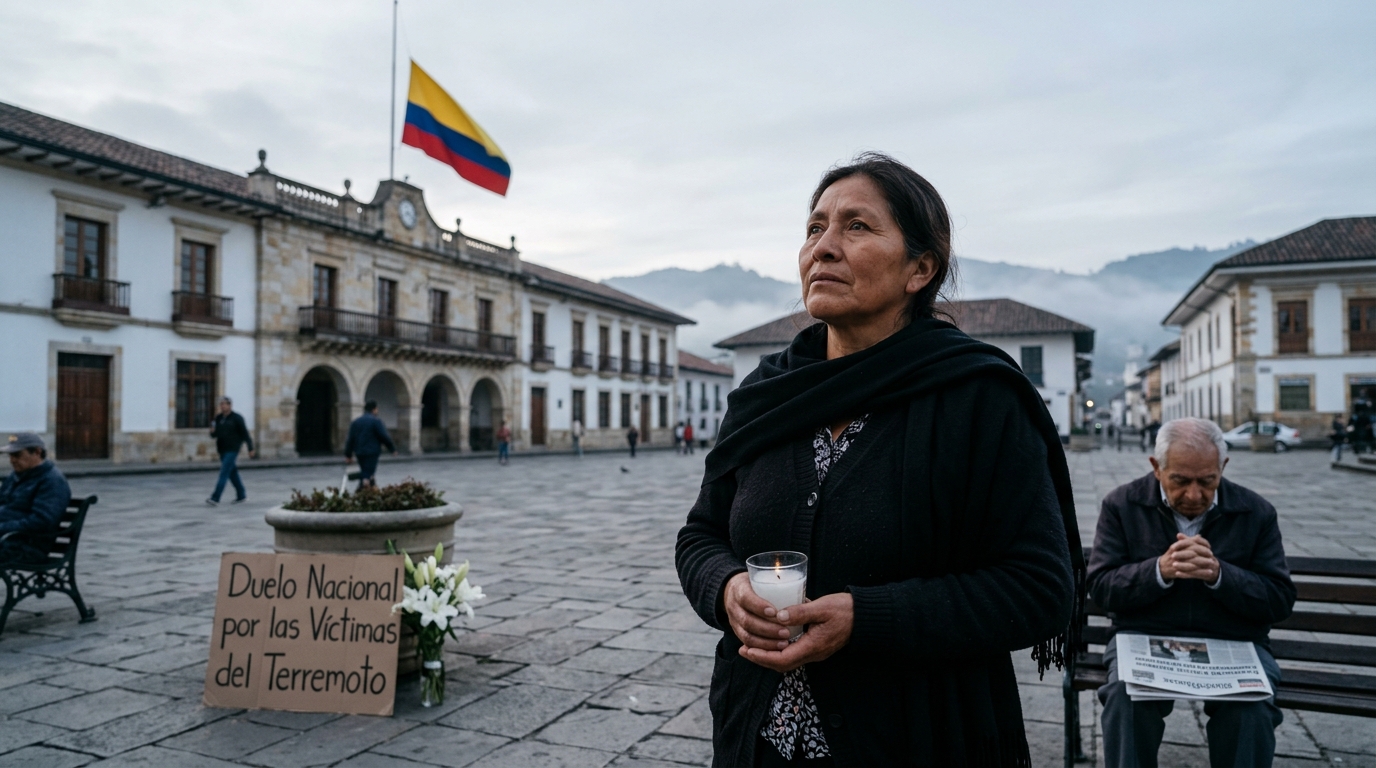
As the dust settles over the rubble and the frantic search for survivors enters its most agonizing, critical phase, the Colombian government has officially plunged the nation into three days of mourning. President Abelardo de la Espriella has mandated that the national tricolor flag be lowered to half-mast on all public buildings and at Colombian diplomatic missions around the globe "in honor of all the dead".
But beneath the solemnity of mourning protocols lies a desperate, ticking clock. With the crucial 72-hour survival window rapidly closing, thousands of emergency responders, civilian volunteers, and international aid workers are digging through the debris with heavy machinery, search dogs, and often their bare hands. What began as a sudden geological rupture has now become a profound test of national resilience, testing a brand-new political administration and stretching Colombia’s infrastructure to its absolute breaking point.
This is the definitive breakdown of the disaster, the facts on the ground, and the long-term shockwaves that could reshape Colombia’s economic and political future.
To grasp the sheer scale of this tragedy, we must examine the verified data emerging from the epicenter and the hardest-hit metropolitan zones. The situation remains highly fluid, but the factual record paints a grim picture of a region fundamentally upended.
The Seismic Event and the Immediate Toll
At a magnitude of 7.4, the earthquake struck with devastating force, centered near the historically marginalized and ruggedly remote Choco region. Its shockwaves radiated aggressively outward, heavily damaging vital economic and cultural hubs across western Colombia, including Cali, Pereira, Manizales, and Quibdo. The initial tremor was followed by a relentless series of aftershocks—over 100 recorded by Tuesday afternoon—which have consistently hampered rescue operations and further weakened compromised structures.
The human cost has been staggering and continues to climb. Official reports indicate that the death toll has reached at least 265 individuals, though local authorities have had to frequently revise figures as they comb through flattened neighborhoods. The number of injured currently stands at nearly 3,500 people. TRT World
Perhaps most alarming is the discrepancy in the numbers of the missing. While government figures initially cited 195 people officially unaccounted for, civilian-run databases and grassroots tracking networks suggest that the true number of missing persons could be closer to 4,000.
Disaster Footprint: At a Glance
| Metric | Verified Data |
| Magnitude | 7.4 (Strongest in Colombia in a century) |
| Epicenter Proximity | Choco Region |
| Major Cities Affected | Cali, Pereira, Manizales, Quibdo |
| Fatalities | Up to 265 (Figures fluid as recovery continues) |
| Injured | Approx. 3,494 |
The 72-Hour Window: Miracles and Despair
Aid agencies universally recognize the first 48 to 72 hours following a seismic event as the critical "golden window" for pulling survivors from the rubble alive. Cali Mayor Alejandro Eder addressed the grim reality on Wednesday morning, stating, "We're entering the final phase of the first 72 hours. That doesn't mean there won't be survivors afterwards, but it is more difficult".
Amid the widespread devastation, miraculous stories of survival have fueled the exhausted rescue teams. In the city of Pereira, emergency crews pulled 32-year-old Daniela Largo alive from the mangled wreckage of a collapsed hotel after she had been trapped for 35 agonizing hours. Rescuers were alerted by a local resident who heard muffled cries beneath the concrete, prompting neighbors to begin clearing the debris by hand before professional crews arrived with cranes. "We were losing hope and then we received a call," her mother, Sandra Milena Perez, told journalists, adding her profound gratitude for the stranger who heard her daughter's voice. RTL Lëtzebuerg+ 1
Infrastructure Collapse and the Healthcare Crisis
The earthquake has exposed severe vulnerabilities in regional infrastructure. In Cali, entire residential blocks and apartment buildings have been completely flattened, leaving vehicles crushed beneath walls and concrete slabs.
The disaster has placed an unbearable strain on the local health system. Tragically, a section of the Hospital Universitario del Valle in Cali collapsed during the quake. Medical professionals were forced to execute emergency evacuations, moving highly vulnerable patients into the facility's parking lot, where doctors are now treating severe trauma injuries in makeshift open-air wards. Meanwhile, ordinary citizens have mobilized en masse, forming long lines at blood donation centers and ferrying water and food to affected neighborhoods.
A Political Baptism by Fire
For Colombia’s leadership, the timing of the disaster is historically unprecedented. President Abelardo de la Espriella assumed office just three days prior to the earthquake following a highly divisive national election. Before his cabinet could even be fully briefed on standard domestic policies, the first-time president was thrust into the greatest humanitarian crisis in modern Colombian history. De la Espriella has swiftly declared a state of emergency and promised emergency rent subsidies for families rendered homeless, but the logistical execution of these promises remains to be seen.
As the initial shock wears off and the 72-hour rescue window inevitably closes, international analysts, economists, and political scientists are actively modeling what the recovery phase will look like. The path forward for Colombia is fraught with logistical complexities and economic vulnerabilities.
While the exact outcomes remain unwritten, market observers and geopolitical strategists are closely watching three potential, trend-driven scenarios:
Scenario A: The Agricultural and Supply Chain Shock (Market Sentiment)
- The Possibility: Western Colombia is world-renowned as the Eje Cafetero—the Coffee Axis. Industry analysts are deeply concerned about the earthquake's impact on agricultural infrastructure, processing facilities, and mountain transport routes. If rural roadways remain impassable, the harvest and distribution of coffee beans could face massive bottlenecks.
- Potential Impact: Market speculators suggest this could lead to a temporary tightening in global coffee supplies, potentially driving up commodity futures and temporarily inflating prices for international buyers. Locally, a sustained disruption could devastate the livelihoods of thousands of rural farmers who rely entirely on uninterrupted harvest cycles.
Scenario B: The Rural Logistical Logjam (Worst-Case Outlook)
- The Possibility: While urban centers like Cali and Pereira are receiving the bulk of international aid and heavy machinery, the epicenter in Choco presents a uniquely harrowing challenge. Choco is notoriously difficult to access; many of its communities can only be reached by boat, dense jungle trails, or specialized aircraft.
- Potential Impact: Humanitarian experts fear a prolonged "invisible crisis" in these remote areas. Furthermore, the region has historically been highly volatile, marked by the presence of armed militant groups. A worst-case scenario entails violent factions interfering with the distribution of international aid, creating "no-go" zones for government responders and leaving vulnerable indigenous and Afro-Colombian populations entirely isolated from relief efforts. Al Jazeera
Scenario C: The Political Consolidation or Fracture (The Trend-Driven Crucible)
- The Possibility: Crises of this magnitude have a historical tendency to either make or break new political administrations. President de la Espriella has promised direct financial interventions, such as rent subsidies, to the estimated 3,700 families left suddenly homeless.
- Potential Impact: If the newly inaugurated administration can effectively coordinate international aid—which is already beginning to arrive—and cut through bureaucratic red tape to deliver direct relief, analysts suggest de la Espriella could rapidly consolidate political capital and unify a previously divided electorate. Conversely, if relief funds are mismanaged or rebuilding efforts stall into the next year, the administration could face intense public backlash, widespread protests, and early destabilization of his presidency.
Colombia is currently standing at a devastating intersection of geological misfortune and historical timing. The 7.4-magnitude earthquake that struck on August 10 has irrevocably altered the landscape of the western provinces, testing the limits of human endurance and structural resilience.
As the three days of national mourning conclude and the grim transition from "search and rescue" to "long-term recovery" begins, the global community and financial markets must keep a close eye on several critical variables:
- Logistical Access to the Epicenter: Watch for reports detailing the military and humanitarian penetration into the Choco region. The speed at which remote communities are reached will define the final, tragic scope of the human toll.
- Infrastructure Assessments in the Eje Cafetero: Monitor forthcoming statements from Colombia's agricultural and transit ministries regarding the structural integrity of the bridges, highways, and processing plants that support the region's vital coffee export economy.
- The Efficacy of Government Subsidies: Track whether President de la Espriella's state of emergency declarations successfully translate into tangible rent relief for displaced families, a crucial metric for preventing a secondary crisis of long-term urban homelessness.
The spirit of the Colombian people—evident in the human chains of volunteers digging through concrete with bare hands—remains unbreakable. However, the road to rebuilding will require immense, sustained international cooperation long after the national flags are raised back to full mast.