Category: Global politics || Posted Aug 10, 2026
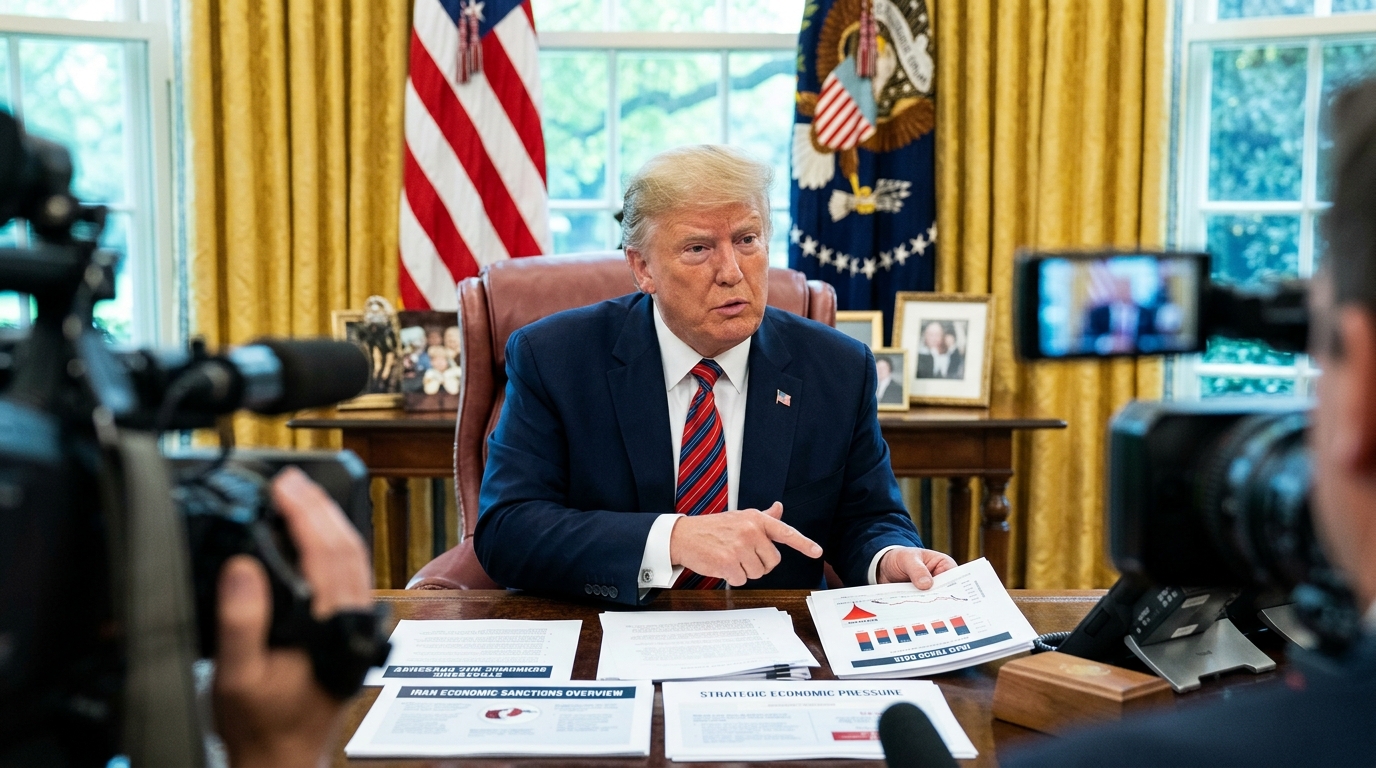
Trump Signals Shift Toward Economic Pressure on Iran Rather Than Immediate Military Action
The Great Asphyxiation: Inside Trump’s High-Stakes Pivot to Economic Warfare Against Iran
For weeks, the global media cycle was dominated by a singular, deafening countdown: Would the White House order an unprecedented military campaign to blast open the paralyzed Strait of Hormuz?
Just days after issuing fiery ultimatums and threatening to hit Tehran “really hard,” U.S. President Donald Trump has executed a sharp, calculated pivot that has left international observers and commodity markets scrambling to decode the shift. The new strategy? A calculated tactical retreat from immediate kinetic escalation, replaced by a cold, patient reliance on financial strangulation.
"We are low-keying it," Trump remarked in a striking pivot. Instead of preparing fresh waves of airstrikes, Washington is leaning back, watching inflation soar inside Iranian borders, and calculating that a crippled economy will achieve what cruise missiles alone cannot.
As indirect talks mediated through Oman stall over sweeping new demands from Tehran, the confrontation has transformed from a high-stakes military standoff into a grim war of attrition. Let’s investigate the realities of this economic chokehold, the current state of regional negotiations, and the probabilistic future of a global economy caught in the crossfire.
To understand the weight of this strategic shift, we must ground ourselves in the facts of the current geopolitical landscape as of August 2026.
From Kinetic Threats to Financial Watchtowers
Following months of military friction that began earlier this year, the U.S. naval blockade in and around the Persian Gulf has achieved a brutal objective: cutting off the lifeblood of the Iranian state's external commerce.
In a recent interview detailing the administration's new posture, President Trump highlighted the core metrics driving his decision to hold off on fresh military offensives:
- The Currency and Inflation Crisis: Washington is closely monitoring skyrocketing inflation inside Iran, noting that the regime is facing severe liquidity shortages.
- Troop Payment Strain: According to administration assessments, Tehran is struggling to maintain regular cash disbursements to its security apparatus and proxy forces.
- Stabilized Domestic Energy Pressures: Crucially for domestic political calculations ahead of the autumn midterm elections, global crude oil benchmarks have eased back to slightly above $75 a barrel—a far cry from the $118 peaks recorded earlier in the conflict.
Because American consumers are feeling considerably less pain at the pump, the White House enjoys newfound room to let economic gravity do the heavy lifting.
The Diplomatic Stalemate in Muscat
While Washington adopts a "low-key" economic posture, diplomatic channels have hit a major roadblock.
Indirect negotiations—mediated by regional partners like Oman, Qatar, and Pakistan to draft a 60-day interim agreement for the Strait of Hormuz—have stalled. Hopes for an immediate breakthrough faded after Tehran’s Supreme National Security Council, led by Mohammad Bagher Zolghadr, issued an expanded and uncompromising list of preconditions.
Among other stipulations, Iranian authorities demanded that the United States:
- Permanently end military hostilities against Iran and its regional allies in Lebanon, Gaza, Yemen, and Iraq.
- Terminate the naval blockade and withdraw all military forces stationed around Iran.
- Lift all economic sanctions, unfreeze billions in foreign assets, and provide financial compensation for war-related damages.
- Agree never to threaten or insult Iran diplomatically.
Washington has firmly rejected these sweeping pre-conditions, particularly any framework that involves granting Iran permanent oversight or a controversial 7% toll on international commercial vessels transiting the strait. Consequently, formal talks remain frozen, leaving the U.S. content to let economic pressure mount rather than rush into a compromise or a military escalation.
What's Next? Probabilities and Scenarios
As the White House tests whether financial asphyxiation can force a shift in Tehran without a new round of bombing runs, geopolitical strategists and market analysts are modeling several forward-looking scenarios.
Note: The following scenarios represent speculative market sentiment and analytical projections rather than guaranteed outcomes.
Scenario A: The Internal Pressure Threshold (Estimated Probability: ~45%)
- The Hypothesis: The combined weight of the U.S. naval blockade, hyperinflation, and frozen assets eventually fractures the internal stability of the regime, compelling Iranian leadership to moderate its demands and return to the negotiating table on Western terms.
- Market Sentiment: Energy and equity markets would likely react with a strong relief rally, pricing out lingering geopolitical risk premiums as shipping lanes through the Strait of Hormuz reopen unconditionally.
Scenario B: The Protracted War of Attrition (Estimated Probability: ~35%)
- The Hypothesis: Tehran proves resilient against economic isolation, absorbing the shock through black-market oil exports (primarily via clandestine ship-to-ship transfers) while keeping the Strait of Hormuz restricted. Washington maintains its "low-key" posture, refusing to launch new strikes while keeping the economic tourniquet tight.
- Market Sentiment: Commodities settle into a persistent, choppy plateau. Shipping companies adapt permanently to longer alternative routing, embedding a permanent baseline risk surcharge into global supply chains.
Scenario C: The Desperation Flare-Up (Estimated Probability: ~20%)
- The Hypothesis: Pushed into an economic corner with depleted funds and mounting domestic unrest, hardline elements within Tehran choose escalation over capitulation, launching asymmetric attacks against regional energy infrastructure or coalition shipping to break the financial blockade by force.
- Market Sentiment: Crude oil prices instantly erase their recent gains, spiking past previous highs and threatening a severe inflationary shock just as Western central banks attempt to stabilize domestic economies.
President Trump’s pivot toward economic pressure marks a critical tactical phase in the ongoing Middle Eastern crisis. By stepping back from the immediate precipice of major military strikes and betting on Iran's internal financial deterioration, Washington has transformed a fast-moving kinetic crisis into a slow-motion chess match.
As investors, journalists, and global citizens monitor the situation over the coming weeks, several vital indicators will dictate where the board moves next:
- Iranian Domestic Indicators: Watch for verified reports regarding internal labor strikes, currency stability, and civil unrest inside major Iranian urban centers.
- Omani Mediation Resumption: Monitor whether regional intermediaries can coax either Washington or Tehran into softening their mutually exclusive preliminary demands regarding the Strait of Hormuz.
- Crude Oil Price Stability: Track whether Brent and WTI benchmarks remain anchored near the $75 threshold or begin creeping upward in response to ongoing maritime uncertainties.
The chess game continues. Whether economic containment can succeed where military threats stalled will define the geopolitical ledger for the remainder of the year. Anadolu Ajansı