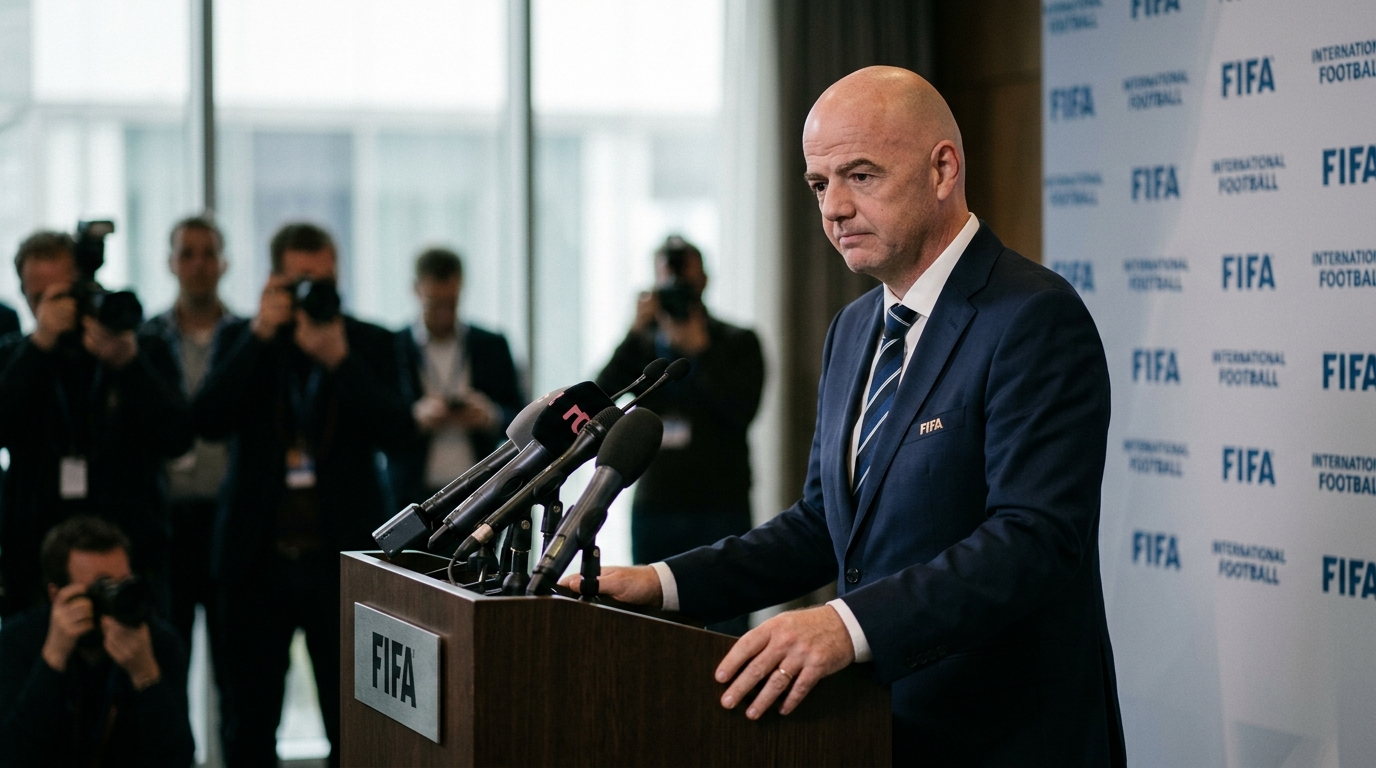
Category: Opinion & Analysis || Posted Aug 06, 2026
Is This the Final Whistle for Gianni Infantino at FIFA?
The world’s most popular sport is governed by a political machine more complex and far-reaching than the United Nations, and at its absolute center sits one man. When Gianni Infantino ascended to the presidency of the Fédération Internationale de Football Association (FIFA) in 2016, he inherited an empire in the ashes. Following the dramatic fallout of the Sepp Blatter era, the Swiss-Italian lawyer promised a new dawn of transparency, reform, and a strict adherence to ethical governance.
Fast forward to today, and the landscape of global football has been fundamentally transformed. Tournaments have expanded, revenue projections have shattered historical records, and power has been increasingly centralized in Zurich. Yet, beneath the glittering surface of multi-billion-dollar broadcast deals and sprawling global competitions, a tempest is brewing. Discontent is rumbling through the elite corridors of European football, governance watchdogs are raising alarms over systemic transparency, and recent crisis meetings suggest that the internal consensus may be fracturing.
With the 2027 FIFA presidential election approaching on the horizon, the global sports industry is buzzing with a singular, high-stakes question: Are we witnessing the beginning of the end for Gianni Infantino, or is he merely setting the stage to consolidate power for another decade? To understand where the world’s most lucrative sport is heading, we have to look past the pitch and examine the hard numbers, the statutory loopholes, and the geopolitical chess board that dictates the future of the beautiful game.
To accurately assess the current climate surrounding the FIFA presidency, one must separate the emotional discourse of global fandom from the cold, hard realities of the organization's governance, financial structure, and constitutional rules. The facts of Infantino's tenure paint a picture of aggressive commercial expansion matched by equally aggressive political maneuvering.
The Revenue Engine and the Power of the Vote
At its core, FIFA is a wealth-redistribution mechanism. Under Infantino’s leadership, the organization’s revenues have seen unprecedented growth. For the four-year cycle leading up to the 2026 World Cup, FIFA projected an income of $11 billion. Looking even further ahead to the 2027–2030 cycle, projections suggest the organization could generate a staggering $14 billion. Wikipedia+ 1
This financial boom is the ultimate shield for the incumbent president. Through the "FIFA Forward" development programme, roughly 20 percent of these funds (an estimated $2.7 billion in the upcoming cycle) is redistributed directly to national football associations. Infantino has essentially quadrupled grants to member associations since taking office.
Crucially, FIFA operates on a "one nation, one vote" system. In the FIFA Congress, the footballing juggernauts of Brazil, France, and Germany hold the exact same voting power as Papua New Guinea, Trinidad and Tobago, or San Marino. By ensuring a steady, increasing stream of development funds to the 211 member federations—particularly the 54 African nations and the 35 Central American and Caribbean nations—Infantino has built an incredibly robust political base. As long as the financial subsidies flow to the smaller nations, securing the necessary votes to maintain power becomes a matter of simple arithmetic.
The Expansion of the Calendar
Infantino’s strategy for revenue growth relies heavily on creating more inventory to sell. During his tenure, the number of FIFA-sanctioned competitions has exploded. The 2026 Men’s World Cup, co-hosted by the United States, Canada, and Mexico, will be the first to feature an expanded 48-team format. The Women’s World Cup was successfully expanded to 32 teams in 2023. Furthermore, FIFA has launched a newly expanded, 32-team FIFA Club World Cup, designed to capture a larger share of the lucrative club football market.
While these expansions create more matches, more broadcast rights, and more ticketing revenue, they have also become a primary source of friction. Elite leagues and player unions have consistently raised concerns regarding player welfare, fixture congestion, and the unilateral nature of FIFA’s calendar decisions.
The Term Limit Loophole
Perhaps the most critical factual development regarding Infantino’s longevity occurred in a boardroom, far from the public eye. Following the scandals of the early 2010s, FIFA statutes were reformed to limit a president to a maximum of three four-year terms (12 years total).
Infantino was first elected in February 2016 to complete the remaining 39 months of Sepp Blatter’s mandate. He was subsequently re-elected unopposed in 2019 and again in 2023. Mathematically, three terms would conclude in 2027. However, in December 2022, the FIFA Council officially ruled that Infantino’s initial 39 months in office did not count as a full term.
This ruling is monumental. It legally clears the path for Infantino to stand for re-election in 2027. Should he win, he would be permitted to remain in power until 2031, effectively granting him a 15-year reign despite the supposed 12-year reform limit.
The Friction and the Pushback
Despite his ironclad electoral position, Infantino’s presidency has been marked by intense controversies and public rebukes. His staunch defense of the 2022 World Cup host, Qatar, in the face of widespread scrutiny regarding human rights and migrant worker conditions, drew severe criticism from Western European nations. Infantino publicly accused Western critics of "hypocrisy," stating that Europe should spend the next 3,000 years apologizing for its own history before giving moral lessons.
More recently, internal turbulence has spilled into the public domain. Controversial commercial proposals—such as a reported plan to sell stakes in the World Cup through a subsidiary called "FIFA Forward Enterprise"—triggered a massive backlash. The Association of European Professional Football Leagues (including the Premier League and La Liga) labeled the proposal "dangerous," demanding immediate governance reform and an end to "unilaterally disruptive decisions".
The pressure reached a boiling point when UEFA reportedly threatened to boycott the World Cup if the commercial plans proceeded, forcing a crisis meeting where FIFA ultimately acknowledged mistakes and took the proposal off the table. Prominent figures, including Norwegian federation president Lise Klaveness and German FA president Bernd Neuendorf, have publicly refused to back Infantino, citing a lack of transparency. Even former allies, like Canadian Prime Minister Mark Carney, publicly stated a loss of confidence in the FIFA president following these governance failures.
As the global sports industry looks toward the 2027 FIFA Congress, analysts, market speculators, and football insiders are gaming out potential scenarios. While Infantino’s grip on the global voting bloc remains structurally dominant, the shifting political dynamics of world football suggest that the future is anything but predetermined. What follows is an analysis of potential outcomes based on current market trends and hypothetical shifts in the sporting landscape.
Scenario 1: The Unstoppable March to 2031
The Probability: High. The Outlook: In the most likely scenario, Infantino will leverage the immense financial power of the FIFA Forward program to secure a final term. If the 2026 World Cup in North America shatters revenue records as expected, the financial dividends paid out to the 211 member associations will make it politically toxic for federation presidents in developing football nations to vote against him.
In this outlook, the European rebellion remains loud but ultimately toothless. If UEFA and CONMEBOL (South America) fail to unite behind a single, highly credible challenger who can appeal to African and Asian voting blocs, Infantino will likely run unopposed, or easily defeat a symbolic challenger, coasting to a mandate that expires in 2031.
Scenario 2: The European Schism and a Credible Challenger
The Probability: Moderate. The Outlook: Industry analysts are closely monitoring the escalating tension between FIFA and the European club ecosystem. The recent crisis over the FFE commercial subsidiary proved that when pushed to the absolute brink, UEFA and the major domestic leagues possess the leverage to force FIFA into a retreat.
A potential scenario involves the major European and South American federations forming a hardline coalition ahead of 2027. If this coalition can weaponize the issue of fixture congestion—perhaps threatening to withhold elite players from expanded FIFA tournaments—they could disrupt Infantino’s revenue projections. Should they put forward a unifying candidate who promises to decentralize power and guarantee greater operational transparency, they might fracture Infantino's global coalition. If the major broadcast markets (primarily Europe and North America) signal to sponsors that they are unhappy with the current leadership, the commercial pressure could force a competitive, high-stakes election.
Scenario 3: Exogenous Shocks and Geopolitical Intervention
The Probability: Low, but highly disruptive. The Outlook: FIFA does not operate in a vacuum; it is deeply intertwined with global geopolitics. Market speculators note that the 2026 World Cup, hosted primarily by the United States, will place FIFA under unprecedented scrutiny from American legal and regulatory frameworks.
A potential wild-card scenario involves external, non-sporting pressures. Should further governance scandals emerge, or should investigations by external governmental bodies target FIFA's internal financial operations or commercial dealings, the landscape could shift overnight. Historically, sweeping changes at FIFA (such as the fall of Blatter) were precipitated not by internal voting, but by external legal interventions. While there is no current evidence to suggest this is imminent, the sheer scale of billions of dollars crossing international borders means that compliance, regulatory friction, and geopolitical shifts remain the ultimate unpredictable variables.
Is this the final whistle for Gianni Infantino? The structural mathematics of FIFA suggest the answer is no. With the legal pathway cleared to govern until 2031, a record-breaking financial war chest, and the unwavering support of the global majority who benefit from his wealth-redistribution policies, the incumbent president holds a formidable hand.
Yet, the foundations of that power are experiencing unprecedented stress. The recent European backlash over commercial control, combined with public votes of no-confidence from influential global figures, indicates that the era of ruling by uncontested acclamation may be over.
For the astute observer of the sports industry, the key variables to watch over the next 24 months are clear:
- The Commercial Success of 2026: Will the expanded 48-team World Cup deliver the projected billions required to keep the global federations loyal?
- The UEFA/ECA Alliance: Will European governing bodies and elite clubs move beyond releasing angry statements and actually present a viable alternative candidate for 2027?
- Sponsor Sentiment: Will blue-chip corporate partners demand greater governance reform as a condition for their continued billions?
Gianni Infantino has proven to be a master political survivor, adept at navigating the treacherous waters of global sports diplomacy. But as the sport grows ever larger, so too do the forces pulling at its seams. The road to 2027 is set to be the most consequential political contest in modern sports history—and the whole world will be watching.
2026 World Cup Scrutiny and FIFA's Defense This video breakdown explores the ongoing controversies surrounding the 2026 World Cup and analyzes the public statements made by FIFA's leadership in response to external scrutiny.