Category: Opinion & Analysis || Posted Aug 03, 2026
The Great Disconnect: Why the AI Supercycle Will Drive Above-Trend S&P 500 Earnings Despite Broad Market Strain
For over a century, equity markets have operated on a fundamental principle: when the broader economy slows, corporate earnings fall, and stock prices compress in tandem. It is the inescapable gravity of the business cycle. But what happens when the most capitalized companies in history collectively decide to rewrite the physical infrastructure of the internet—and spend over a trillion dollars to do it—regardless of whether consumers are tightening their belts?
We are witnessing the birth of the earnings supercycle anomaly.
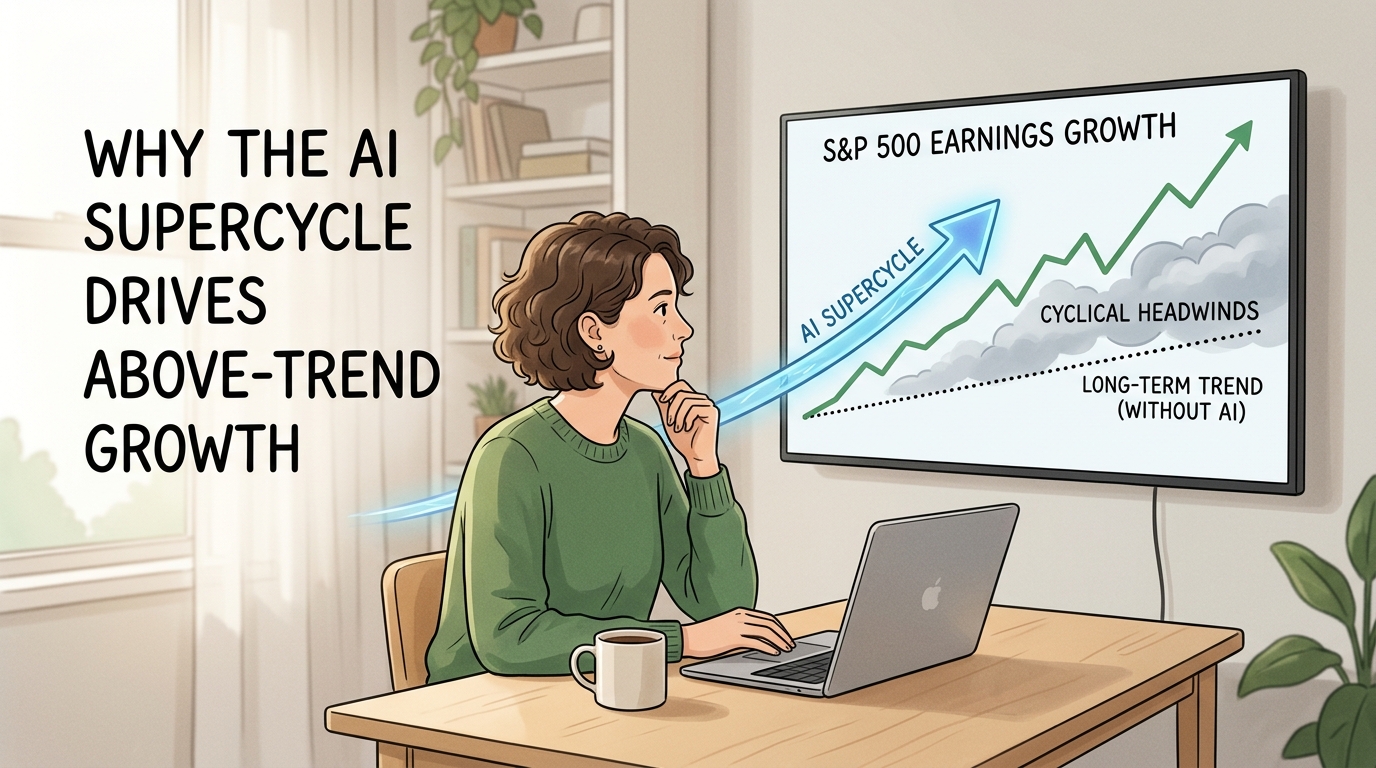
As we move deeper into 2026, a profound schism has opened up within the S&P 500. On the surface, the index is charging toward the 8000 mark, propelled by earnings growth not seen since the post-pandemic rebound. Yet beneath this headline euphoria lies a deeply divided market. We are no longer looking at a broad-based economic expansion. Instead, we are looking at a market forcibly dragged upward by a single, colossal theme: the Artificial Intelligence capital expenditure (capex) supercycle.
The gravity of the business cycle hasn't disappeared, but it is currently being overwhelmed by the sheer, brute-force spending of the technology hyperscalers. And for investors and analysts, understanding this dynamic is no longer optional—it is the only way to navigate the next decade of equity markets.
The Numbers Behind the Narrative
The reality of the current earnings environment is stark, and it is entirely bifurcated. Recent forecasts from Goldman Sachs Research have raised the S&P 500 year-end target to 8000, projecting a massive 24% annual growth in earnings per share (EPS) to $340 for 2026.
However, the source of this growth is highly concentrated. It is estimated that roughly half of all S&P 500 earnings growth in 2026 will be driven directly by the beneficiaries of AI infrastructure spending.
The primary engine of this growth is unprecedented capital expenditure by the "hyperscalers"—the massive cloud and technology companies (such as Alphabet, Meta, Amazon, and Microsoft) building out the physical backbone of AI.
- The Capex Surge: At the start of 2026, analysts anticipated hyperscaler capex growth of under 40%. The reality? Consensus estimates now project hyperscalers will spend a staggering $754 billion on capital expenditures this year—an 83% increase from 2025.
- The Beneficiaries: This capital is flowing directly into the balance sheets of the "AI physical layer". Semiconductor companies are the obvious winners, with major players reporting massive margin expansion and explosive earnings growth as they supply the vital compute power. But the wave is expanding into a broader industrial reality, boosting earnings for data-center operators, advanced cooling providers, and utility companies supplying the immense power required.
- The "K-Shaped" Strain: Conversely, the remaining 490-plus companies in the S&P 500 face a very different reality. Broad consumer spending is softening, input costs remain elevated, and the fiscal stimulus of previous years is fading. Companies lacking AI-related revenue streams or international exposure are struggling to maintain margins.
The Hyperscaler Dilemma
A fascinating paradox has emerged in 2026: the market is aggressively rewarding the recipients of AI capex (the chipmakers and infrastructure builders) while actively punishing the hyperscalers funding it.
As hyperscalers tap debt markets and dedicate near-total operating cash flows to fund data center buildouts, their stock valuations have faced compression, despite strong underlying earnings. The market is expressing skepticism about the near-term return on investment (ROI) for these massive AI models, questioning whether enterprise adoption will accelerate fast enough to justify the unprecedented capital outlay.
As we look toward 2027 and beyond, institutional analysts and market strategists are attempting to model how long this supercycle can defy broader macroeconomic gravity. The future hinges on whether the AI buildout transitions from a pure infrastructure phase into widespread, profitable enterprise adoption.
Scenario 1: The Productivity Payoff (The Bull Case)
In this scenario, the massive infrastructure investments begin to yield tangible productivity gains across the broader economy.
- Broadening Earnings: Enterprise adoption of AI tools accelerates, allowing companies outside the tech sector (from healthcare to logistics) to significantly reduce operational costs and improve margins. Goldman Sachs forecasts embed an expectation that AI productivity will begin boosting aggregate S&P 500 EPS, potentially adding 1.5 percentage points to growth by 2027.
- Sustained Capex: Hyperscalers successfully monetize their AI models, justifying their massive capital outlays and encouraging further, sustained investment into the physical infrastructure layer, keeping the supercycle alive into the late 2020s.
Scenario 2: The ROI Reckoning (The Bear Case)
The counter-narrative suggests that the current capex trajectory is unsustainable without a rapid acceleration in AI revenue generation.
- Capex Contraction: If enterprise adoption stalls or AI models fail to generate the necessary high-margin returns, hyperscalers may face immense shareholder pressure to curtail capital expenditures.
- The Bullwhip Effect: A sudden moderation in hyperscaler spending would trigger a massive contraction for the semiconductor and infrastructure companies currently driving S&P 500 earnings. Because these beneficiaries account for roughly half of the index's projected growth, a pullback would likely trigger a broad market correction, exacerbated by the underlying weakness in the traditional consumer economy.
Scenario 3: The Infrastructure Bottleneck (The Structural Constraint)
A third possibility focuses on physical limitations rather than financial ones. The market may discover that the ceiling on AI growth isn't capital, but atoms.
- Power and Cooling: The limiting factor for AI expansion may become the availability of grid power, advanced cooling systems, and specialized real estate for data centers. If power generation cannot scale to meet the demands of next-generation AI clusters, capex may be forced to slow down artificially, creating localized bottlenecks and shifting investment toward utilities and nuclear energy providers rather than pure silicon.
The US equity market is currently operating under a bifurcated reality. Headline S&P 500 earnings are masking significant underlying economic strain, propped up by a historic, concentrated capital expenditure supercycle driven by a handful of technology giants.
For investors navigating this landscape, the old rules of tracking aggregate consumer sentiment or broad manufacturing indices are insufficient. The variables that will dictate market performance over the next 18 months are highly specific:
- Hyperscaler Forward Guidance: Any deviation in planned capex spending by the major cloud providers is the single most critical metric for near-term S&P 500 stability.
- Enterprise AI Monetization: Watch corporate earnings calls outside the tech sector for concrete evidence of AI-driven margin expansion or cost reductions. The transition from "building the infrastructure" to "using the tools" must occur to sustain valuations.
- Industrial Constraint Indicators: Monitor constraints in the physical layer—specifically energy utility commentary, cooling system supply chains, and data center real estate acquisition.
The AI supercycle has the power to drive above-trend growth, but it is currently a narrow bridge. Whether the rest of the economy can cross that bridge before the hyperscalers run out of capital will define the next era of global markets.