Category: Market News & Trends || Posted Aug 04, 2026
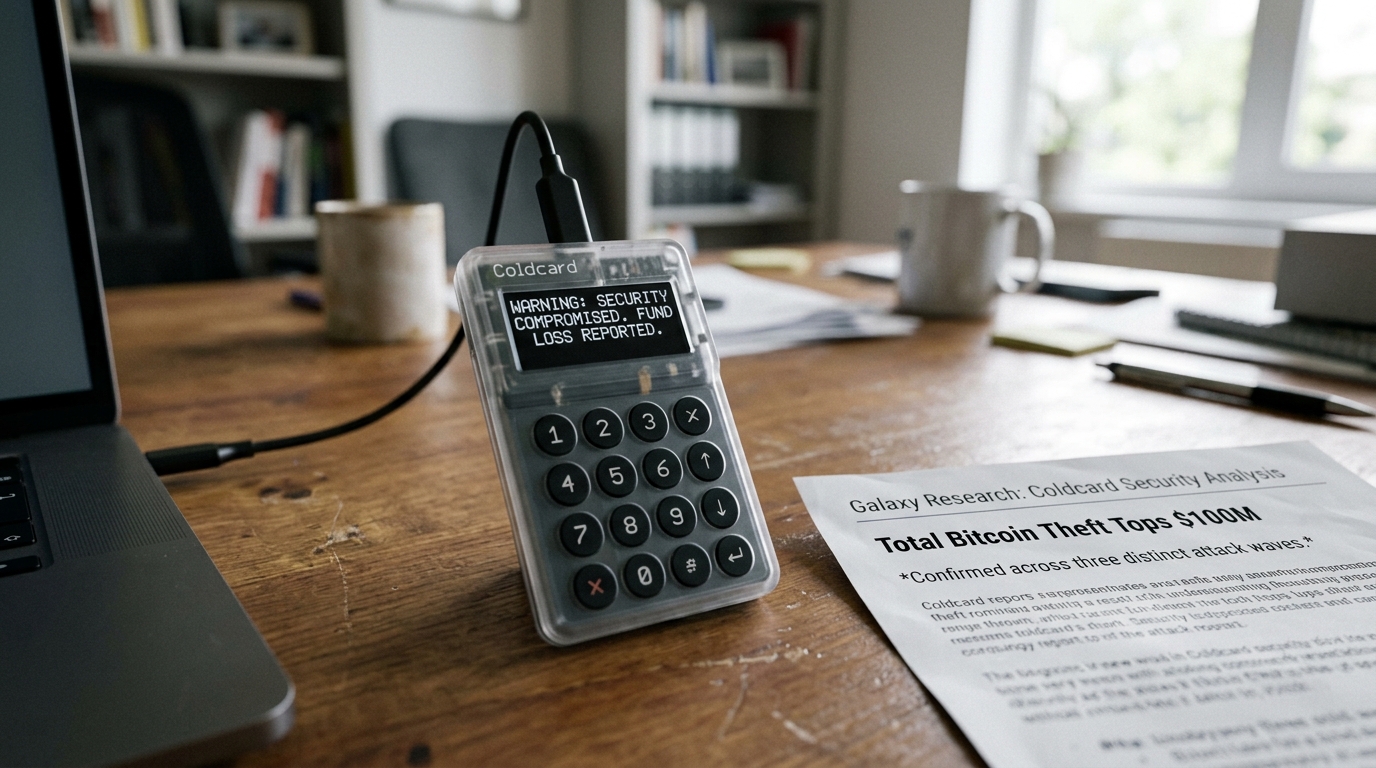
Coldcard Bitcoin Theft Tops $100M Across Three Confirmed Attack Waves, Galaxy Research Says
In the sovereign ethos of Bitcoin, one directive stands above all others: Not your keys, not your coins.
For years, high-net-worth holders, institutional treasuries, and privacy-focused cypherpunks entrusted their life savings to air-gapped hardware wallets. Among these, Coinkite’s Coldcard was long venerated as the gold standard—a device built specifically for the Bitcoin maximalist, designed to operate in total isolation from the digital grid, signing transactions via MicroSD cards or NFC without ever touching an internet-connected port.
Then, on July 30, 2026, the unthinkable happened.
Without a single physical device being stolen, without a single PIN code being coerced, and without a single seed phrase being phished, wallet balances across the globe began silently zeroing out. In a terrifying 41-minute window, over $70 million in Bitcoin vanished into the void. Within days, confirmed losses escalated past $100 million across three distinct attack waves, with on-chain security researchers identifying a looming fourth wave that could push total damages beyond $130 million.
What unravelled was not a conventional database breach, an exchange exit scam, or a social engineering scheme. It was a subterranean cryptographic flaw—a dormant seed generation vulnerability introduced half a decade prior—that turned the ultimate tool of financial self-sovereignty into a predictable, deterministic bank vault with a master skeleton key.
The Reality: Anatomy of a Cryptographic Landmine
To understand how over 7,300 Bitcoin addresses were systematically drained, one must look deep into the physics of cryptographic entropy.
"The Coldcard exploit is ongoing. Move Coldcard single-sig funds to safe locations immediately," warned Galaxy Research in a stark directive issued to the global Bitcoin community.
The Flaw in the Foundation: Deterministic Fallbacks
The incident stems from an underlying flaw in specific firmware builds released as far back as March 17, 2021. According to an analytical breakdown released by Block’s Bitcoin Engineering and Security team, the exploit targets the core mechanism used by the hardware wallet to generate new wallet seeds (master keys).
When functioning normally, a hardware wallet relies on a True Random Number Generator (TRNG)—a hardware element that pulls entropy from physical noise—to ensure that no two seed phrases generated on Earth could ever be identical. However, due to a severe firmware logic bug, the device under certain conditions bypassed its hardware-based TRNG. Instead of halting operation or alerting the user, the firmware silently defaulted to a deterministic Pseudo-Random Number Generator (PRNG) fallback.
Because the fallback algorithm lacked sufficient cryptographic entropy, the resulting "random" seed phrases were not random at all. They existed within a mathematically constrained key space. Once malicious actors mapped this constrained key space, they could pre-calculate the public addresses generated by those weak seeds offline, monitor the Bitcoin blockchain for incoming deposits, and construct sweep transactions using pre-computed private keys.
Chronology of Chaos: The Three Confirmed Waves
According to detailed forensic data compiled by Galaxy Research, the breach executed in distinct, highly organized phases, demonstrating an extraordinary degree of operational discipline and technical evolution.
Wave 1: The High-Value Harvest (July 30, 2026)
The attack opened with a high-speed blitzkrieg. Within 41 minutes, automated scripts targeted the highest-value addresses within the vulnerable key space. Wave 1 drained 1,082.65 BTC (approximately $70 million) across 1,195 addresses. The attacker funneled victim funds into four primary, shared collector addresses utilizing Pay-to-Witness-Public-Key-Hash (P2WPKH) output formats.
Wave 2: Lower-Hanging Fruit (July 31, 2026)
Roughly 27 hours after the initial wave, a second automated push targeted smaller wallets. Liquidating 1,478 addresses, Wave 2 extracted 76.16 BTC. Transaction patterns and derivation path combinations heavily matched Wave 1, leading researchers to conclude that Waves 1 and 2 were conducted by the exact same primary threat actor.
Wave 3: Operational Evolution (July 31 – August 1, 2026)
Wave 3 revealed a drastic mutation in attacker methodology. Sweeping 1,912 addresses for 208.24 BTC, the operation abandoned shared consolidation addresses entirely. Instead, the attacker routed funds into separate, isolated Pay-to-Witness-Script-Hash (P2WSH) vault addresses for each victim. Furthermore, while network mempools were clear and transaction fees were sitting below 3 sat/vB, the Wave 3 actor paid exorbitant fees up to 200 sat/vB to guarantee instant, un-jammable block inclusion.
Opportunistic Footprints & The Suspected Fourth Wave
Alongside the three major coordinated waves, Galaxy Research tracked 14 smaller attack "footprints," likely representing opportunistic third-party bots capitalizing on the public disclosure of the weak key space. In total, confirmed losses crossed 1,596 BTC ($100M+) across roughly 7,300 addresses. Galaxy has also identified a suspected fourth wave targeting an additional 459 BTC—which, if confirmed by affected victims, would elevate total damages to 2,055 BTC (~$130 million).
Quantitative Breakdown of the Exploit
| Attack Phase | Date Executed | Affected Addresses | BTC Stolen | Key Technical Characteristics |
| Wave 1 | July 30, 2026 | 1,195 addresses | 1,082.65 BTC | Targeted top-tier wallets; P2WPKH output consolidation; 41-min execution window. |
| Wave 2 | July 31, 2026 | 1,478 addresses | 76.16 BTC | Swept mid-tier wallets; shared derivation paths matching Wave 1. |
| Wave 3 | July 31 – Aug 1, 2026 | 1,912 addresses | 208.24 BTC | Shifted to individual P2WSH vault addresses; paid aggressive 200 sat/vB fees. |
| Opportunistic Footprints | Ongoing | ~2,700 addresses | ~228.95 BTC | Independent actors scanning publicly disclosed vulnerable entropy pools. |
| Suspected Wave 4 (Unconfirmed) | Pending Verification | Unconfirmed | 459 BTC | Medium-high confidence attacker activity; pending victim confirmation. |
| Confirmed Totals | July 30 – Aug 3, 2026 | ~7,300 addresses | 1,596+ BTC ($100M+) | 90% of stolen funds remain unspent in monitored vault addresses. |
The Silent Vaults: On-Chain Discipline
One of the most striking aspects of the breach is the attacker’s cold operational discipline. According to Galaxy Research, over 90% of the stolen Bitcoin remains entirely unmoved across the destination addresses. Rather than rushing to deposit coins into decentralized mixers or privacy protocols—where liquidity limits could cause slip-ups—the threat actors are holding the funds static in on-chain vaults.
In response, Galaxy, Block, and partner cybersecurity firms have submitted hundreds of identified attacker addresses to U.S. federal law enforcement, chain-analysis providers, and global exchange compliance desks to freeze any potential off-ramp attempts.
The Horizon: Hardening Self-Custody and the Future of Cold Storage
The $100 million Coldcard exploit marks a major psychological turning point for the cryptocurrency industry. For years, the security narrative focused almost exclusively on protecting users from external phishing, malicious smart contracts, and compromised hot wallets. The revelation that air-gapped, open-source hardware could generate deterministic seeds fundamentally alters the risk landscape.
Industry analysts, cryptographic engineers, and institutional custodians are evaluating several potential scenarios for how the hardware security sector will react in the months ahead.
Scenario 1: The Multi-Vendor Multisig Standard (Best-Case Trajectory)
Industry researchers are watching to see if this incident permanently dismantles the industry's reliance on "single-signature" hardware setups.
- The Dual-Entropy Mandate: Hardware wallet manufacturers may quickly institute mandatory multi-source entropy models. In this potential outcome, devices would refuse to generate a seed phrase unless hardware TRNG is blended with user-generated physical entropy—such as rolling physical dice directly on the device interface before key creation.
- Multi-Vendor Security Schemes: Security experts are advocating that high-value funds should never reside on a single hardware manufacturer's firmware. A potential consensus best-practice involves establishing 2-of-3 multisig vaults where keys are generated across entirely separate hardware vendors (e.g., combining Coldcard, Trezor, and BitBox). In this scenario, even if one vendor suffers a catastrophic firmware RNG failure, an attacker cannot construct a valid transaction without compromising an entirely different code base.
Scenario 2: Automated Scanners and Cascading Sweeps (Worst-Case Trajectory)
The immediate risk facing the Bitcoin ecosystem is the democratization of the exploit.
- The Copycat Threat: Because the mathematics of weak PRNG fallbacks can be analyzed on-chain, open-source security tools designed to help victims audit their wallets can also be weaponized by rogue actors. One potential scenario is that automated global scanning bots will continuously crawl the entire history of the Bitcoin blockchain to identify un-migrated funds sitting in weak-entropy addresses.
- Suspected Wave 4 Materialization: If the unconfirmed fourth wave identified by Galaxy Research materializes, total stolen assets could rapidly surpass 2,055 BTC ($130M+). For non-technical or long-term "buy-and-hold" investors who keep their hardware devices tucked away in bank vaults or physical safes without actively monitoring crypto news, their funds remain at acute, continuous risk until manual migration occurs.
Scenario 3: The Formal Verification Mandate (Architectural Trend)
Looking further ahead, the exploit will likely accelerate a fundamental shift in how open-source cryptographic firmware is audited and verified.
- Beyond Code Audits: Traditional human code reviews have proven insufficient to catch deep mathematical logic bugs that only trigger under rare hardware exception states.
- Mathematical Formal Verification: The industry is speculating that future top-tier hardware wallets will require mathematically proven mathematical specs (Formal Verification), alongside reproducible air-gapped firmware builds where the binary code running on the physical microcontrollers can be independently audited against the source code at every single boot cycle.
The Takeaway: Operational Lessons from the $100M Breach
The Coldcard disaster demonstrates that security is not a static state, but a continuous operational discipline. While hardware wallets remain vastly superior to holding assets on centralized exchanges or hot software applications, absolute reliance on any single hardware device introduces a single point of failure.
To insulate capital against potential single-vendor firmware vulnerabilities, market participants and security researchers emphasize three key operational variables to monitor moving forward:
- 1. Active Migration of Single-Sig Funds: Anyone who generated a Coldcard seed phrase on single-sig setups following the March 2021 firmware release must evaluate their exposure immediately and consider migrating funds to a clean, newly generated seed or a multi-signature setup.
- 2. Adoption of User-Generated Entropy: Relying solely on algorithmic randomness—regardless of how reputable the device manufacturer is—carries inherent risk. Utilizing physical dice rolls to generate or verify entropy during wallet creation eliminates algorithmic PRNG fallbacks entirely.
- 3. Architectural Diversification via Multisig: Distributing threshold keys across different hardware manufacturers, operating systems, and physical locations ensures that no single software bug, firmware flaw, or supply-chain compromise can single-handedly drain a vault.
As law enforcement agencies and chain-analysis firms trace the $100 million in unmoved attacker vaults, the digital asset community faces a critical moment of maturity. The lesson of August 2026 is clear: true self-custody requires not just air-gapped hardware, but mathematical redundancy that leaves zero room for single points of failure.
Editorial & Legal Disclaimer: This article is written strictly for educational, informational, and investigative journalism purposes. It does not constitute financial, legal, or professional cybersecurity advice. Cryptocurrency self-custody and hardware wallet management carry inherent technical risks. Readers should perform independent research and consult certified security professionals before undertaking major fund migrations or structural wallet reconfigurations.