Category: Global politics || Posted Aug 03, 2026
Beyond the Ballot: Dissecting the Fault Lines Between Social Democracy and Democratic Socialism
To the casual political observer scrolling through modern headlines, they sound interchangeable. Mention either term in a cable news debate, and you are likely to trigger an immediate chorus of approval from the political left or warnings of impending economic ruin from the right. Yet, beneath their nearly identical sounding names lies a profound, decades-old ideological fault line.
Is the ultimate goal to humanize capitalism with a robust safety net, or is it to dismantle the market system entirely through democratic means?
As global economic inequality widens, public debt mounts, and debates over the future of work and welfare dominate international discourse, understanding the distinct mechanics of Social Democracy and Democratic Socialism is no longer just an academic exercise. It is the core framework shaping modern political battles from Scandinavia to the Americas. Let’s pull back the curtain on these two titans of modern political thought, examine how they operate in the real world, and explore where the global economy might be heading next.
To understand the core divergence between these two ideologies, one must look past the shared emphasis on democratic elections, civil liberties, and public welfare. The true difference comes down to a single, fundamental question: What do you do with capitalism?
Social Democracy: Taming the Market Beast
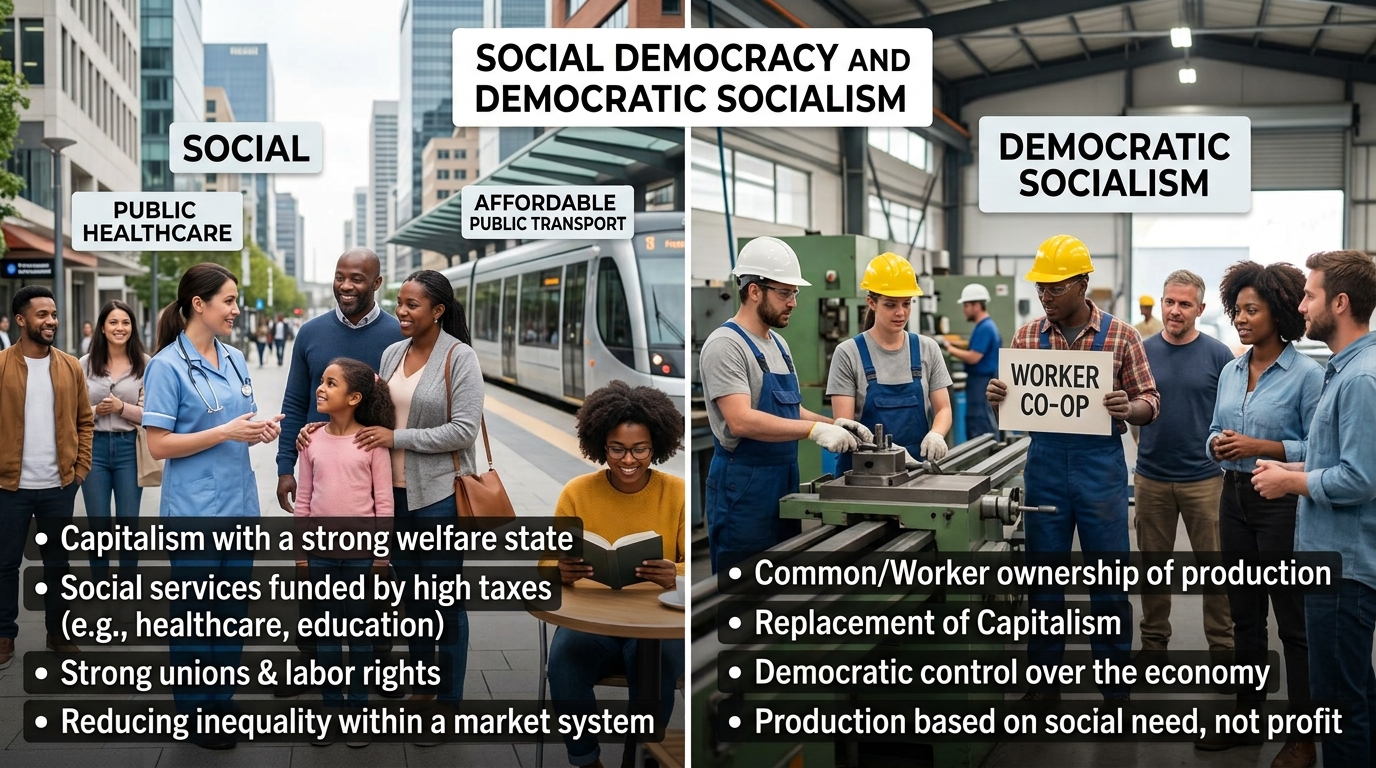
Social Democracy accepts the basic framework of a capitalist market economy, including private property, corporate enterprise, and entrepreneurial competition. However, social democrats argue that unbridled free markets naturally produce unacceptable levels of wealth inequality, economic insecurity, and social neglect.
The solution? Do not destroy the market; harness it.
Under a social democratic model—largely epitomized by the Nordic model seen in countries like Sweden, Denmark, and Norway—the state levies progressive taxes on private wealth and corporate profits. These revenues are then recycled into an expansive public safety net: universal healthcare, heavily subsidized or free higher education, robust unemployment insurance, and expansive parental leave.
- The Economic Engine: Private ownership and market forces.
- The State’s Role: Heavy regulation, labor protection, and wealth redistribution via public services.
- Core Philosophy: Capitalism is a powerful wealth-generating engine, but it requires a conscientious driver and a strong set of guardrails.
Democratic Socialism: Replacing the Engine
Democratic Socialism, by contrast, views capitalism itself as inherently exploitative and structurally incompatible with true human liberation and democracy. While traditional 20th-century socialism was often imposed via violent, authoritarian revolutions (such as in the Soviet Union), democratic socialists insist that the transition away from capitalism must happen through peaceful, democratic processes.
Instead of merely taxing corporate profits to fund social programs, democratic socialists advocate for the systemic transformation of the economy. This means shifting the "means of production"—major industries, utilities, financial institutions, and large-scale enterprises—away from private shareholders and into public, cooperative, or worker-owned structures.
- The Economic Engine: Social, public, or cooperative ownership.
- The State’s Role: Democratic management of core economic production to serve public need rather than private profit.
- Core Philosophy: True democracy cannot exist alongside deep economic inequality; political freedom requires economic democracy.
| Comparative Metric | Social Democracy | Democratic Socialism |
| View of Capitalism | Reformable; a useful tool to generate wealth if heavily regulated. | Unreformable and exploitative; must be systematically replaced. |
| Means of Production | Primarily private ownership with strong state oversight. | Public, cooperative, or collective ownership. |
| Primary Goal | High standard of living, low inequality, and universal welfare via taxation. | Abolition of class divides through collective economic control. |
| Real-World Examples | Nordic countries (Sweden, Denmark). | No pure national examples, though heavily influenced policy debates in modern left-wing political parties. |
[The Horizon: What’s Next for the Left-Economic Spectrum?]
As global economies navigate post-pandemic recovery, skyrocketing housing costs, and the disruptive arrival of automation and artificial intelligence, both economic philosophies are facing new pressures. Looking ahead, industry analysts and political scientists are tracking several major trend-driven outcomes and speculative scenarios:
1. The Pragmatic Convergence ("The Hybrid Shift")
- The Scenario: In mainstream political discourse, the distinction between the two models often blurs. Pragmatic political movements frequently borrow rhetoric from democratic socialism (such as calls to dismantle corporate monopolies) while implementing actual policies rooted in social democracy (such as universal childcare or stronger antitrust regulations).
- Market Implications: Private corporations face increased regulatory scrutiny, higher corporate tax floors, and mandatory worker representation on boards, without facing outright nationalization.
- Probability: High. Practical governance constraints in advanced market economies make wholesale systemic replacement difficult, leading reformers to lean toward aggressive regulatory social democracy.
2. The Rise of Workplace Democracy and Co-Ops
- The Scenario: Driven by growing worker discontent and the gig-economy squeeze, policy experiments around cooperative ownership, employee stock ownership plans (ESOPs), and codetermination laws gain legislative traction.
- Market Implications: Capital markets experience a slow evolution toward hybrid corporate structures where labor holds structural voting power alongside traditional institutional investors.
- Probability: Moderate. While full democratic socialist ownership remains rare, incremental models of worker-inclusive governance are actively being explored in various regional jurisdictions.
3. The Fiscal Strain and Austerity Backlash
- The Scenario: As aging populations place unprecedented stress on public health and pension budgets, social democratic welfare states face severe fiscal gravity. This forces a choice between massive tax increases on the middle class or structural retrenchment.
- Market Implications: Increased sovereign bond yields, intense political polarization over taxation thresholds, and recurring debates over private-public delivery models in healthcare and education.
- Probability: High. Demographic realities dictate that maintaining high-tax, high-service social democratic models will require continuous structural adaptation.
The debate between social democracy and democratic socialism touches on the most fundamental questions of how society should organize itself. Whether one views the future through the lens of reforming capitalism or replacing it entirely, both ideologies share a common historical DNA: the conviction that runaway market capitalism left to its own devices fails the broader public good.
As readers and observers of global economic trends, tracking how political systems balance individual enterprise with collective welfare will define the next chapter of modern governance.
Social Democracy and Democratic Socialism Explained EASY
This video provides a concise breakdown of how social democracy operates within a capitalist framework compared to democratic socialist goals.