Category: Security & Regulation || Posted Jul 31, 2026
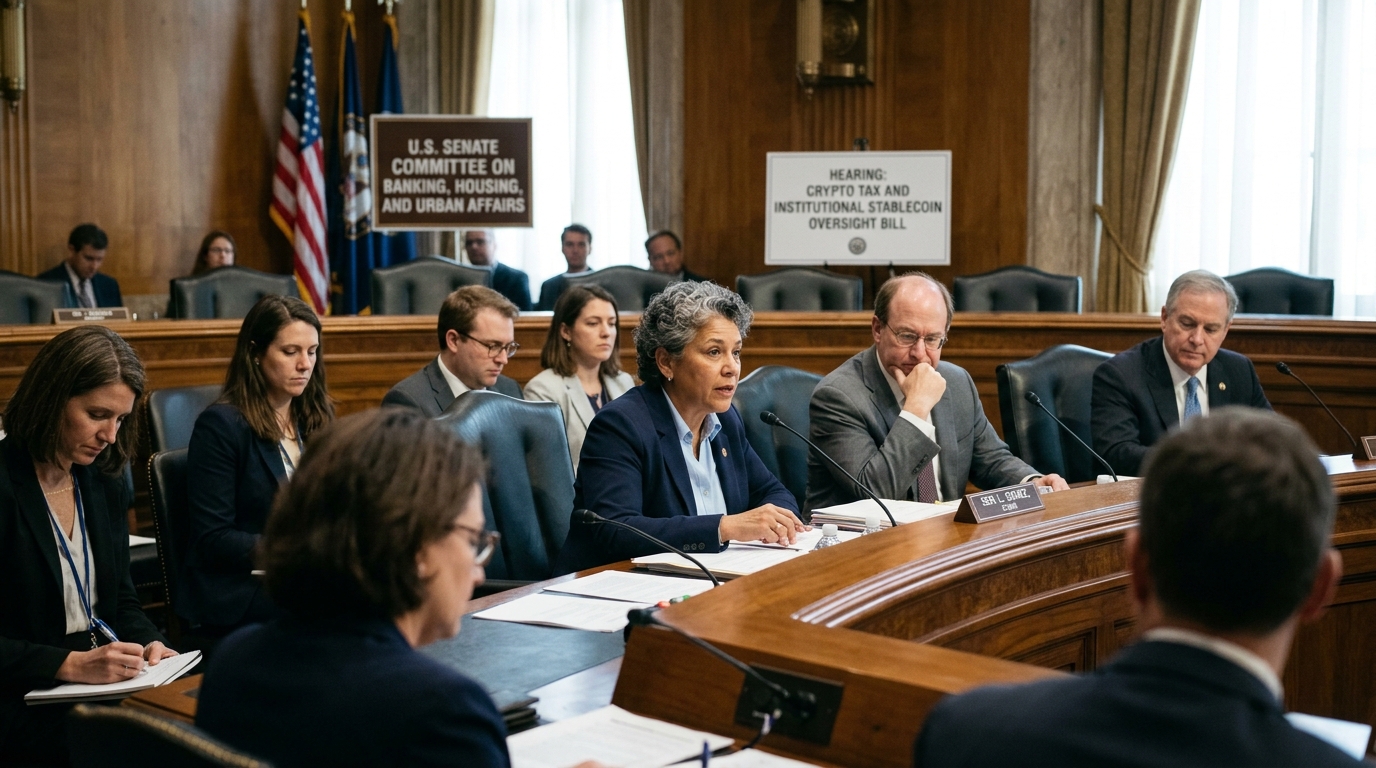
U.S. Senate Committee Advances Updated Crypto Tax and Institutional Stablecoin Oversight Bill
Inside the marble corridors of the Dirksen Senate Office Building, a multi-trillion-dollar battle over the future of global money is reaching a historic crescendo.
For over a decade, digital assets existed in a regulatory borderland—a high-volatility frontier governed by enforcement actions, administrative warnings, and patchwork legal interpretations rather than statutory certainty. But as Capitol Hill grapples with the updated text of the Digital Asset Market Clarity (CLARITY) Act, the debate has shifted from abstract theories about blockchain mechanics to an intense, zero-sum tug-of-war between legacy financial institutions and the emerging digital asset economy.
At the center of this legislative duel is a fundamental question: Who gets to issue, custody, and earn yield on the digital dollars of the 21st century?
With the Senate Banking Committee having advanced the legislation to the Senate Legislative Calendar, lawmakers are attempting to enact the most sweeping federal framework for digital assets in United States history. From defining explicit jurisdictional boundaries between the Commodity Futures Trading Commission (CFTC) and the Securities and Exchange Commission (SEC), to imposing Bank Secrecy Act (BSA) compliance on digital service providers and restricting bank-like stablecoin yields, the bill represents a structural re-architecting of American financial infrastructure.
As lobbying teams from major banking associations, global technology firms, and crypto treasuries descend on Washington, the market stands at a critical juncture. Will this landmark legislation build a permanent bridge between traditional finance and Web3, or will fierce disputes over yield restrictions and national security safeguards stall the bill on the Senate floor?
[The Reality]
To understand the magnitude of the current moment, one must examine the legislative trail that brought the CLARITY Act to the threshold of full Senate consideration.
In May 2026, the Senate Banking Committee voted 15–9 to approve a comprehensive substitute version of the Digital Asset Market CLARITY Act. Committee Chairman Tim Scott (R-SC) assembled a bipartisan majority, combining committee Republicans with key Democratic support from Senators Angela Alsobrooks (D-MD) and Ruben Gallego (D-AZ). By June 2026, the bill was formally placed on the Senate Legislative Calendar under General Orders (Calendar No. 423), marking a major milestone toward potential floor debate.
In late July 2026, Senate leadership published an updated consolidated text that merged provisions from both the Senate Banking Committee and the Senate Agriculture Committee. This updated draft clarifies regulator jurisdiction, strengthens anti-money laundering tools, and sets formal reporting expectations for institutional market participants.
1. Drawing Jurisdictional Lines: SEC vs. CFTC
A primary objective of the CLARITY Act is eliminating "regulation by enforcement" by establishing statutory definitions for digital asset classifications:
- CFTC Authority over Spot Commodities: The Commodity Futures Trading Commission receives explicit regulatory authority over spot digital commodity markets. The bill expands CFTC registration frameworks to include digital commodity brokers, digital commodity dealers, digital commodity exchanges, and digital commodity pool operators.
- SEC Authority over Securities: The Securities and Exchange Commission retains jurisdiction over digital asset securities, equity-like primary capital raises, and non-decentralized tokens.
- Decentralization Tests: The bill creates formal statutory safe harbors to determine when a digital network has achieved sufficient decentralization. Once a network meets predefined metrics regarding token distribution and governance independence, the asset transitions from SEC security oversight to CFTC commodity oversight.
2. The Yield Compromise: Tillis-Alsobrooks vs. The Banking Lobby
The most intensely lobbied feature of the updated legislation centers on institutional payment stablecoins.
Under compromise language introduced by Senators Thom Tillis (R-NC) and Angela Alsobrooks (D-MD), payment stablecoin issuers and digital asset service providers are prohibited from directly or indirectly paying passive interest or yield on stablecoin balances that are "economically or functionally equivalent" to interest-bearing bank deposits.
However, the bill explicitly permits activity-based and usage-driven incentives. Digital asset platforms may reward users for active trading volume, transaction volume, or network validation (staking).
| Core Issue | Regulatory Framework in Updated Text | Key Industry Stance |
| Passive Yield on Stablecoins | Strictly Banned. Issuers cannot offer deposit-like passive interest. | Traditional Banks: Support ban; worry third-party loopholes could still cause deposit flight. |
| Activity-Based Rewards | Permitted. Platforms can reward users for trading volume, staking, or app usage. | Web3 / Fintech: Welcome usage rewards; argue passive yield bans protect bank monopolies. |
| Broker BSA Compliance | Full Application. DASPs must perform KYC, SAR reporting, and sanction screening. | Privacy Advocates: Concerned over broad DASP definitions for non-custodial developers. |
Major banking trade groups—including the Bank Policy Institute (BPI), the American Bankers Association (ABA), and the Independent Community Bankers of America (ICBA)—continue to express strong reservations. They argue that if stablecoin issuers utilize third-party affiliates or synthetic structures to distribute yield, massive capital could flow out of traditional bank deposits, threatening commercial and mortgage lending across local communities. Conversely, digital asset advocates argue that banning yield altogether deprives consumers of productive return structures and insulates traditional banks from market competition.
3. National Security, BSA Parity, and Tax Reporting Infrastructure
To address national security and illicit finance concerns, the updated Senate draft installs rigorous anti-money laundering (AML) and compliance infrastructure:
- Bank Secrecy Act (BSA) Applicability: Digital Asset Service Providers (DASPs), brokers, and institutional custodians must implement formal Customer Identification Programs (CIP), file Suspicious Activity Reports (SARs), and comply with Office of Foreign Assets Control (OFAC) sanctions rules.
- Special Measure 6 Powers: The bill grants the U.S. Department of the Treasury "Special Measure 6" authority, enabling swift administrative action against foreign entities, mixing services, or transaction mechanisms determined to pose primary money laundering risks.
- Kiosk Oversight: Operators of digital asset kiosks (crypto ATMs) must adhere to mandatory identity checks, fraud warnings, withdrawal limits, and real-time transaction monitoring.
- Tax and Cost-Basis Reporting: The text incorporates transactional data-matching requirements for digital asset brokers to align reporting standards with Internal Revenue Service (IRS) expectations, giving institutional asset managers clear cost-basis rules for corporate treasuries and spot digital commodity holdings.
[The Horizon]
As the CLARITY Act sits on the Senate Legislative Calendar, economists, legal scholars, and market strategists are analyzing three primary forward-looking scenarios for how this regulatory shift could unfold over the coming years.
Scenario A: The Institutional Floodgate (Best-Case Probability)
Industry analysts speculate that if the CLARITY Act achieves the 60 votes required for Senate passage and is signed into law, it could remove the primary structural barriers preventing institutional capital allocation.
In this theoretical scenario:
- Corporate Treasury Allocation: Fortune 500 corporations and global treasuries, previously constrained by regulatory uncertainty, could begin holding regulated payment stablecoins and CFTC-classified digital commodities directly on their balance sheets.
- Tier-1 Bank Integration: Established commercial banks could launch native digital asset custody and payment clearing channels under explicit Federal Reserve and OCC frameworks.
- Payment Velocity Acceleration: Banning passive deposit yield while authorizing usage-driven rewards could force stablecoin issuers to compete on settlement speed, zero-fee transaction rails, and global cross-border efficiency.
Scenario B: Senate Gridlock and "Crypto Purgatory" (Status Quo / Delay Probability)
Policy observers caution that calendar congestion and election-year political dynamics make legislative delay through late 2026 a distinct possibility. With mandatory defense spending, government funding bills, and surveillance legislation competing for limited floor time, Senate leadership may struggle to schedule extended debate on crypto market structure.
In this prospective scenario:
- Banking Lobby Stalemate: Intensive lobbying by traditional banking groups could prevent a unified 60-vote cloture coalition, leaving the bill stuck in procedural holds.
- ETF Dominance, Native Stagnation: Investors would continue accessing digital assets through approved spot ETFs and ETPs, while native Web3 software deployment within the U.S. remains under administrative oversight.
- Offshore Capital Migration: Capital, developer activity, and institutional issuance could increasingly shift toward international jurisdictions operating under established legal frameworks, such as the European Union's MiCA regulation.
Scenario C: Regulatory Fragmentation and Protocol Bifurcation (Worst-Case Scenario)
Market strategists highlight a third scenario in which expansive compliance mandates create structural friction across decentralized protocols:
- DeFi Compliance Challenges: If Bank Secrecy Act obligations are applied broadly to non-custodial software developers or protocol interfaces without clear safe harbors, open-source projects may restrict access for U.S.-based IP addresses.
- Two-Tiered Liquidity: The market could split into permissioned, KYC-compliant institutional pools governed by federal oversight, and offshore, permissionless liquidity pools operating outside American jurisdiction.
- Ongoing Banking Conflicts: Disputes over third-party stablecoin yield arrangements could trigger prolonged litigation between fintech platforms and banking associations, slowing institutional payment deployments.
[The Takeaway]
The advancement of the updated CLARITY Act represents a historic shift in American monetary and financial policy. Digital assets have evolved from an experimental technological niche into a central consideration of international banking, tax compliance, and national security policy.
As lawmakers work through competing industry interests, four key policy metrics will determine the legislative trajectory:
- The 60-Vote Math: Monitoring whether Senate leadership can maintain a bipartisan coalition to overcome procedural floor votes.
- Stablecoin Yield Refinements: Watching for potential legislative adjustments regarding third-party stablecoin rewards to address banking sector concerns.
- House-Senate Reconciliation: Observing how the Senate text is reconciled with the previously passed House market structure bill.
- Treasury & IRS Implementation Rules: Following draft rulemaking from FinCEN and the IRS regarding DASP broker definitions and institutional reporting standards.
Regardless of whether the CLARITY Act reaches the President's desk in 2026 or undergoes further revision, the line separating traditional finance from digital asset infrastructure has been permanently redrawn.
Editorial Disclaimer: This article is strictly for informational, educational, and analytical purposes. It does not constitute financial, legal, tax, or investment advice. Market predictions, legislative scenarios, and hypothetical outcomes represent qualitative policy analysis, not guaranteed future results. Readers should conduct independent research and consult qualified financial and legal advisors before making investment or operational decisions.