Category: Market News & Trends || Posted Aug 02, 2026
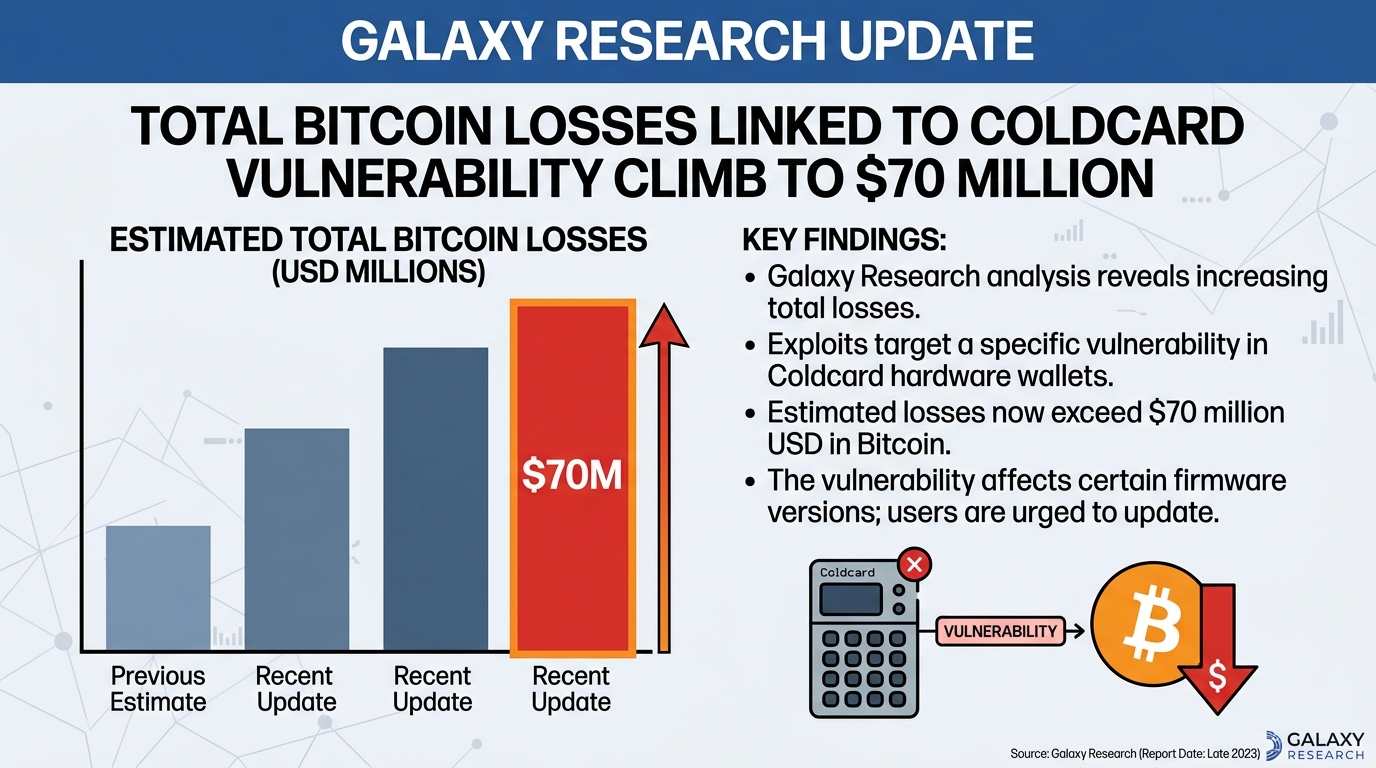
Galaxy Research Reveals Total Bitcoin Losses Linked to Coldcard Hardware Vulnerability Have Climbed to $70 Million
In the shadowy plumbing of the blockchain, a 41-minute window can alter history.
Between 1:10 AM and 1:51 AM UTC on July 30, an invisible operator systematically vacuumed 1,082.65 Bitcoin—valued at approximately $70.2 million at the time—across 1,196 distinct addresses. There were no phishing lures, no compromised exchange logins, and no frantic approvals of malicious smart contracts. Instead, the victims were individuals who had followed the ultimate gospel of cryptocurrency: they trusted cold, offline hardware storage.
When Galaxy Research published its comprehensive on-chain mapping of the incident, it confirmed a chilling reality. The breach was not a generic web-layer exploit, but a structural fracture at the absolute foundation of digital sovereignty. It targeted the Coldcard hardware wallet—a device manufactured by Coinkite and universally revered as a gold standard for Bitcoin-only security.
As the crypto world reels from the revelations, the incident has ignited urgent industry-wide debates about entropy, supply chain integrity, and the terrifying math of pseudo-random number generation.
The Reality: Unraveling the Firmware Flaw and the $70 Million Sweep
To understand how a hardware vault could be bypassed, one must look deep into the firmware architecture. According to technical post-mortems and disclosures from security analysts and Coinkite leadership, the root cause traces back to a March 2021 firmware integration error.
The Mechanics of the Flaw
The vulnerability centered on how the device generated cryptographic seed phrases. Under normal operating parameters, a hardware wallet relies on a physical hardware random number generator (RNG)—specifically integrated within the STM32 chip architecture—to ensure absolute unpredictability.
However, due to a production configuration error (MICROPY_HW_ENABLE_RNG being defined as zero because Coinkite supplied its own custom hardware-RNG wrapper), a library check misfired. Instead of pulling true physical entropy, the build defaulted to MicroPython’s Yasmarang pseudorandom number generator (PRNG) software fallback.
- The Entropy Deficit: This software fallback was initialized using the chip's unique ID (UID) and internal timer registers, collecting zero fresh entropy after initialization.
- The Mathematical Weakness: Coinkite estimated that this reduced the effective entropy pool to roughly 40 bits on the Mk3 model and about 72 bits on the Mk4, Mk5, and Q models—vastly inferior to the standard 128 bits of security required for a 12-word BIP-39 seed.
With sufficient constraints on device UIDs, boot timing, and prior RNG-call history, an advanced attacker could reproduce candidate output streams offline without ever touching the physical device, deriving public addresses and matching them against the blockchain.
The On-Chain Fingerprint
Galaxy Research’s mapping revealed the sheer scale and clinical precision of the exploit. The stolen funds were swept across blocks 960,183 to 960,191. Analysts noted a distinct transactional signature: every sweep featured an identical fee rate of 30 satoshis per virtual byte (sat/vB) with zero change outputs.
While Coinkite rushed emergency firmware patches out across all affected model lines (including Mk3 versions 4.0.1 through 4.1.9, Mk4/Mk5 builds prior to 5.6.0, and Q models prior to 1.5.0Q), developers issued a sobering clarification: installing a software update does not repair an already compromised seed. Because the vulnerability occurred at the moment of creation, any wallet initialized on vulnerable firmware carries the systemic weakness permanently, forcing manufacturers to urge complete asset migration to newly generated seeds.
The Horizon: What’s Next for Hardware Security and Self-Custody?
The Coldcard incident has sent shockwaves through the cybersecurity and digital asset landscapes. As developers, manufacturers, and institutional custodians scramble to audit existing paradigms, several potential future scenarios and industry shifts are coming into focus.
1. The Era of Mandatory Open-Source Hardware Auditing
- The Trend: In the wake of the disclosure, market sentiment is rapidly pivoting toward extreme verification. While hardware wallets have long marketed themselves as "trustless," the industry is recognizing that closed-source or partially verified compilation toolchains represent a critical vector of failure.
- Potential Outcomes: Industry analysts are watching to see if hardware manufacturers will transition entirely to deterministic, reproducible builds verified by independent third-party cryptographic auditing firms. The market may begin heavily penalizing brands that fail to subject their random number generation pathways to continuous, automated formal verification.
2. Multi-Vendor Quorums and Hardware Diversity
- The Trend: Many advanced Bitcoin holders rely on multisignature setups to eliminate single points of failure. However, if a user builds a multisig quorum exclusively using devices from a single manufacturer sharing a common codebase, a single firmware bug can compromise the entire security model.
- Potential Outcomes: A likely trend is the acceleration of heterogeneous multisig architectures—where users deliberately mix hardware devices across entirely different manufacturers (e.g., combining different independent codebases) so that a flaw in one vendor's RNG implementation cannot compromise the vault's overarching quorum.
3. The Re-Emphasizing of Physical Entropy (Dice Rolls)
- The Trend: Coinkite explicitly noted that seeds generated using at least 50 fair, independent, private physical dice rolls remain secure against this specific firmware bug, because external entropy bypasses the device's internal random number generator entirely.
- Potential Outcomes: We may see a cultural renaissance in old-school security practices. The reliance on push-button automated seed generation may take a backseat as privacy-conscious users return to manual dice-rolling protocols as a mandatory baseline for high-net-worth cold storage.
The Takeaway: Vigilance in the Age of Code Complexity
The $70 million Coldcard breach serves as a stark, sobering reminder that self-custody is not a set-it-and-forget-it endeavor; it is an ongoing practice of active risk management. While hardware wallets remain the safest mechanism for storing digital assets offline, this incident underscores that complexity is the enemy of security, and even the most trusted toolchains are susceptible to integration oversight.
For observers and participants across the digital asset space, several critical variables will dictate the ecosystem's response over the coming months:
- Migration Rates: Monitoring how quickly historical users of affected hardware models complete their seed migrations and asset transfers to patched environments.
- Manufacturer Transparency: Evaluating how hardware vendors adjust their firmware release pipelines, continuous integration testing, and vulnerability disclosure programs.
- Open-Source Tooling: Assessing the adoption of community-driven auditing frameworks designed to inspect low-level cryptographic entropy calls before code ever reaches production devices.
As the industry digests the fallout, one core truth remains immutable: in the decentralized economy, trust is an absolute vulnerability—and verification is the only reliable defense.
Disclaimer: This article is provided strictly for informational and educational purposes. It does not constitute financial, legal, or cybersecurity advice.