Category: Global politics || Posted Jul 31, 2026
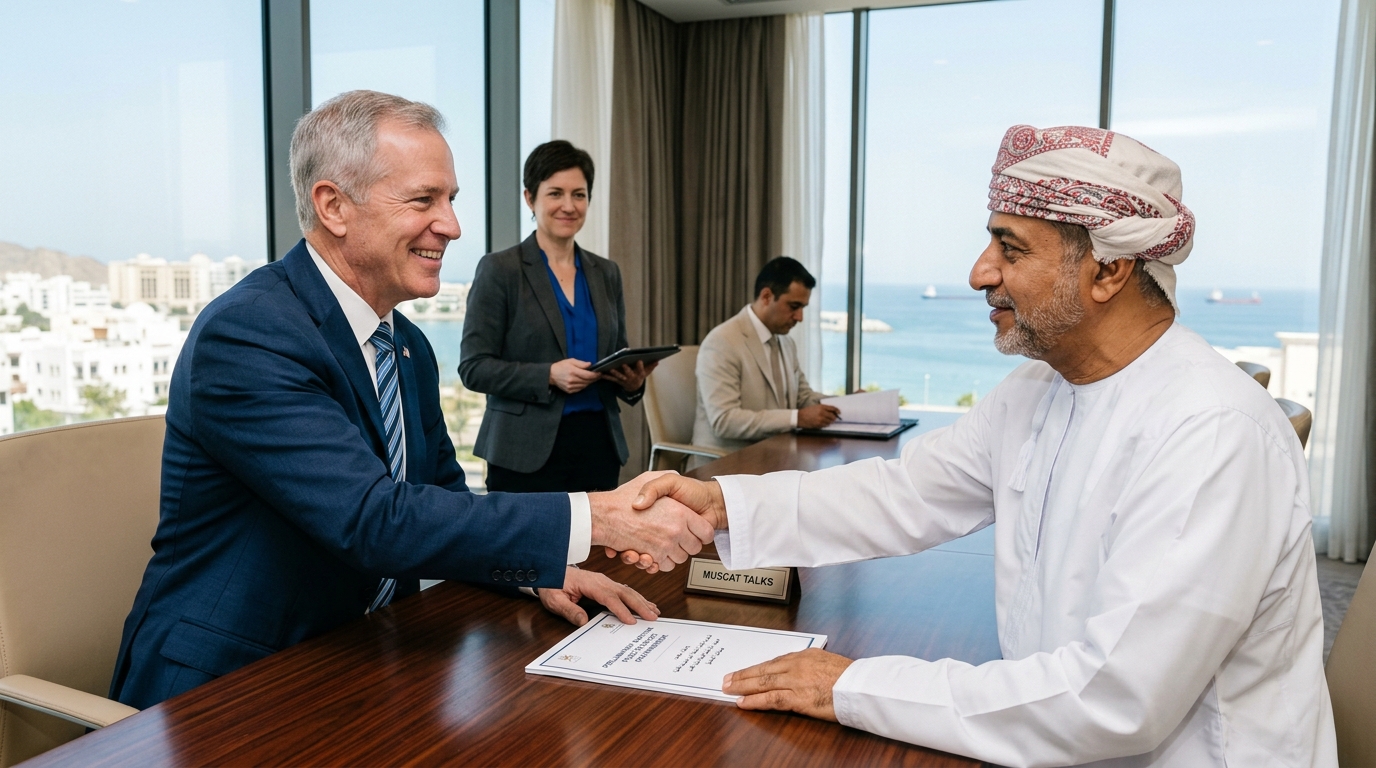
U.S. and Middle East Envoys Reach Preliminary Maritime Peace Framework in Muscat Talks
1. The Hook: High Stakes in the Sultanate
For thirteen consecutive nights, the night skies over the Persian Gulf detonated with the fire of high-stakes modern warfare. Precision-guided munitions from U.S. naval vessels and strike aircraft systematically targeted coastal radar installations, drone assembly depots, and missile sites along the Iranian coastline. In response, retaliatory drone and missile salvos lit up air defense displays from Bahrain to Kuwait, while commercial energy shipments through the Strait of Hormuz—the narrow artery carrying nearly twenty percent of the world’s petroleum—ground to a agonizing crawl. Global crude benchmarks surged past $100 per barrel, threatening to ignite a global stagflation crisis.
Then, amid the drone of warplanes and the alarms of commercial shipping conglomerates, came an abrupt and unexpected stillness.
For three consecutive days, U.S. Central Command (CENTCOM) held its fire. In the quiet that followed, dark-windowed diplomatic sedans began pulling up to private wings in Muscat, Oman. Behind closed doors, senior Western envoys, Omani negotiators, and Iranian representatives reached what diplomats are describing as a preliminary, game-changing Maritime Peace Framework.
This is not merely a tactical pause; it is a high-wire diplomatic maneuver designed to pull the global economy back from the edge of a structural energy shock. The core question now echoing through intelligence agencies, energy trading desks, and shipping boardrooms across the globe is straightforward: Can a fragile, Omani-brokered maritime blueprint survive the deep mistrust between Washington and Tehran, or is this simply the quiet before an even larger regional storm?
2. The Reality: Inside the Muscat Blueprint
To understand how the Muscat negotiators achieved a preliminary breakthrough, one must look at the technical mechanics that brought military operations to a halt.
The current conflict escalated sharply following the collapse of earlier ceasefire understandings, leading Washington to enforce a stringent naval blockade while Tehran declared the Strait of Hormuz a restricted zone. Over thirteen days of intensive bombardment, U.S. forces sought to degrade the Islamic Revolutionary Guard Corps’ (IRGC) anti-ship missile capacity and coastal surveillance assets. However, as commercial tanker traffic through the Gulf plummeted to historical lows, the economic threat to European and Asian energy security escalated rapidly.
Enter the Sultanate of Oman. Long celebrated as the Middle East’s premier backchannel mediator, Omani foreign ministry officials constructed a compromise built on a proven international precedent: The Strait of Malacca Model.
The Malacca Precedent and the Technical Blueprint
Rather than forcing either side to concede sovereignty or accept absolute military defeat, the draft Muscat framework redefines how the Strait of Hormuz is governed and managed:
- The Central Transit Lane: The proposal establishes a strictly delineated deep-water shipping lane through the middle of the strait, dedicated exclusively to commercial energy carriers, food, and medical shipments.
- Voluntary Service Charges vs. Unilateral Tolls: To resolve the fierce dispute over Iran’s demand for transit fees—which Washington rejected as illegal toll-gouging—the framework introduces voluntary "maritime service contributions". These funds will be managed via neutral Omani-held escrow accounts to pay for regional navigation safety, hydrographic charting, and search-and-rescue services.
- Third-Party Inspection Protocols: To address U.S. intelligence concerns regarding weapon smuggling and military cargo, commercial vessels will undergo verified inspections at neutral ports like Salalah, Oman, bypassing direct U.S. naval boardings.
- Joint Coordination Channels: The agreement establishes a direct operational communications bridge between CENTCOM officials and regional maritime authorities based in Doha and Muscat to resolve real-time tactical friction.
| Framework Parameter | Previous Standoff Position | The Draft Muscat Framework |
| Waterway Access | Unilateral Iranian blockade vs. U.S. naval enforcement | Dedicated, demilitarized central transit corridor |
| Financial Claims | Mandatory Iranian toll charges on commercial traffic | Voluntary maritime service fees held in Swiss/Omani escrow |
| Inspection Regime | Direct U.S. Navy boardings and intercepts | Pre-transit verification at neutral regional ports |
| Military De-confliction | Indirect messaging through media and third parties | Direct IRGC-CENTCOM operational liaison in Doha/Muscat |
Official Statements and Positionings
The preliminary nature of the framework is underscored by carefully calibrated statements from all primary stakeholders:
In Washington, President Donald Trump confirmed that U.S. strike authorizations were held back to evaluate diplomatic progress, framing the posture as "locked and loaded" while noting that diplomacy represents the preferable path if terms are respected. U.S. Secretary of State Marco Rubio emphasized that Washington’s evaluation remains purely operational:
"What we're interested in is not their press conferences—what we're interested in is whether or not ships are moving. If ships are moving, as they should be moving, then that's what we're going to judge... International waterways do not belong to any nation-state."
— Marco Rubio, U.S. Secretary of State
In Tehran, Iranian Foreign Ministry spokesman Esmaeil Baqaei confirmed that multi-day technical discussions with Omani officials had yielded meaningful progress regarding common principles for safe transit, while maintaining that direct bilateral talks with Washington remain off the table.
International institutions have reacted with measured relief. International Maritime Organization (IMO) Secretary-General Arsenio Dominguez publicly welcomed the diplomatic momentum, noting that restoring freedom of navigation is essential to protect innocent seafarers stranded or endangered by maritime hostilities.
3. The Horizon: Scenarios, Probabilities, and "What's Next?"
While the draft framework achieved an immediate pause in bombardment, the path forward remains highly volatile. Energy markets, defense analysts, and international trade conglomerates are actively weighing three potential forward-looking scenarios over the coming weeks.
Scenario A: The Best-Case "Corridor Stabilization"
- The Mechanism: Both sides formally adopt the Omani technical annexes. Commercial tankers resume transits under Omani-monitored protocols without military harassment.
- Potential Market Impact: Global crude prices could rapidly retreat from crisis premiums, settling back toward $75–$82 per barrel. Marine war-risk insurance surcharges would likely normalize, easing inflationary pressures across Western consumer markets.
- Geopolitical Outlook: A functional maritime corridor could serve as a confidence-building foundation, opening doors to broader negotiations regarding regional security architecture and nuclear monitoring.
Scenario B: The Worst-Case "Spoilers and Campaign Resumption"
- The Mechanism: A tactical miscalculation, a non-compliant vessel intercept, or hardline opposition within regional proxy networks breaks the three-day lull. Alternatively, parallel anti-ship missile activity in the Red Sea forces a breakdown in the Muscat framework.
- Potential Market Impact: U.S. strike operations resume with expanded targeting against Iranian state power grids and industrial assets. Brent crude spikes sharply past $115–$130 per barrel, triggering immediate emergency oil reserve releases across IEA member states.
- Geopolitical Outlook: The conflict shifts from targeted maritime enforcement into an unrestricted regional war of attrition, drawing in broader regional infrastructure.
Scenario C: The Trend-Driven "Hybrid Friction & High-Cost Transit"
- The Mechanism: The framework is implemented informally without a binding treaty. Commercial ships transit the Strait of Hormuz, but remain subject to rigorous, time-consuming Omani inspections and naval escort shadowing.
- Potential Market Impact: Oil prices stabilize around $85–$92 per barrel. Shipping lines face higher operational costs due to inspection delays and lingering war-risk surcharges, creating persistent friction in global logistics chains.
- Geopolitical Outlook: The Persian Gulf enters a prolonged "neither war nor peace" state, where shadow intelligence operations and electronic warfare persist despite official compliance.
4. The Takeaway: Key Variables to Watch
The Muscat Maritime Peace Framework represents the most significant diplomatic opening since the resurgence of Gulf hostilities. However, history proves that agreements forged in the crucible of military bombardment require rigorous execution to survive.
Over the next 72 to 96 hours, four key indicators will determine whether this preliminary framework holds:
- Vessel Transit Metrics: Watch live AIS tracking data and Lloyd’s List shipping telemetry. A verifiable increase in commercial oil tanker transits through the central Hormuz corridor will signal real-world compliance.
- Insurance Underwriter Sentiments: Marine insurers in London and Singapore must adjust their war-risk risk ratings. Until insurance premiums drop, shipping firms will remain hesitant to commit fleets.
- Parallel Chokepoint Stability: Watch for activity in the Red Sea and Bab el-Mandeb. If proxy strikes persist in secondary corridors, the broader diplomatic architecture remains exposed.
- Domestic Political Signals: Monitor official communications from the White House, the Iranian Supreme National Security Council, and Omani mediators for formal confirmation of the escrow and inspection mechanisms.
The Muscat talks have provided a brief, critical breathing space. Whether it marks the beginning of enduring regional stability or merely a tactical pause in a longer campaign depends entirely on the actions taken in the days ahead.