Category: Opinion & Analysis || Posted Jul 27, 2026
Production over Consumption: Examining Peter Obi's Model for Nigeria's Economic Recovery
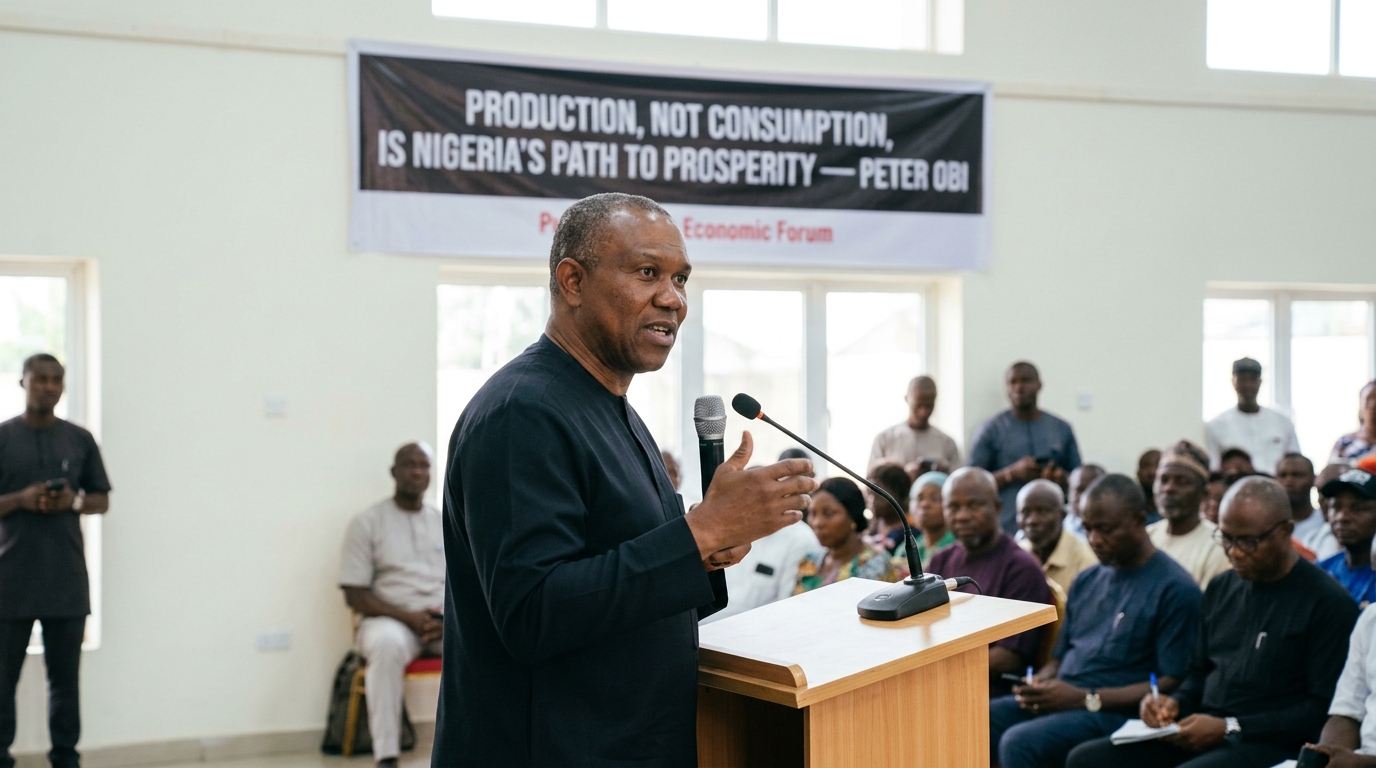
In public statements and policy discussions, political leader and former Anambra State Governor Peter Obi has consistently advocated for a structural pivot in Nigeria’s economic orientation: transitioning the nation from a consumption-driven economy to a production-centered model. Speaking in national broadcasts and policy forums, Obi maintains that sustainable growth, job creation, and poverty reduction depend on leveraging domestic assets—particularly in agriculture, manufacturing, and small business enterprise.
Core Pillars of the Production-Centered Framework
Obi's economic thesis rests on several interconnected pillars aimed at shifting national focus away from import dependency and rent-seeking toward value addition and localized industry.
Key Takeaways of the Proposal:
- Agricultural Foundation: Prioritizing agricultural production to secure domestic food supply, feed local processing industries, and generate foreign exchange earnings that could surpass oil revenues.
- Industrialization and Value Chains: Linking farming outputs directly to manufacturing capacity rather than exporting unprocessed commodities, establishing an export-oriented industrial base.
- Support for Enterprise & MSMEs: Positioning Micro, Small, and Medium Enterprises (MSMEs) as the primary drivers of job creation, supported by affordable credit, training, and streamlined regulatory environments.
- Prudent Resource Management: Reducing the cost of public governance, curtailing wasteful spending, and redirecting borrowed funds exclusively toward productive investments like infrastructure, education, and health.
Sectoral Strategy: From Agrarian Potential to Manufacturing
Central to Obi’s vision is the strategic deployment of Nigeria’s uncultivated land, particularly across northern regions, which he highlights as having the potential to become Africa’s primary agricultural hub. He contrasts Nigeria's current agricultural yield with international benchmarks, noting that smaller nations like Bangladesh, Morocco, and Vietnam have achieved significantly higher output through targeted investments and modern farming techniques.
"The only way to pull Nigeria out of poverty, or even genuinely grow GDP, is through production, not consumption. That production starts with agriculture, which gives you the food you need, raw materials for your factories, and jobs." — Peter Obi
To achieve this, Obi emphasizes that security must be restored in rural farming communities to enable unhindered access to arable land. Rather than implementing immediate blanket import bans, his stated policy is to systematically increase domestic production and processing capabilities first, ensuring food security before restricting trade flows.
Enabling Infrastructure and Enterprise Environment
Under this policy framework, the government's primary role is defined not as an operator of state-owned enterprises, but as an enabler for private sector initiative. Obi draws comparisons with economies like Indonesia, where small businesses account for roughly 90 percent of employment, emphasizing that government must ensure accessible financing and institutional support.
Furthermore, the model ties economic productivity directly to fiscal reform and human capital development. Addressing national debt concerns, Obi distinguishes between borrowing for immediate consumption—which burdens future generations—and borrowing for wealth-generating infrastructure, science, education, and public health. By curbing waste, eliminating leakages, and fostering a stable business climate, the proposed approach aims to build systemic trust and attract sustained capital investment.