Category: Opinion & Analysis || Posted Jul 26, 2026
Global Economy Caught in Crosscurrents of Middle East Conflict and AI Boom – IMF Analysis
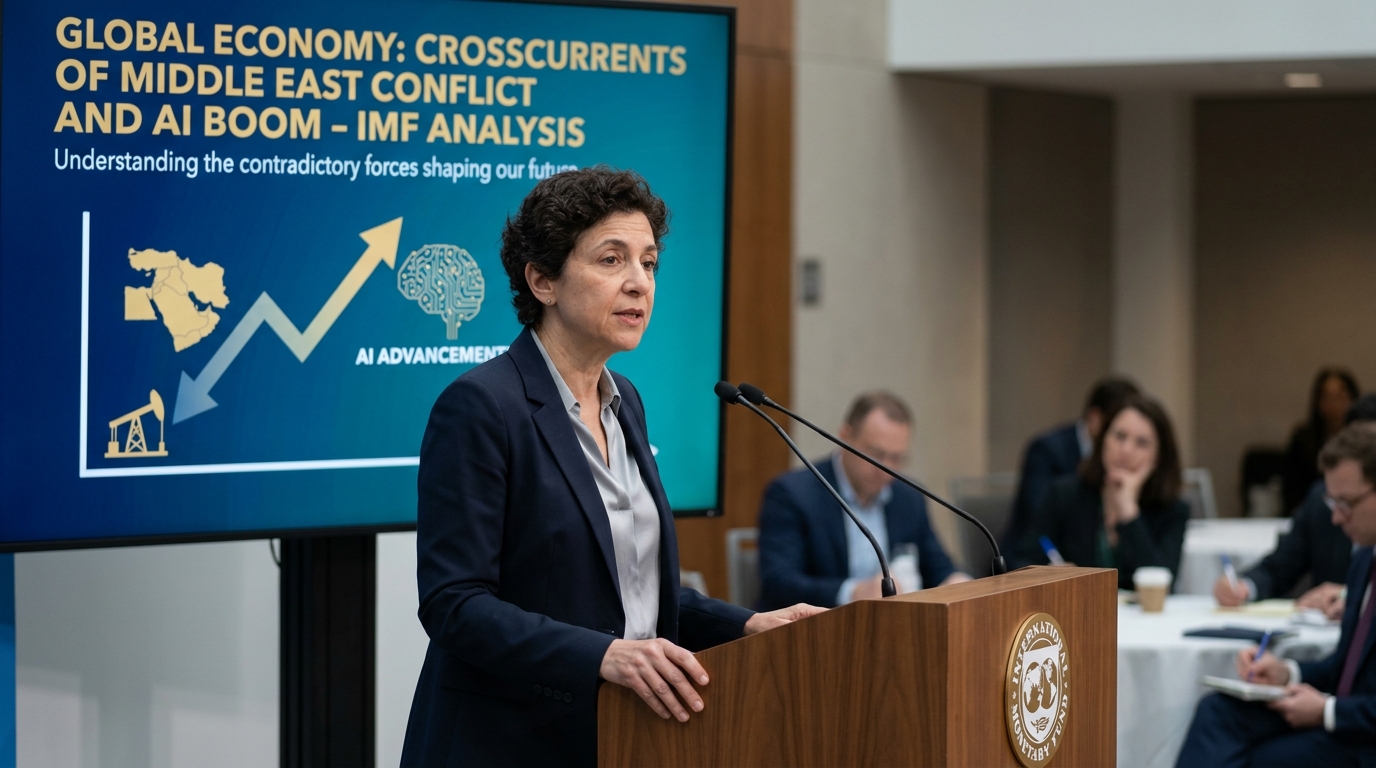
The International Monetary Fund (IMF) released its July 2026 World Economic Outlook Update, titled "Global Economy in Crosscurrents of War and Technology." The report captures a world economy pulled sharply in two opposite directions.
On one side, persistent military conflict in the Middle East and disruptions along key transit channels like the Strait of Hormuz have pushed energy prices roughly 25% higher than pre-war baselines. On the other side, an unprecedented capital investment boom in Artificial Intelligence (AI) and semiconductor hardware is generating strong economic tailwinds.
As a result, the IMF adjusted its 2026 global growth forecast down slightly to 3.0% (from 3.1% in April), while projecting a rebound to 3.4% in 2027.
"Global economic activity and the outlook are being shaped by two major forces pushing in opposite directions: the negative supply shock induced by war in the Middle East and the ongoing positive technology shock manifesting in accelerated momentum of the global technology cycle."
— International Monetary Fund (July 2026 WEO Update)
1. The Energy Shock and Stalled Disinflation
The most immediate strain on global output stems from the Middle East conflict. Shipping bottlenecks and temporary blockades along critical energy arteries have kept crude oil and natural gas prices elevated, creating persistent supply-side headwinds.
This ongoing volatility has stalled the global disinflation trend that began in early 2024:
- Inflation Acceleration: The IMF raised its 2026 global headline inflation forecast to 4.7%, up from 4.1% in 2025.
- Central Bank Hesitation: Central banks in major advanced economies are forced to keep interest rates higher for longer to prevent energy shocks from feeding into core service prices.
- Growth Downgrades: The Eurozone's growth forecast was trimmed to 0.9% for 2026, while growth in Middle Eastern and Central Asian economies received a sharp 1.2 percentage-point downgrade down to 0.7%.
2. The AI Investment Supercycle
Without the buffer provided by the global technology boom, the economic slowdown would be considerably worse. Unprecedented demand for generative AI infrastructure—spanning data center expansion, advanced power grid equipment, and high-performance computing hardware—is delivering a massive demand shock to manufacturing and technology hubs.
Key net exporters of AI hardware—including Taiwan, South Korea, Malaysia, and Thailand—have demonstrated remarkable resilience, outperforming broader global trade trends despite high energy costs. Furthermore, U.S. growth projections held firm at 2.3% for 2026, largely anchored by robust capital expenditure in the tech sector.
3. Asymmetric Impacts: Who Wins and Who Loses?
The crosscurrents of war and technology are creating a stark divide across national economies based on their position in the tech value chain and their exposure to energy imports.
| Country Category | Economic Impact | Primary Growth Drivers | Key Examples |
| Tech Supply Chain Hubs | Resilient / Outperforming | High global demand for chips, server hardware, and AI infrastructure | South Korea, Taiwan, United States |
| Non-Conflict Energy Exporters | Favorable Terms of Trade | Elevated crude oil and natural gas export revenues offsetting global uncertainty | Select Gulf, Latin American, & African producers |
| Non-Tech Energy Importers | Severe Drag | Compounded by high imported energy bills with zero offset from the AI hardware boom | Sub-Saharan Africa, low-income developing nations, parts of Europe |
4. Key Risks on the Horizon
While global growth has proven surprisingly durable, the IMF cautions that downside risks remain dominant:
- Re-escalation of Regional Hostilities: Further exchanges or long-term blockades of energy transit routes could trigger secondary commodity spikes.
- AI Valuation and Sentiment Correction: If market expectations surrounding AI monetization cool down before corporate productivity gains fully materialize, tech investment could slow rapidly.
- Accelerating Trade Fragmentation: Geopolitical rivalries and protectionist trade tariffs risk creating duplicated supply chains, further raising production costs worldwide.
World Economic Outlook July 2026 Update: 3 Key Questions, Answered
This video provides an official breakdown directly from the International Monetary Fund, answering key questions regarding the dual economic forces of Middle East conflict and the global AI boom shaping the 2026 outlook.