Category: Security & Regulation || Posted Jul 24, 2026
U.S. Imposes New Tariffs on 60 Countries Over Trade Import and Forced Labor Rules
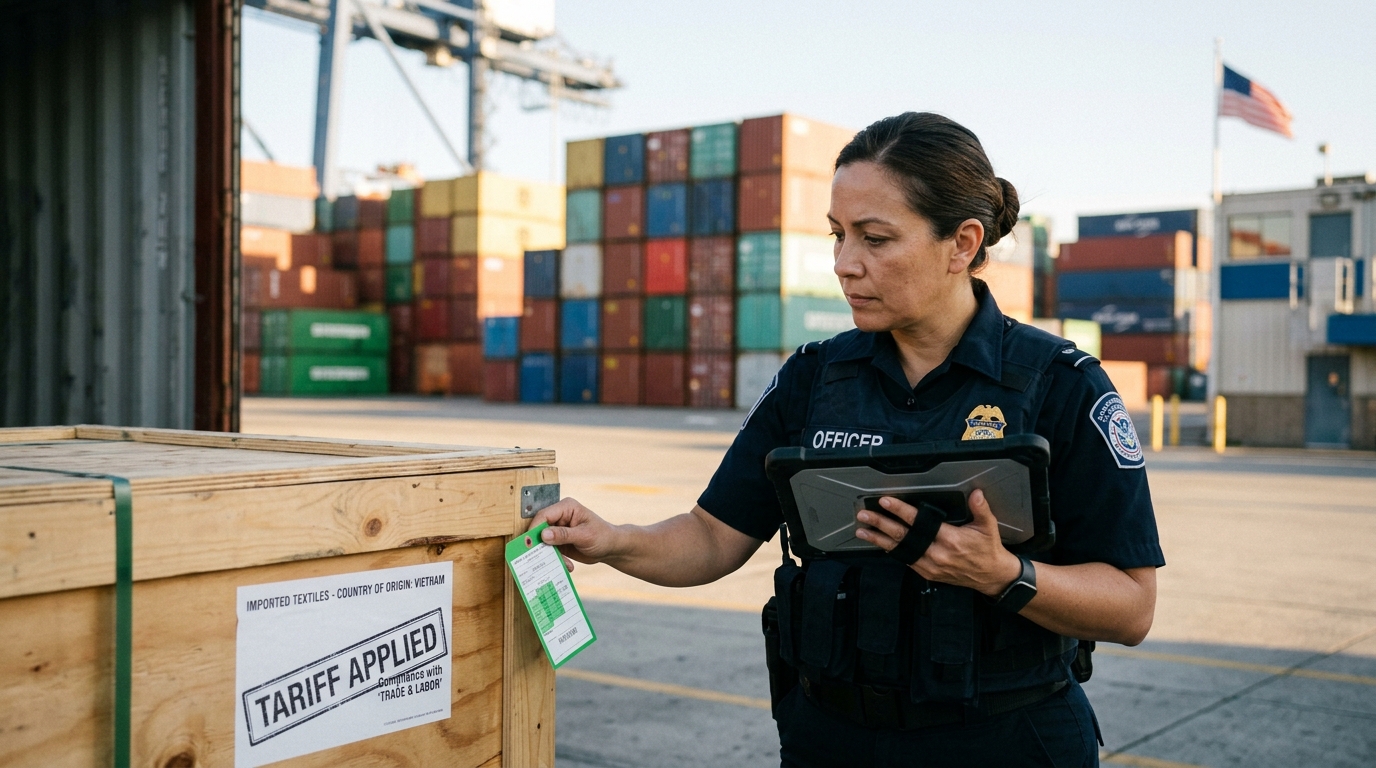
In what senior U.S. officials are calling the most expansive international labor action in modern economic history, a new wave of American tariffs has officially taken effect against 60 trading partners.
Directed by President Donald Trump and executed by U.S. Trade Representative Jamieson Greer under Section 301 of the Trade Act of 1974, the duties range between 10% and 12.5%. They target countries accused of failing to impose or effectively enforce strict prohibitions on importing goods produced with forced labor.
The action went into effect at 12:01 a.m. ET on July 24, 2026, immediately replacing the temporary 10% global emergency tariff (under Section 122) that expired at the same moment. With the USTR confirming the measures cover trading partners accounting for 99.4% of all U.S. imports, global supply chains have been plunged into a major recalibration.
1. The Legal Pivot: Section 122 Out, Section 301 In
To understand today’s tariff rollout, you have to look at the legal maneuvering in Washington over the past several months:
- The Supreme Court Reset: Following a Supreme Court ruling earlier in 2026 that struck down emergency country-by-country tariffs imposed under IEEPA, the administration temporarily invoked Section 122 (balance-of-payments authority) to maintain a 10% baseline duty on global goods.
- The 150-Day Clock: Because Section 122 carries a strict 150-day statutory limit, the administration launched a massive Section 301 investigation in March 2026 into global forced labor compliance.
- The Determination: Following two public hearings and over 1,600 public comments, USTR determined that widespread failure abroad to stop forced-labor goods creates an "unreasonable burden" on compliant U.S. businesses and workers. The resulting Section 301 duties now provide a longer-lasting legal vehicle for the administration's trade agenda.
2. The Two-Tiered Penalty Architecture
Rather than a blanket flat rate, the USTR structured the duties into a two-tiered system. The rate assigned to each economy depends on whether it has enacted baseline import bans or entered reciprocal enforcement agreements with Washington:
The 10% Tier (Partial Enforcement / Reciprocal Commitments)
Seventeen economies qualified for the lower 10% duty rate because they either enforce an import ban on forced labor goods, have implemented partial enforcement regimes, or signed formal commitments via Agreements on Reciprocal Trade. Key partners in this group include Canada, Mexico, the United Kingdom, India, Indonesia, Malaysia, Argentina, and Bangladesh.
The 12.5% Tier (Inadequate Frameworks)
Trading partners deemed to have insufficient or poorly enforced forced-labor import restrictions face the higher 12.5% duty rate. This category covers a massive footprint of top U.S. trade partners, including the European Union, China, Japan, South Korea, Vietnam, Brazil, Switzerland, Taiwan, Nigeria, and Saudi Arabia.
(Note: For economies with existing Most-Favored-Nation (MFN) tariffs, such as the EU and Japan, the Section 301 levy is calculated net of the MFN rate so the total duty does not exceed the 10% or 12.5% cap).
3. Product Exemptions and Supply Chain Shields
Recognizing the potential for severe domestic market disruptions, the White House carved out specific exemptions from the forced-labor duties:
- Critical Raw Materials & Energy: Commodities that cannot be grown, mined, or produced in sufficient quantities within the U.S. (including oil and natural gas) are exempted to prevent localized energy spikes.
- No Double-Dipping on Metals: Products already subject to Section 232 national security tariffs—most notably steel and aluminum—will not face additional forced-labor duties.
- USMCA Compliance: Goods entering under compliant, origin-verified rules under the U.S.-Mexico-Canada Agreement are shielded from the new duties.
What Lies Ahead
While administration officials frame the move as a historic strike against human rights abuses and unfair trade advantages, importers and global logistics networks are scrambling.
The new duties require importers of record to demonstrate rigorous supply chain traceability to verify that inputs at every tier are free from forced labor. With several other Section 301 investigations—including probes into global manufacturing "excess capacity"—still underway in Washington, today's action signals that global trade in 2026 will continue to be defined by high tariffs and intense regulatory scrutiny.