Category: Global politics || Posted Jul 25, 2026
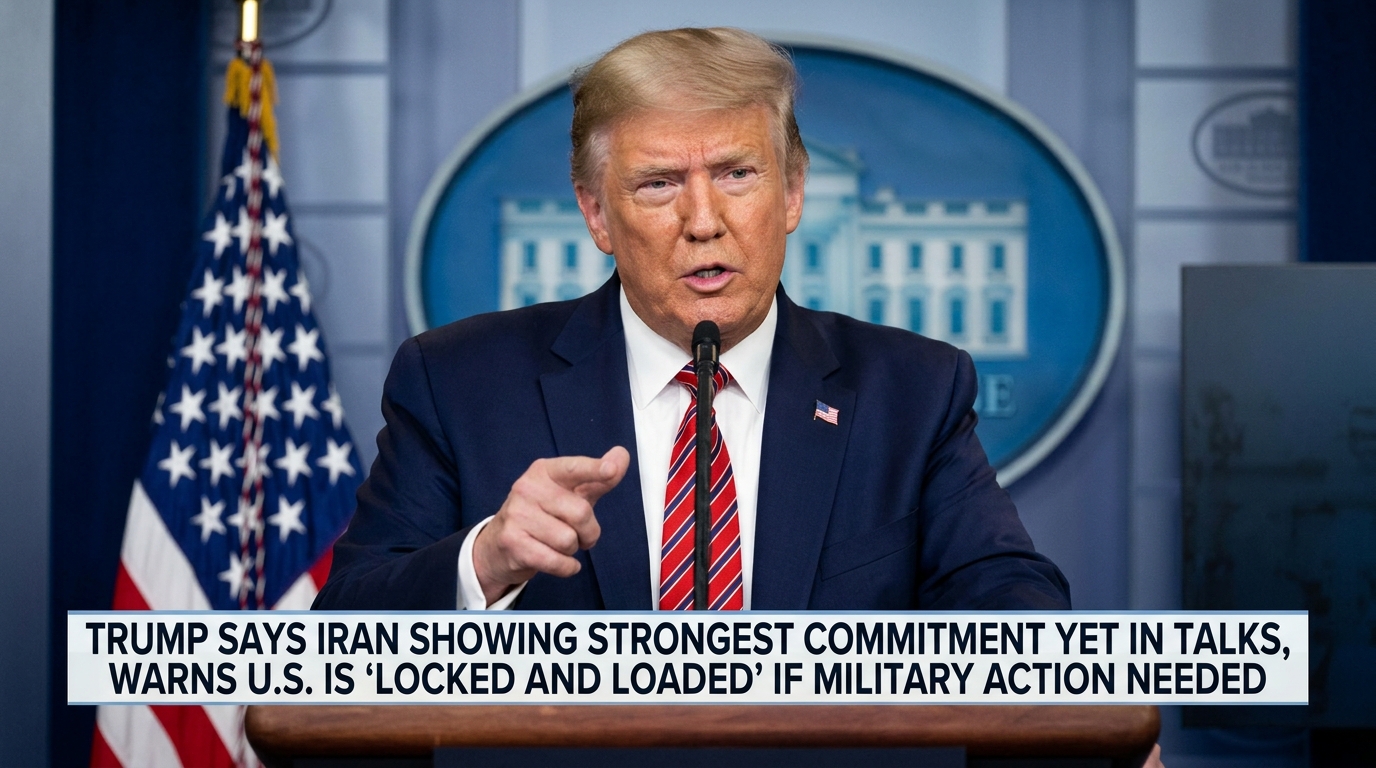
Trump Says Iran Showing Strongest Commitment Yet in Talks, Warns U.S. Is 'Locked and Loaded' If Military Action Needed
"The Smarter Way or the Easier Way": Trump Signals Progress in Iran Talks While Keeping U.S. Forces "Locked and Loaded"
In the midst of two weeks of military strikes across West Asia and escalating friction in the world's most vital energy corridor, President Donald Trump offered a rare glimpse of potential diplomatic traction. Speaking to reporters, Trump revealed that Tehran is demonstrating its "strongest commitment yet" in active negotiations with Washington—even as he insists the U.S. military remains fully prepared to escalate force if talks break down.
1. The View From the Oval Office
During an Oval Office press briefing, President Trump noted that Iranian officials appear increasingly motivated to reach an agreement as regional pressures mount.
"We're talking to them right now. I think they're getting more and more serious as the days go by, for maybe the obvious reason," Trump told reporters. "I think they are being by far the most serious that we've seen them. But that doesn't mean we get there. We'll see what happens."
When pressed on whether he had made a final decision to authorize a massive, broad-scale military offensive against Iranian state infrastructure, Trump clarified that no such order has been issued. Instead, he framed the situation as a choice between two distinct paths:
"We can take that to a much higher level if we want to, we're prepared to do that… We're locked and loaded and ready to go," Trump stated. "There are two ways. I consider that [diplomacy] the smarter way, but the other is probably the easier way."
2. Diplomacy Under the Shadow of 13 Nights of Strikes
Trump’s comments arrive against an intensely kinetic backdrop. U.S. Central Command (CENTCOM) recently completed its 13th consecutive night of military strikes targeting Iranian command nodes, coastal radar arrays, and ballistic missile launch infrastructure.
The military campaign was launched following Iranian interference with commercial tankers transiting the Strait of Hormuz—a choke point responsible for nearly a fifth of global petroleum traffic. In response, Tehran has launched retaliatory drone and missile salvos targeting forward facilities used by U.S. forces in Bahrain, Jordan, and Kuwait.
Despite the high-voltage exchanges on the water and in the air, the White House has kept third-party mediation lines open. Trump confirmed that a wide team of senior advisers—including Vice President JD Vance, Secretary of State Marco Rubio, Special Envoy Steve Witkoff, and Jared Kushner—are directly engaged in the diplomatic push.
3. The Red Lines and Global Dynamics
While signaling a willingness to negotiate, the administration’s non-negotiable bottom line remains unchanged: Iran must permanently abandon its pathway to a nuclear weapon.
Beyond the immediate bilateral dynamic, Trump highlighted several geopolitical factors shaping the crisis:
- Great Power Assurances: Trump noted that during recent diplomatic exchanges, Chinese President Xi Jinping and Russian President Vladimir Putin assured Washington that neither power would supply arms to Tehran under current conditions.
- No Rush for Midterm Politics: Addressing concerns that rising crude oil prices and domestic opposition could pressure the White House ahead of the upcoming U.S. midterm elections, Trump insisted he is not rushing into a premature deal. "Despite what everyone says about the election, I'm not in a hurry. We have to do it right," he emphasized.
- Financial Accountability: The administration continues to warn that any financial losses suffered by commercial shipping in the Strait of Hormuz will be compensated using frozen Iranian funds currently held in U.S. financial institutions.
The Road Ahead
The standoff stands at a critical juncture. While the presence of active, high-level backchannels offers the first real hope for a de-escalation framework since the collapse of the June truce, the military posture on both sides remains fully primed. Whether the "smarter way" prevails over a wider conflict will depend on whether diplomats can translate Oval Office talks into a binding, verifiable agreement before the next tactical spark ignites the Gulf.