Category: Opinion & Analysis || Posted Jul 23, 2026
The Growing Disconnect Between Paper Regulatory Compliance and Real-World Crypto Enforcement
On paper, mid-2026 was supposed to be the moment crypto regulation finally grew up.
The European Union’s Markets in Crypto-Assets (MiCA) grandfathering grace period officially expired on July 1, establishing a single, unified authorization framework across all 27 member states. In the United States, joint SEC-CFTC taxonomy initiatives and state-level frameworks like California’s Digital Financial Assets Law (DFAL) created explicit, standardized compliance categories for stablecoins, digital commodities, and custody providers.
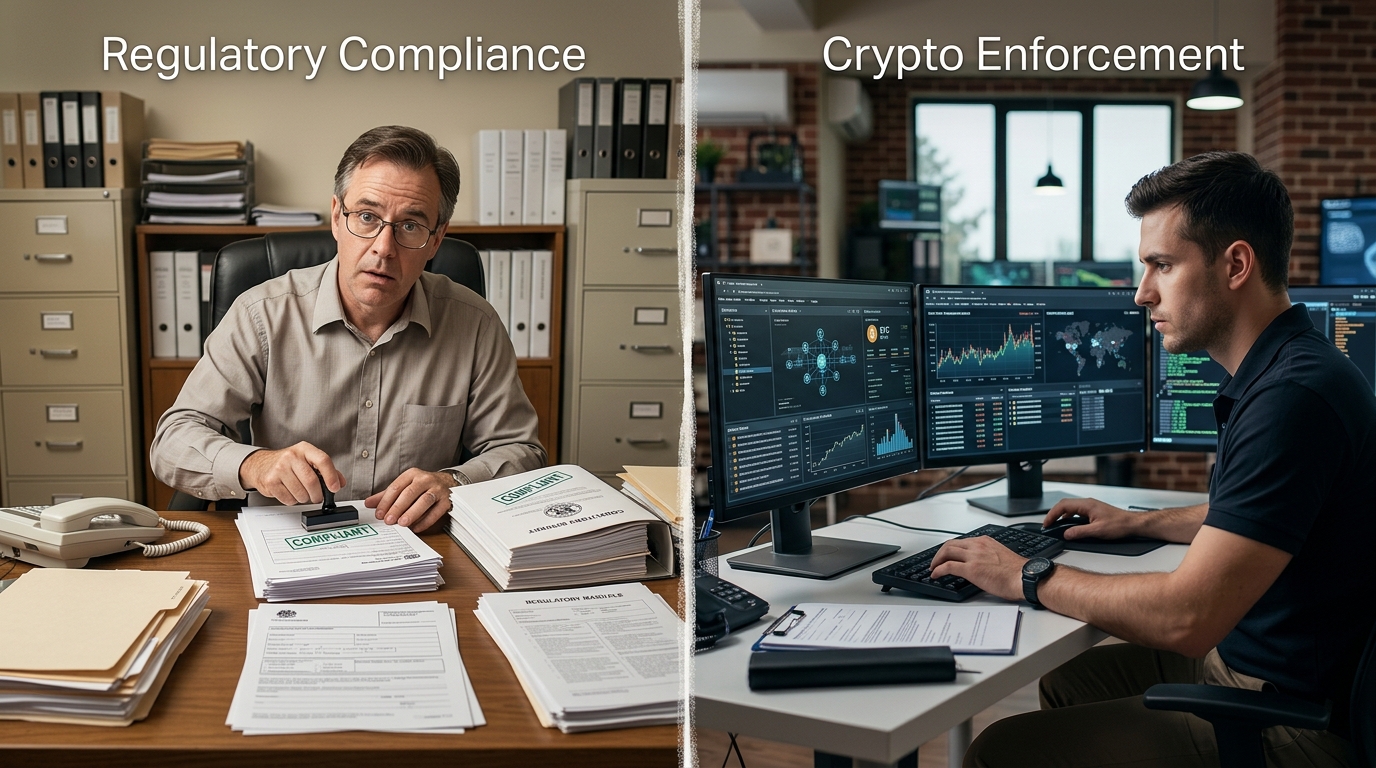
Yet, under the surface, the gap between paper regulatory compliance and real-world operational enforcement has never been wider.
While legal teams collect Virtual Asset Service Provider (VASP) licenses, draft formal opinions, and check regulatory boxes, enforcement agencies, courts, and cybercrime units are discovering that neat paperwork rarely reflects how crypto platforms actually move capital, exercise control, or manage risk.
1. The Geofencing Lie vs. Network-Level Enforcement
For years, offshore Web3 platforms relied on a standard form of paper compliance: update the terms of service, implement basic IP-based geoblocking, and declare specific jurisdictions "off-limits."
Enforcement agencies have stripped away this legal fiction. When regulators face platforms where hundreds of thousands of domestic users easily bypass soft geoblocks using VPNs, mirror sites, or direct API connections, passive "view-only" homepages are no longer treated as compliance. Instead, authorities view public odds displays and active front-ends as unauthorized public solicitation.
The Operational Reality: A terms-of-service clause prohibiting specific users carries zero weight in court if real-world network traffic, API endpoints, and operational behavior demonstrate active user engagement.
2. Shell Entities vs. Actual Control Points
Another major friction point is the reliance on offshore foundation structures. Incorporating an entity in a friendly jurisdiction no longer insulates developers, executives, or governance token holders from legal liability.
Courts and global regulators are increasingly ignoring paper structures in favor of practical operational control:
- DAOs and Governance Concentration: Where a small cluster of addresses holds voting control, multisig authorization, or protocol upgrade keys, regulators treat those holders as de facto operators, regardless of whether a formal corporate entity exists.
- Middleware and Bridges: Traditional compliance focuses heavily on centralized fiat gateways. Yet, massive capital flows bypass these checkpoints entirely through non-custodial cross-chain bridges, decentralized sequencers, and liquidity aggregators. When illicit funds route through middleware, static paper audits miss the real surface area of financial risk.
3. The MiCA Consolidation Paradox
The July 1 MiCA deadline provides a stark example of how rigid paper standards can create unexpected real-world consequences. Fewer than 20% of pre-existing crypto service providers successfully converted their national registrations into full MiCA authorizations before the cutoff, leaving over 80% forced to halt operations or exit the EU market.
| Paper Compliance Goal | Real-World Market Reality |
| Unified European Licensing | Market consolidation favoring heavily funded legacy firms with large legal budgets. |
| Strict Travel Rule & AML Reporting | Non-compliant venues squeezed out, driving retail users toward unhosted wallets and peer-to-peer liquidity networks. |
| Standardized Disclosures | Compliance costs pushing early-stage protocols completely offshore or into fully anonymous infrastructure. |
By setting the paper compliance bar so high, regulators succeeded in cleaner corporate registries—but at the cost of pushing significant retail volume into unmonitored, decentralized channels.
4. Static Audits vs. Dynamic Code Risks
The deepest structural disconnect lies in how compliance is evaluated. Traditional financial supervision relies on periodic, static audits: balance sheet reviews, historical Customer Due Diligence (CDD) logs, and written internal policies.
Crypto systems, by contrast, run on continuous, automated code. Modern exploits, market manipulation, and systemic failures rarely stem from fraudulent ledger entries. They happen through dynamic architectural vulnerabilities—flash loan attacks, oracle feed manipulation, and smart contract logic flaws.
A business can present an flawless paper AML audit while remaining completely vulnerable to automated code drains.
Moving Beyond "Defensive Paperwork"
The era of relying on boilerplate legal disclaimers, superficial geoblocks, and formalistic entity creation is ending.
Regulatory bodies and law enforcement are no longer asking "What do your compliance files say?" They are asking "Who controls the administrative keys, where does the operational traffic flow, and can your software actually enforce the rules you promise on paper?"
For digital asset platforms navigating the second half of 2026, compliance cannot remain an auxiliary task handled by legal counsel. It has to be built directly into the cryptographic architecture, smart contract permissions, and real-time operational monitoring of the software itself.