Category: Opinion & Analysis || Posted Jul 22, 2026
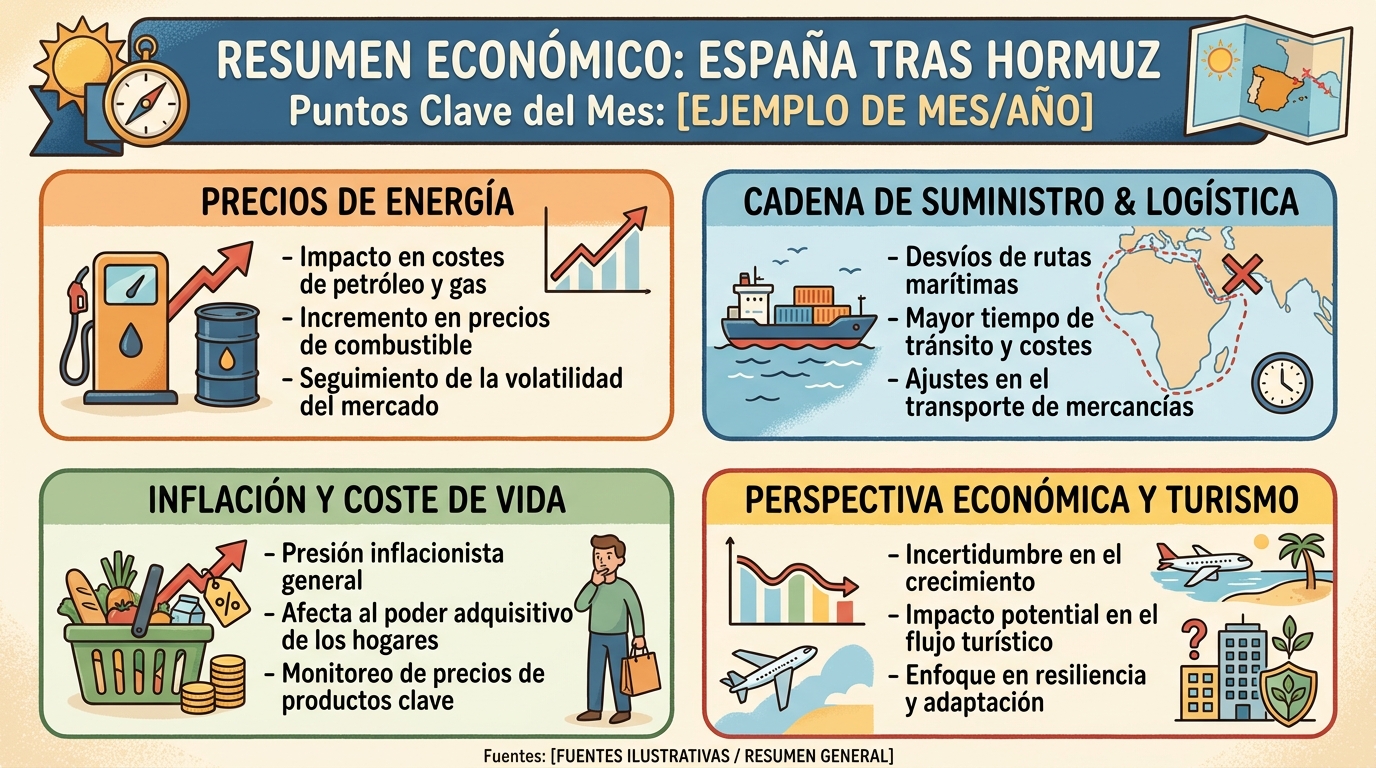
The Spanish Economy After Hormuz: Key Points of the Month
Four months after tension in the Middle East and disruptions through the Strait of Hormuz sent global energy prices spiraling, the post-truce economic landscape in mid-July 2026 is offering a clear look at how European nations survived the shock.
While much of the Eurozone spent the spring wrestling with stagflation risks and industrial pullbacks, the Spanish economy once again proved unexpectedly resilient. Backed by a booming summer tourism wave, a sturdy labor market, and an early normalization of Brent crude prices following the recent U.S.–Iran agreement, Spain has largely dispelled fears of a severe growth slowdown.
Here are the key macro takeaways defining the Spanish economy after the Hormuz crisis.
1. The Inflation Shock Was Sharp—But Short-Lived
The most immediate casualty of the Hormuz bottleneck was Spanish consumer sentiment. Between March and June, headline inflation hovered consistently above 3.2%—a notable jump from early-year expectations. Had it not been for targeted government energy subsidies and fuel price caps, CPI would have likely approached 4%.
This price surge triggered a brief "U-shaped" dip in household spending. Retail trade sales contracted by 1.5% in April as cautious consumers pulled back. However, as news of the diplomatic agreement broke in late June and energy benchmarks pulled back toward pre-crisis levels, confidence staged a rapid recovery. Spain’s Composite Purchasing Managers' Index (PMI) surged from 50.1 in May to 53.3 in June—its highest level since late 2025—signaling that domestic activity is rebounding sharply going into late summer.
2. The Safe-Haven Tourism Windfall
While geopolitical instability crushed economic growth in parts of the Eastern Mediterranean, it produced an accidental macroeconomic boost for Spain.
The Geopolitical Pivot: Perceiving Western Europe as the safest regional destination, millions of European holidaymakers rerouted their summer travel plans away from the Middle East and North Africa toward Spanish coastal hubs.
International tourist arrivals surged by 9.5% and 10.9% year-on-year in May and June, far outpacing the modest 1% to 4% growth recorded during the same period in 2025. This influx of foreign service revenue has provided a vital cushion, helping Spain maintain a healthy current account balance despite paying higher net energy import bills earlier in the quarter.
3. Labor Markets Absorbed the Shock Smoothly
Macroeconomic shocks often take six to nine months to show up in employment data, but Spain’s job market weathered the peak of the Hormuz crisis without missing a beat.
Social Security affiliations expanded by nearly 595,000 workers in Q2 2026. Even when adjusting for the government’s extraordinary migrant regularization policy—which registered roughly 160,000 workers—net organic job growth came in at a healthy 435,000 affiliates (~0.5% quarter-on-quarter). Service-sector hiring, particularly in hospitality and logistics, offset temporary hiring pauses in energy-intensive manufacturing.
Key Indicators: Pre-Shock vs. Post-Hormuz Recovery
| Macro Metric | Peak Shock Phase (April–May 2026) | Post-Hormuz Reality (Mid-July 2026) | Primary Driver |
| Headline CPI | ~3.2%–3.5% | Moderating toward ~3.0% | Lower oil import prices following the truce |
| Composite PMI | 50.1 (Near-stagnation) | 53.3 (Strong expansion) | Rebound in business & consumer confidence |
| Tourist Arrivals | +1.2% YoY (2025 baseline) | +9.5% to +10.9% YoY | Travel rerouting to safe-haven destinations |
| Q2 GDP Estimate | Threatened with <0.1% | +0.3% to +0.5% QoQ | Strong domestic services & export resilience |
What Lies Ahead for H2 2026
Thanks to its low direct reliance on Persian Gulf gas pipelines (relying instead on domestic LNG regasification infrastructure) and the buffer provided by NextGenerationEU funds, Spain enters the second half of 2026 in a position of relative strength. Analysts have revised Spain's 2026 GDP growth forecast slightly down from 2.4% to 2.1%—a figure that still comfortably doubles the projected growth rate of the wider Eurozone (~0.8%).
As long as the fragile peace agreement in the Strait of Hormuz holds, Spain has successfully turned what could have been a growth-killing stagflation shock into a manageable bump in the road.