Category: Security & Regulation || Posted Jul 22, 2026
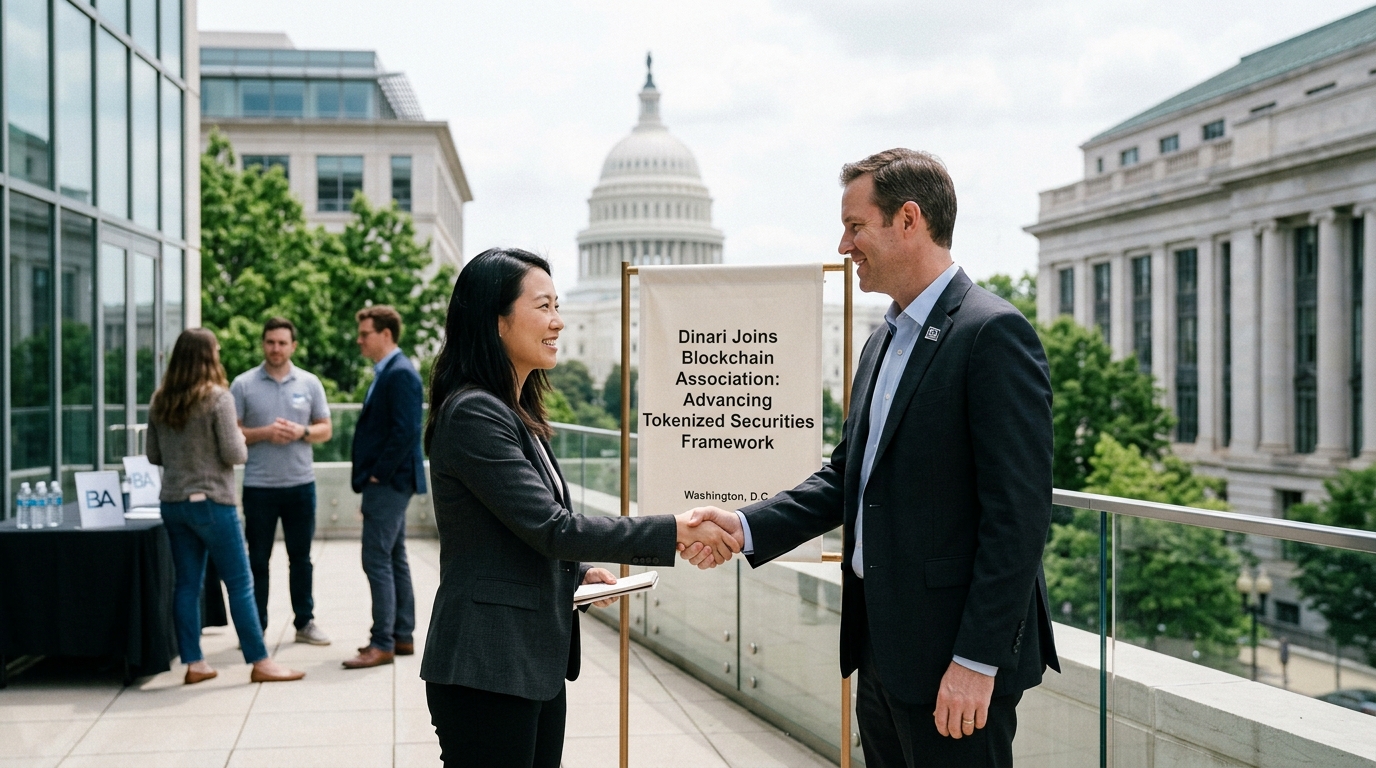
Dinari Joins Blockchain Association to Advance Tokenized Securities Framework in Washington
The convergence of traditional finance and Web3 infrastructure is accelerating. As Wall Street and digital asset innovators increasingly view Real-World Asset (RWA) tokenization as the future of capital markets, the battle for clear, innovation-friendly regulation has moved squarely to Washington, D.C.
In a major strategic move, Dinari—the pioneer of the custodial model for tokenized U.S. public equities—announced it has officially joined the Blockchain Association, the leading trade organization representing the digital asset industry in the nation's capital.
The membership brings Dinari’s firsthand experience in building regulated, custodial tokenized stocks and ETFs directly to Capitol Hill at a crucial turning point: as federal policymakers actively draft frameworks to govern how traditional securities operate on public blockchains.
1. Bridging Wall Street and Web3: The Custodial Model
For years, early iterations of "tokenized stocks" operated in a legal shadow land—frequently utilizing synthetic derivatives or offshore structures that failed to offer true investor protections or direct claims to underlying assets.
Dinari turned that dynamic on its head through its dShares platform. Under its SEC-registered transfer agent status and through its affiliated FINRA-member broker-dealer, Dinari built infrastructure that issues tokens backed 1:1 by actual NMS securities (like Apple, Tesla, or S&P 500 ETFs) held at a regulated U.S. custodian.
This setup—where a regulated entity holds traditional assets in custody and mints 1:1 backed tokens representing the holder's economic entitlement—aligns directly with the custodial framework outlined by the SEC in its taxonomy on tokenized securities.
By joining forces with the Blockchain Association, Dinari aims to show lawmakers that tokenizing stocks doesn't mean bypassing market safeguards. Instead, it enhances them through:
- 1:1 Verifiable Backing: Audited, transparent reserves ensuring every circulating token corresponds to a real share in a custodial account.
- Automated Corporate Actions: Passing through cash dividends directly to user wallets in stablecoins (like USDC) and mirroring stock splits automatically onchain.
- Guaranteed Redemption & Liquidity: Allowing institutional and retail holders to redeem tokens at the National Best Bid and Offer (NBBO) rate.
2. Why Washington Policy Matters Right Now
The timing of Dinari joining the Blockchain Association is no coincidence. With the SEC actively updating its regulatory agenda to incorporate tokenized market structures and safe harbors, Washington is moving away from purely reactive litigation and toward establishing concrete rules of the road.
"We're thrilled to welcome Dinari to the Blockchain Association and look forward to bringing their expertise on tokenized securities and blockchain-based capital markets into the policy conversations taking place in Washington."
— Summer Mersinger, CEO of the Blockchain Association
Several critical policy discussions will benefit directly from Dinari's institutional input:
- Transfer Agent & Clearing Rules: Updating legacy recordkeeping laws so that public blockchains can be legally recognized as authoritative transfer logs alongside traditional market databases.
- Secondary Market Trading: Establishing pathways for regulated Alternative Trading Systems (ATS) and broker-dealers to handle 24/7 onchain settlement without running into archaic capital penalty rules.
- Cross-Chain Interoperability: Defining how tokenized securities can move securely across different blockchain layers without compromising Know-Your-Customer (KYC) or Anti-Money Laundering (AML) compliance.
3. The Grand Goal: Modernizing the Global Capital Stack
The push for tokenized securities isn't just about bringing stock tickers into Web3 wallets; it's about fundamentally modernizing how global finance operates.
Traditionally, international investors—particularly in emerging markets—face massive friction, high fees, and limited market hours when trying to access U.S. capital markets. Tokenizing public equities on transparent, programmable rails unlocks fractional ownership, instant settlement, and 24/7 liquidity while preserving the core property rights that make U.S. markets the gold standard globally.
"We believe tokenization represents one of the greatest opportunities to modernize capital markets in decades, but long-term adoption depends on preserving the trust, transparency, and investor protections that have made U.S. securities markets the global standard."
— Gabriel Otte, Co-Founder and CEO of Dinari
The Bottom Line
As traditional giants like tZERO, the NYSE, and Nasdaq experiment with onchain settlement frameworks, Dinari's arrival in Washington signals that the tokenized asset sector is ready to help write the playbook.
By uniting regulated fintech infrastructure with the policy megaphone of the Blockchain Association, Dinari is ensuring that as Congress and federal agencies build the next generation of financial rules, tokenized securities have a seat at the main table.