Category: Market News & Trends || Posted Jul 18, 2026
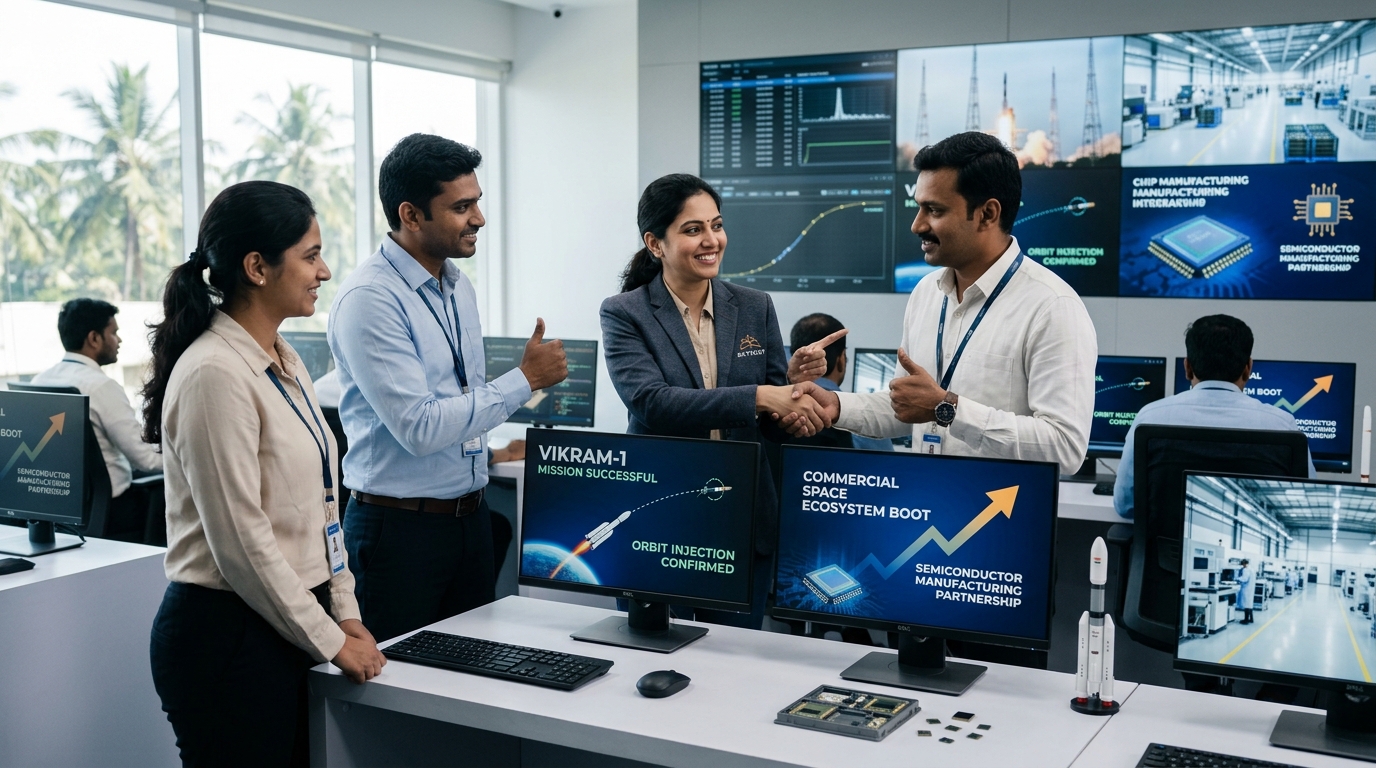
Vikram-1 Launch Success Props Up India’s Growing Commercial Space and Semiconductor Ecosystems
The successful maiden orbital flight of Skyroot Aerospace’s Vikram-1 rocket (Mission Aagaman) on July 18, 2026, marks a historic turning point for India's technology sector. By successfully placing multiple technology demonstration payloads into a 450 km Low Earth Orbit (LEO) on its very first attempt, Skyroot has made India the third country in the world—after the U.S. and China—to possess domestic private orbital launch capabilities.
This milestone does more than just solidify India's position as a low-cost, high-reliability launch destination; it serves as a powerful catalyst for two tightly intertwined domestic sectors: Commercial Space (SpaceTech) and Advanced Semiconductors.
1. The Commercial Space Boom: On-Demand Logistics
For decades, the global space market relied on massive, multi-ton rockets. However, modern commercial space needs are dominated by constellations of small, agile satellites. Vikram-1 is custom-built exactly for this paradigm shift.
- Rapid, On-Demand Launches: The four-stage Vikram-1 rocket is designed to slash the lengthy waiting queues associated with traditional large-payload vehicles. It offers tailored, flexible launch windows capable of lifting payloads up to 350 kg into LEO.
- Transitioning from Support to Collaboration: While India’s space program has historically been state-driven, the reforms governed by IN-SPACe have created a vibrant ecosystem. ISRO provided critical infrastructure—including solid motor casting facilities, static test beds, and 24/7 safety integration teams—shifting its role from sole executioner to the ultimate enabler of private tech.
- Global Market Share Capture: With the global small-satellite launch market expanding rapidly, India's private sector is positioned to capture massive international market share by driving down price-per-kilogram launch costs.
2. The Semiconductor Link: Propelling Advanced Silicon
Rockets are effectively flying supercomputers operating under extreme environmental conditions. The validation of Vikram-1 is a direct victory for India's aggressive semiconductor push, which includes the multi-billion-dollar India Semiconductor Mission (ISM).
- Rad-Hardened & Flight-Proven Silicon: Aerospace applications demand radiation-hardened microchips, complex application-specific integrated circuits (ASICs), and advanced telemetry modules. A successful private orbital mission proves that the indigenous suppliers, engineering teams, and testing frameworks within India are fully capable of delivering high-reliability aerospace components.
- The Embedded Systems Flywheel: Autonomous flight, precision navigation systems, and 3D-printed engine electronics (like those utilized in Skyroot's hardware) require heavy localized chip assembly and embedded software expertise. The commercial success of SpaceTech creates a steady, high-margin anchor customer for the country’s burgeoning domestic chip design houses and upcoming semiconductor fabrication units.
- Edge Computing in Space: Beyond the rocket itself, the payloads injected into orbit—such as the SCOPE satellite—increasingly carry AI-enabled edge-computing chips to process image and telemetry data directly in space rather than relaying massive raw data streams back to Earth.
The Broader Macroeconomic Impact
The successful launch of Vikram-1 sets off a virtuous cycle across India’s high-tech manufacturing corridors:
This alignment ensures that the space and chip-manufacturing ecosystems are no longer siloed national aspirations. Instead, they are operating as a singular, highly integrated economic engine. Vikram-1 demonstrates that the talent, private capital, and state regulatory support are aligned to deliver end-to-end deep-tech execution from Indian soil.