Category: Global politics || Posted Jul 10, 2026
The Post-Ankara Rearmament: German Chancellor Friedrich Merz Shocks European Defense Sectors by Sealing a Massive Deal to Purchase U.S. Tomahawk Cruise Missiles
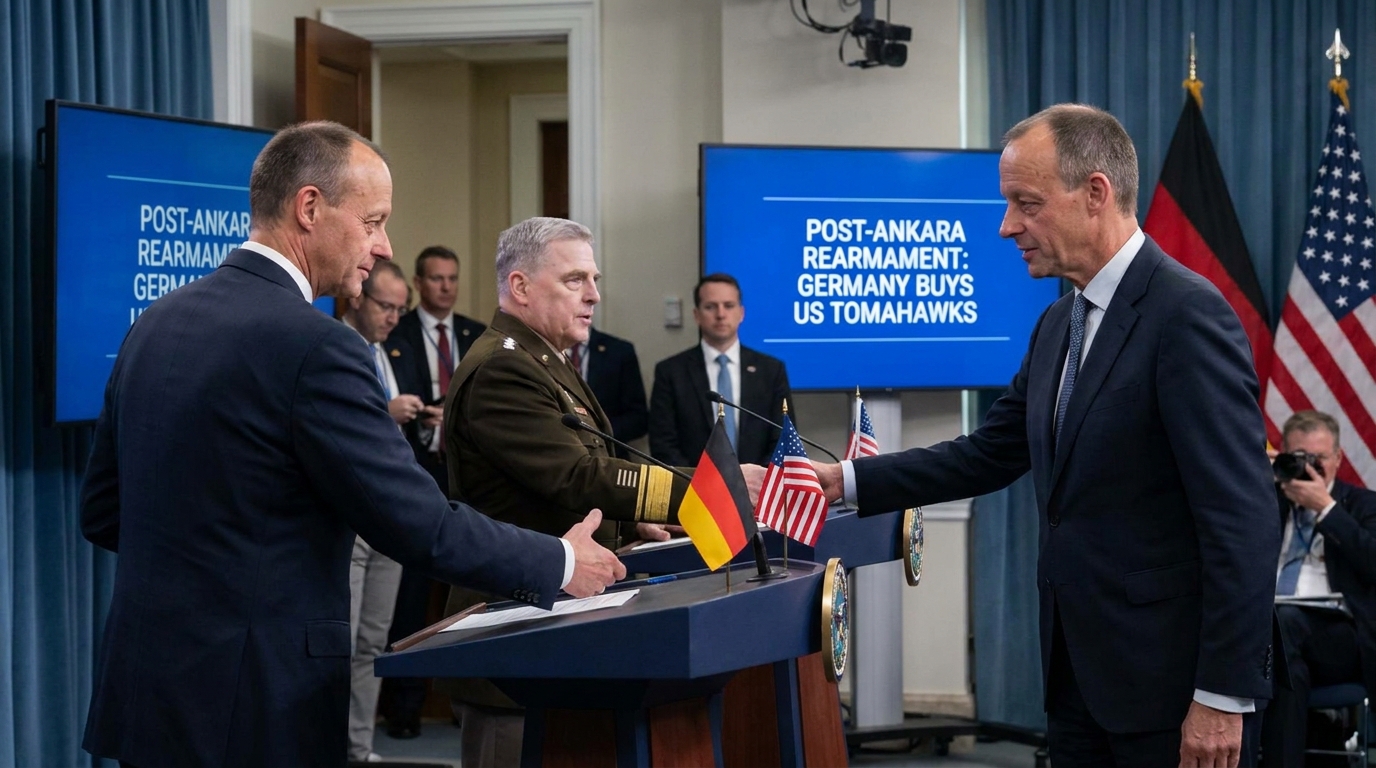
Fresh off the grueling fiscal debates of the Ankara Summit, German Chancellor Friedrich Merz has sent a major shockwave through the continental defense establishment. Bypassing years of delicate European joint-development negotiations, Berlin has unilaterally sealed a multi-billion-dollar agreement with Washington to acquire the U.S.-made Tomahawk land-attack cruise missile.
The massive acquisition marks a watershed moment for the Bundeswehr, transforming Germany’s military posture into a deep-strike conventional power practically overnight, while effectively delivering a blunt reality check to the dream of an integrated European defense industry.
The Need for Speed: Bypassing the Decade-Long Pipeline
For Chancellor Merz, a traditional, business-oriented Atlanticist who took office in May 2025, the decision boiled down to harsh operational math. Under the newly signed Ankara Consensus, Germany is under intense pressure to aggressively ramp up its core military capabilities to meet the newly codified 3.5% baseline for direct combat readiness.
While France and various European defense consortia have spent months advocating for the collaborative development of a next-generation European long-range strike missile, the projected timeline for such a weapon stretches well into the mid-2030s. Faced with an assertive Russia on the eastern flank, Merz chose to reject the bureaucratic stagnation of Brussels. By purchasing combat-proven, off-the-shelf American Tomahawks, Germany secures an immediate, highly potent strategic deterrent that can be integrated into its forces within months rather than a decade.
Outrage in Paris and the "Import Leakage" Reality
The unilateral deal has triggered immediate, fierce political fury across European capitals, most notably in Paris. French defense officials have quietly accused Berlin of structural betrayal, arguing that the Tomahawk purchase completely undermines the European Union's vision of "strategic autonomy" and ignores collective efforts to build a self-sufficient continental defense infrastructure.
The move perfectly illustrates the "import leakage" trap that economists warned about following the Ankara Summit. By funneling billions of German taxpayer euros directly into American defense contractors, Berlin is boosting industrial payrolls across the Atlantic while leaving European defense champions sidelined. Yet, from Merz’s pragmatic perspective, the immediate physical security of the eastern flank takes absolute precedence over regional industrial protectionism.
The Geopolitical Baseline: For Germany, the era of relying purely on an American security umbrella without matching capabilities is over. Berlin is paying its way into NATO 3.0, even if it means bruising relations with its closest neighbors.
A New Strategic Threshold for the Bundeswehr
The technical scope of the deal changes the entire military architecture of Central Europe. The contract secures hundreds of the latest tactical Tomahawk variants, alongside mobile, land-based containerized launcher systems. This deployment effectively returns long-range conventional missiles to German soil for the first time since the Cold War.
With an operational range exceeding 1,600 kilometers, these systems grant the Bundeswehr the independent capability to strike deep into adversary territory from safely within its own borders. While the German opposition and left-leaning political circles have raised deep concerns over the escalatory nature of introducing deep-strike weapons, the Merz administration remains unyielding, framing the Tomahawks as a foundational pillar of Germany’s new commitment to an independent, heavy-combat posture.
To understand the broader geopolitical shift driving Berlin's current defense strategy, you can watch Friedrich Merz's Special Address at Davos 2026, where he outlines his administration's commitment to aggressively strengthening Germany's military capabilities and navigating the fractured global order.