Category: Security & Regulation || Posted Jul 10, 2026
The External Border Crackdown: EU Foreign Policy Chief Kaja Kallas Proposes an Aggressive New Sanctions Regime Targeting Transnational Human Trafficking and Smuggling Networks
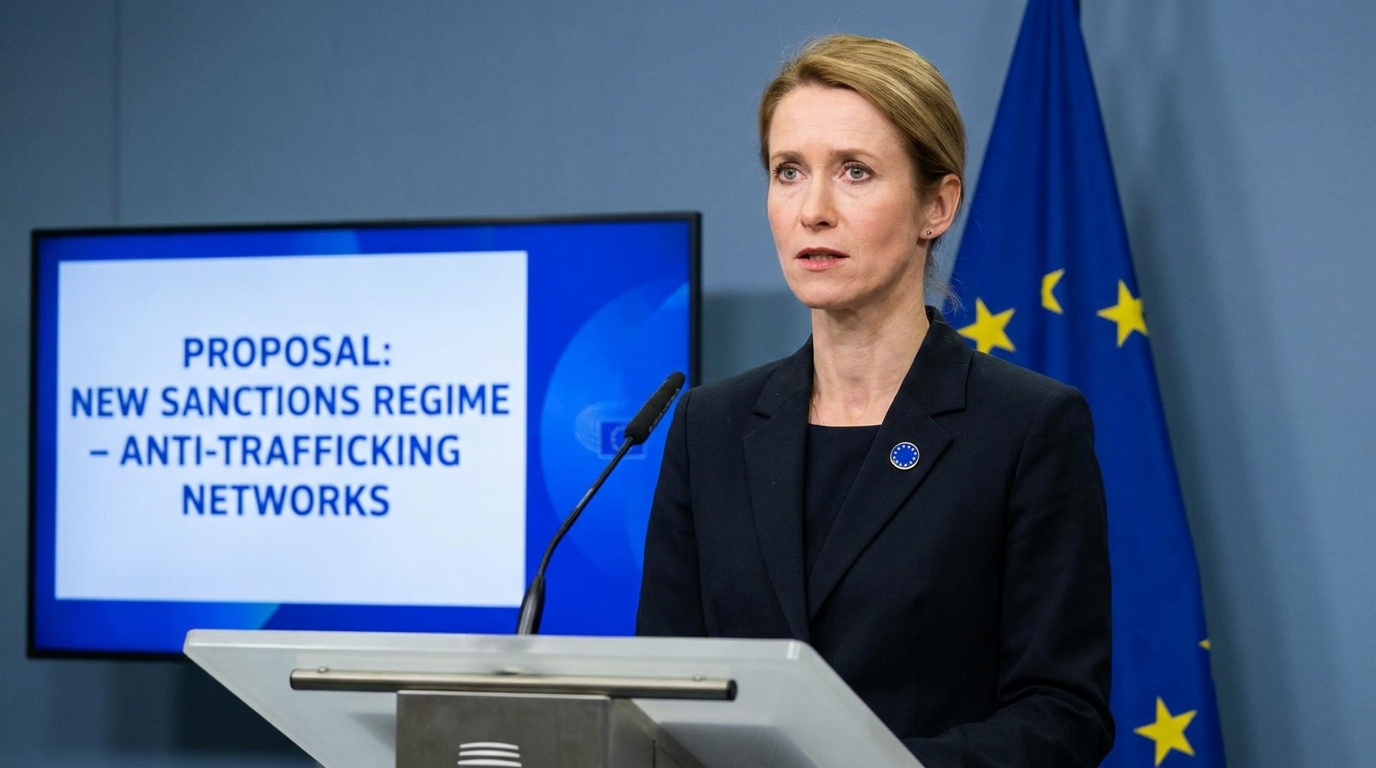
The European Union is shifting its strategy from reactive border security to an offensive economic chokehold against global human smuggling rings. In a decisive joint push, EU Foreign Policy Chief Kaja Kallas and European Commission President Ursula von der Leyen have unveiled a sweeping proposal for a new, standalone sanctions regime. Engineered to dismantle transnational trafficking and smuggling networks operating outside the bloc, the framework targets the multi-billion-dollar business models of criminal organizations profiting from irregular migration.
The initiative represents an ideological pivot in Brussels. Rather than relying solely on physical maritime and land border intercepts, the EU aims to leverage its massive economic clout to neutralize kingpins, financiers, and logistics networks in their home jurisdictions before migrant journeys ever begin.
As Kallas made clear during the presentation of the proposal, the goal is to strike organized criminal networks where they are most vulnerable: their global liquidity and their freedom of movement.
1. Squeezing the Network: Asset Freezes and Travel Bans
The proposed framework equips the EU with a heavy toolkit to blacklists individuals, entities, and state-backed facilitators involved in human smuggling. The core architecture of the sanctions hinges on two aggressive deterrent mechanisms:
- Global Asset Freezes: The EU will enforce immediate freezes on all bank accounts, corporate assets, and real estate held within the bloc by targeted criminal actors, coordinators, and front companies. Furthermore, EU-based businesses and financial institutions will be strictly prohibited from providing any funds, credits, or economic resources to listed entities.
- Strict Travel Bans: Blacklisted individuals will be legally barred from entering or transiting through any EU member state. This mechanism is specifically intended to strip criminal executives of their ability to travel to European financial hubs to manage assets or secure supply contracts.
By transforming border enforcement into a formal instrument of foreign policy, the EU is aiming to shatter the financial stability of organizations that view human lives as low-risk, high-yielding cargo.
2. Dismantling the Broader Criminal Ecosystem
Crucially, the sanctions regime recognizes that human smuggling does not operate in a vacuum. The criteria for listings under Kallas’s blueprint are deliberately broad, targeting organized crime originating outside the EU that is widespread, systematic, or poses a significant threat to the bloc's internal security and rule of law.
The framework broadens its crosshairs to target the interconnected illicit industries that feed and fund smuggling syndicates:
- Weapons and Narcotics Trafficking: Squeezing the illegal arms and drug routes that frequently utilize the exact same physical pipelines, safe houses, and maritime vessels as human trafficking networks.
- Industrial-Scale Money Laundering: Freezing the underground banking systems, shell companies, and alternative payment networks used by syndicates to wash their dirty cash back into the legitimate European financial ecosystem.
While overall irregular border arrivals into the EU have dropped by more than 50% over the last two years due to tighter regional partnerships, the human cost remains devastatingly high. This new regime aims to permanently alter the risk-to-reward ratio for these syndicates, making their cross-border operations significantly harder and far less profitable.
3. The Diplomatic Hurdle: Achieving Council Unanimity
While the blueprint has been aggressively framed by the European Commission and Kallas’s diplomatic services, its ultimate execution relies on the political realities of the European Council. For this sanctions framework to pass into law, it requires the unanimous approval of all EU member states.
Securing total consensus across the bloc on migration-adjacent policies has historically been a diplomatic minefield. While front-line Mediterranean and Eastern European nations are eager for immediate, aggressive deterrent tools, other member states will closely analyze how specific listings might complicate broader diplomatic and trade relationships with partner nations in North Africa, the Middle East, and the Western Balkans.
Nevertheless, with powerful momentum coming directly from top EU leadership—echoed by von der Leyen's firm stance that Europe must be the one to decide who enters its borders and under what circumstances—diplomats are moving quickly to push the legislation through the Council floor.
The Bottom Line
The proposal marks an evolutionary leap in how Europe protects its external borders. By classifying human smuggling networks not merely as a domestic policing issue but as an explicit national security threat to be countered with the same economic warfare tools used against hostile states, Brussels is drawing a new line in the sand. The survival of global criminal networks depends entirely on access to international financial streams; the EU’s latest strategy is designed to lock those doors permanently.
Do you believe that deploying heavy-handed financial sanctions can successfully break up decentralized, underground smuggling networks, or will these criminal groups simply pivot to alternative currencies and non-Western financial systems to bypass Brussels? Let us know your perspective in the comments below.