Category: Security & Regulation || Posted Jul 07, 2026
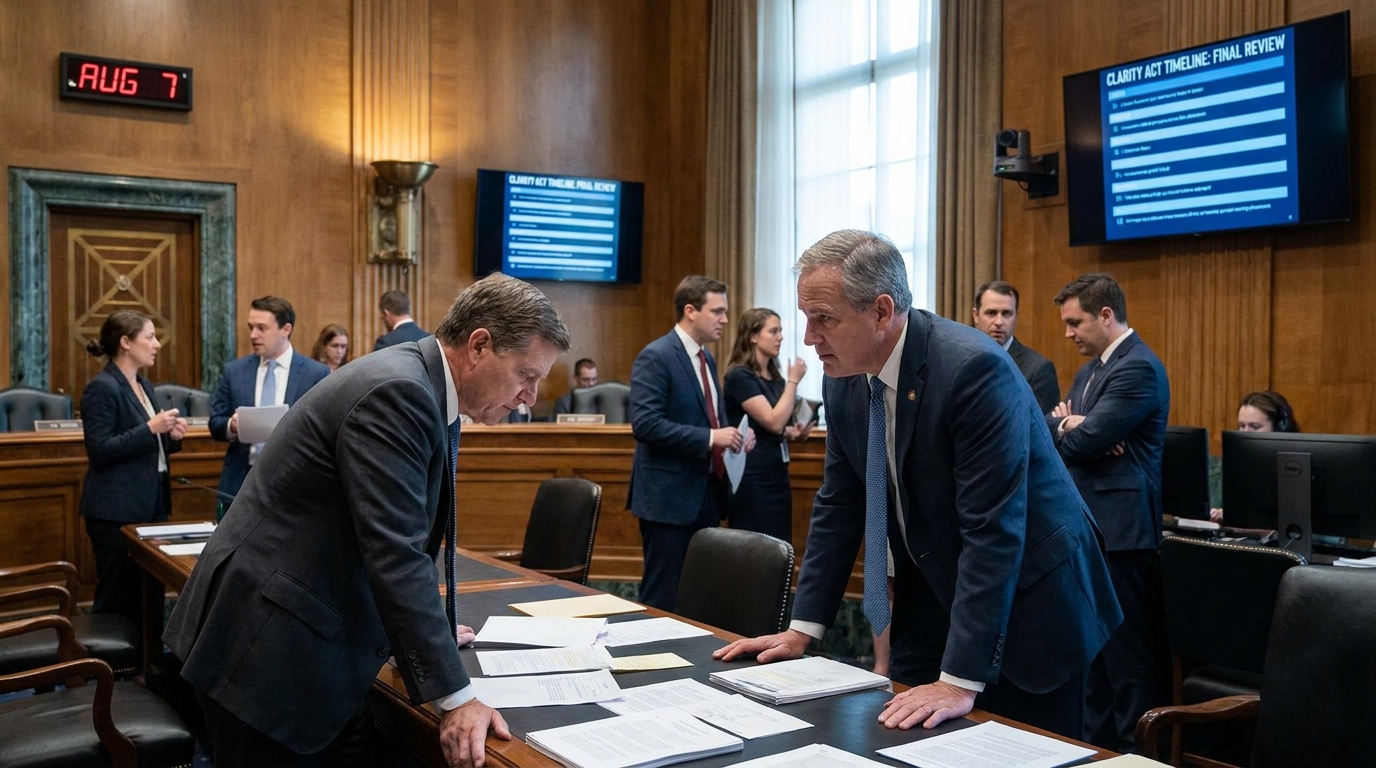
The August 7 Target: U.S. Senate Locks Down Timeline for Finalizing the Clarity Act After Heated Debates Over Platform Oversight and Ethics Provisions
The high-stakes legislative battleground over the future of American digital asset regulation has reached a critical junction. After months of intense backroom negotiations and friction on the Senate floor, lawmakers have locked down an unyielding timeline to finalize the Digital Asset Market Clarity Act (commonly known as the CLARITY Act).
With a hard target set for August 7—the final day before the Senate adjourns for its summer recess—the pressure on leadership to bridge deep policy divides has reached a fever pitch.
The CLARITY Act represents the most comprehensive attempt by Congress to establish a definitive, statutory rulebook for the U.S. crypto industry. Having already passed the House with a strong bipartisan majority and cleared key Senate committees, the bill’s arrival on the full legislative calendar was met with immediate, heavy pushback from competing factions.
The current gridlock centers on two major flashpoints: the exact scope of oversight for decentralized platforms and a highly controversial suite of ethics provisions aimed at regulating the intersection of public office, campaign financing, and digital assets.
1. The Platform Oversight Friction: Defining Control vs. Code
At the core of the bill is a massive structural overhaul that aims to end the long-standing jurisdictional turf war between the Securities and Exchange Commission (SEC) and the Commodity Futures Trading Commission (CFTC). The CLARITY Act draws a distinct statutory line, categorizing major decentralized tokens like Bitcoin and Ethereum as digital commodities under primary CFTC jurisdiction, while reserving traditional investment contracts and tokenized securities under the SEC.
However, the real operational friction lies in how the bill treats the infrastructure of Decentralized Finance (DeFi).
Industry advocates have fiercely lobbied to protect the provisions embedded in the bill’s Blockchain Regulatory Certainty Act (BRCA) carve-out. This provision explicitly shields non-custodial software developers—those who build open-source protocols but do not hold or control user funds—from being classified as financial intermediaries or money transmitters.
Conversely, a powerful contingent of lawmakers argues that leaving pure software protocols outside the regulatory net creates a massive national security backdoor. They are pushing for strict, alternative amendments that would force decentralized platforms to implement heavy, bank-grade transaction monitoring and automated Know Your Customer (KYC) systems if they interact with U.S. consumers, regardless of whether a centralized corporate entity exists.
This dispute over "control vs. code" has drawn more than 1,200 technology companies and prominent trade associations into a unified push, warning leadership that over-regulating non-custodial developers will permanently drive financial innovation offshore to frameworks like Europe’s finalized MiCA regime.
2. The Ethics Provisions: The "Political Threshold" Deadlock
While technical platform oversight dominates industry discussions, the legislative logjam on Capitol Hill is heavily driven by a parallel battle over ethics and political accountability. Several senior lawmakers have refused to clear the bill for a final floor vote unless it includes rigid, newly drafted anti-corruption safeguards.
The debated ethics provisions target several key areas:
- Restrictions on Political Activity: Proposed amendments seek to implement strict disclosure requirements and outright bans on political action committees (PACs) funded primarily by corporate digital asset contributions, following unprecedented spending cycles in recent primary elections.
- Asset Disclosure Rules: Lawmakers are debating an accelerated, mandatory reporting window for federal officials, requiring them to publicly log any personal digital asset transactions within 48 hours, matching the transparency standards applied to traditional equity markets.
- The "Revolving Door" Ban: A contentious clause aims to impose a multi-year cooling-off period preventing former regulatory officials from accepting lucrative advisory or executive roles at digital asset firms immediately after leaving public service.
Negotiators are working around the clock to refine a compromise text that satisfies these ethical red lines without alienating the broader bipartisan coalition required to hit the 60-vote threshold needed to overcome a filibuster.
3. The August Recess Risk: A Race Against the Clock
The decision to establish the August 7 target is a calculated, high-risk gamble by Senate leadership. Washington policy strategists have repeatedly warned that if the CLARITY Act fails to pass the Senate before lawmakers leave for the summer, the tightening legislative calendar ahead of the upcoming November midterm elections will effectively close the window for the year.
A failure to meet the August deadline would carry significant consequences for both the market and the broader economy. Prediction markets and institutional research notes have already adjusted the probability of the bill passing within the year down to a coin-flip.
Analysts warn that a prolonged delay into the next congressional session would prolong the current era of "regulation-by-enforcement," forcing institutional capital to remain on the sidelines and delaying the highly anticipated rollout of specialized spot crypto exchange-traded funds (ETFs) for alternative assets.
The Bottom Line
The next few weeks will determine whether the United States establishes itself as a permanent global hub for financial technology or continues to lag behind international regulatory frameworks. By locking in the August 7 deadline, leadership has transformed the CLARITY Act from a theoretical policy debate into an urgent, down-to-the-wire test of political will.
For an industry starved of structural certainty, the upcoming floor debate represents the most consequential legislative moment in the history of digital assets.
Do you believe that Senate leaders will successfully broker a compromise on ethics and DeFi oversight to pass the CLARITY Act before the August recess, or will partisan divisions push this landmark legislation into the next congressional session? Let us know your thoughts in the comments below.